Choosing between Micro850, CompactLogix and ControlLogix is not simply a matter of buying the fastest controller available.
A ControlLogix may look impressive inside a small pump panel, but it could be unnecessary overkill. At the opposite end, a Micro850 may control a simple machine perfectly well—until someone adds remote I/O, several drives, coordinated motion, plant-wide communications and a list of future upgrades longer than the original specification.
The right choice depends on the scale of the machine, required communications, I/O count, motion, safety, software environment and expected expansion.
In practical terms:
- Micro850 is best for smaller standalone machines.
- CompactLogix is usually the sweet spot for medium-sized machines, skids and production cells.
- ControlLogix is intended for large, complex and plant-wide control systems.
Rockwell Automation describes Micro800 controllers as suitable for simple standalone systems, CompactLogix for small-to-mid-sized machine-level applications and ControlLogix for large systems spanning multiple machines, processes or facilities.
Quick Comparison
| Feature | Micro850 | CompactLogix | ControlLogix |
|---|---|---|---|
| Typical application | Small standalone machine | Medium machine, skid or production cell | Large line, process area or plant-wide system |
| Programming software | Connected Components Workbench | Studio 5000 Logix Designer | Studio 5000 Logix Designer |
| Physical design | PLC with embedded I/O | Compact controller with modular local and remote I/O | Modular chassis-based control system |
| Expansion level | Limited to moderate | Moderate to large | Large and highly scalable |
| Motion | Basic PTO positioning | Integrated Motion over EtherNet/IP | Advanced multi-axis integrated motion |
| Integrated safety option | Not in the standard Micro850 platform | Compact GuardLogix | GuardLogix and newer ControlLogix safety variants |
| Redundancy | No controller redundancy | Normally used without controller redundancy | Redundant and high-availability options |
| Best reason to choose it | Low-cost standalone control | Strong features without a full chassis system | Maximum scalability, performance and availability |
The table is a practical summary rather than a catalog-number specification. Exact memory, node, I/O and motion limits vary considerably between controller models.
Micro850: Best for Small Standalone Machines
The Micro850 belongs to Rockwell Automation’s Micro800 family. Current Micro850 L50E controllers are offered with 24 or 48 embedded I/O points and can be expanded with plug-in and expansion modules. Rockwell lists support for up to 192 total I/O points, embedded Ethernet, serial communications, high-speed counters and up to three PTO motion axes on applicable models.
That makes the Micro850 a sensible option for applications such as:
- Small conveyors
- Pump and fan control panels
- Simple packaging machines
- Standalone dosing systems
- Small compressors
- Basic material-handling equipment
- Machine retrofits with modest I/O
- Simple positioning systems
- Local utility or auxiliary equipment
A Micro850 can do considerably more than switch a few outputs. It supports EtherNet/IP, Modbus TCP, Modbus RTU, serial communications and expansion I/O. Current L50E models also support Class 1 implicit EtherNet/IP messaging for a limited number of nodes.
Still, it remains a micro controller. That distinction matters.
The Micro850 software difference
Micro850 controllers are programmed with Connected Components Workbench, or with supported versions of FactoryTalk Design Workbench—not Studio 5000 Logix Designer.
This is one of the biggest practical differences between Micro850 and the two Logix platforms.
CompactLogix and ControlLogix use the Logix programming environment. Their tag structures, instruction workflow, project organisation and online maintenance experience are closely related. Micro850 lives in a separate software ecosystem.
That does not make it a bad controller. It simply means a plant standardised around Studio 5000 must maintain another software package, another programming workflow and another set of project files.
For one small standalone machine, that may be perfectly acceptable. Across fifty machines, maintenance may have a different opinion.
Where Micro850 starts becoming uncomfortable
A Micro850 may be technically capable of controlling a project while still being the wrong long-term choice.
Think carefully before using one when the system requires:
- Numerous EtherNet/IP devices
- Large quantities of remote I/O
- Advanced coordinated motion
- Integrated safety control
- Complex multi-machine coordination
- Extensive reusable Logix Add-On Instructions
- Plant-wide data integration
- Significant future expansion
- A customer requirement for Studio 5000
A common design mistake is selecting the smallest PLC that can handle the machine today.
The machine then grows. Another drive is added, then a remote panel, a second HMI and a connection to the plant SCADA system. Eventually, the little controller is being asked to run something that no longer resembles the original little machine.
Choose Micro850 when:
Use a Micro850 when the machine is mostly self-contained, the I/O requirement is modest, the sequence is straightforward and CCW is acceptable to the people who will maintain it.
It is particularly attractive when embedded I/O reduces the amount of additional hardware needed.
CompactLogix: The Middle Ground
CompactLogix is often the best fit for a serious standalone machine that does not justify a full ControlLogix chassis.
Rockwell positions CompactLogix for small-to-mid-sized automation systems, including machine control, skid systems and standalone production lines requiring stronger networking, motion or safety capabilities.
Modern CompactLogix 5380 controllers use Studio 5000 Logix Designer and support features such as high-performance EtherNet/IP communications, Compact 5000 local I/O, integrated motion and enhanced controller security. Depending on the controller selected, the 5380 platform supports as many as 31 local I/O modules, up to 32 integrated motion axes and memory options from 0.6 to 10 MB.
Typical CompactLogix applications include:
- Packaging machines
- Palletisers and depalletisers
- Conveyor systems
- Process skids
- Water-treatment skids
- Assembly cells
- Medium-sized production lines
- Machines with multiple PowerFlex drives
- Machines with remote I/O
- Servo-controlled equipment
- Robot support systems
- OEM machinery that must integrate with a larger plant
CompactLogix provides much of the Logix functionality associated with ControlLogix but in a smaller architecture.
Why CompactLogix is often the practical choice
Imagine a machine with:
- 150 to 400 I/O points
- Several EtherNet/IP drives
- One or two remote I/O panels
- An HMI
- A barcode scanner
- A few servo axes
- Connections to another PLC and the plant network
A Micro850 might become restrictive, especially as the application grows. ControlLogix would handle the job, but the chassis, processor and associated hardware could be unnecessarily large for one machine.
CompactLogix fits neatly in the middle.
You get Studio 5000, controller-scoped and program-scoped tags, Add-On Instructions, produced and consumed tags, integrated EtherNet/IP I/O, motion options and a scalable family of processors.
Compact GuardLogix for machine safety
When standard and safety control must be integrated, Compact GuardLogix 5380 variants support safety configurations up to SIL 3/PLe, depending on architecture and model. Rockwell also allows standard and safety I/O to be used within the same controller, software and network environment.
That makes Compact GuardLogix suitable for machines requiring functions such as:
- Emergency-stop monitoring
- Guard-door monitoring
- Safe torque off
- Safety light curtains
- Safe machine zones
- Integrated standard and safety diagnostics
Safety design still requires proper risk assessment, validation and compliance work. Buying a safety PLC does not automatically make a machine safe. Sadly, the controller cannot complete the paperwork for you.
Where CompactLogix reaches its limit
CompactLogix can handle surprisingly substantial systems, but there comes a point where a chassis-based platform becomes easier to design and maintain.
ControlLogix becomes more attractive when the project requires:
- Controller redundancy
- Very high availability
- Large centralised I/O systems
- Numerous communication modules
- Multiple independent networks
- Large process applications
- Extensive motion control
- Several production areas under one controller
- Specialised chassis modules
- Major future expansion
CompactLogix is compact by design. That is one of its strengths—but physical and architectural compactness eventually becomes a limitation.
Choose CompactLogix when:
Use CompactLogix for a medium-sized machine, skid or production cell that needs Studio 5000, good EtherNet/IP integration and room for expansion without the size and complexity of a full ControlLogix system.
For many OEM machines, this is the most balanced option.
ControlLogix: Best for Large and Critical Systems
ControlLogix sits at the top of the three platforms.
It is a modular, chassis-based control system intended for demanding applications involving discrete control, process control, motion, safety, communications and plant-wide integration. Rockwell positions the family for large automation systems spanning multiple machines, processes or complete facilities.
Typical applications include:
- Complete production lines
- Large conveying and material-handling systems
- Plant-wide control architectures
- Large water and wastewater plants
- Process plants
- Oil and gas applications
- Mining and metals systems
- High-speed coordinated motion
- Large batching systems
- Systems requiring controller redundancy
- Critical infrastructure where downtime is extremely expensive
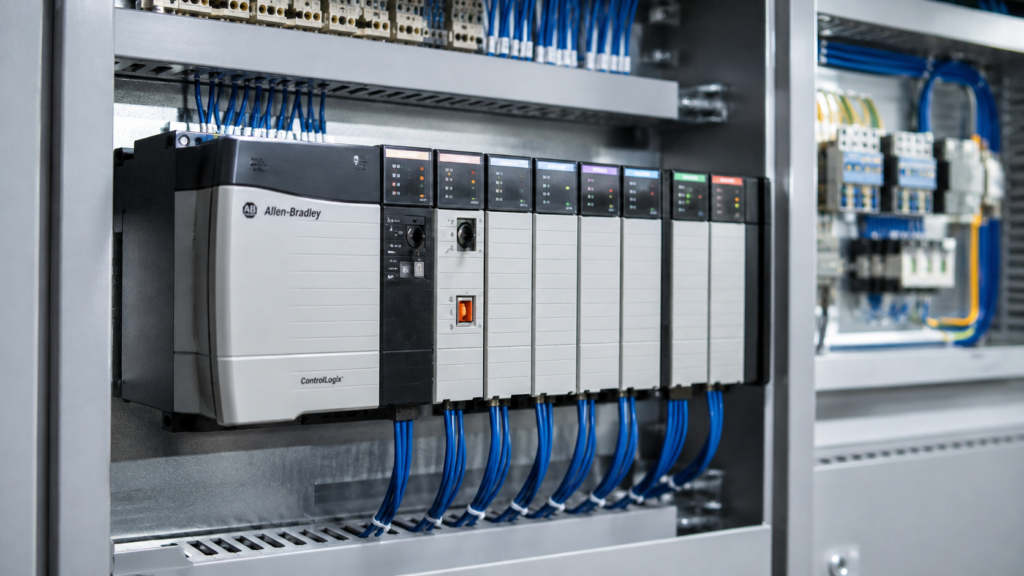
ControlLogix uses a chassis into which the controller, communication modules, I/O modules and specialised
- Large water and wastewater plants
- Process plants
- Oil and gas applications
- Mining and metals systems
- High-speed coordinated motion modules are installed.
This gives the designer much more architectural freedom than a compact controller with a fixed local expansion arrangement.
ControlLogix is about architecture, not only speed
The main reason to select ControlLogix is not that the processor runs logic faster.
It is the ability to build a larger, more flexible system around it.
A ControlLogix chassis can accommodate different combinations of:
- Controllers
- Ethernet communication modules
- Local I/O
- Motion interfaces
- Specialised communication modules
- Redundancy components
- Process-control components
- Safety controllers and safety I/O
The ControlLogix 5580 family supports multidiscipline discrete, motion, process andSpecific models and architectures also support redundant operation, process control and specialised environmental requirements. citeturn217806view1
Redundancy and high availability
When the control system must continue operating after a controller-related failure, ControlLogix is the relevant family to investigate.
ControlLogix 5580 supports redundant controltrolLogix 5590 platform expands high-availability, performance, safety and communications capabilities further. citeturn217806view1turn280595view4
Redundancy adds hardware, networking, configuration rules and testing requirements. It should be used because the cost or risk of an outage justifies it—not because two PLCs look more reassuring than one.
Examples where redundancy may be justified include:
- Continuous process plants
- Major water-treatment facilities
- Critical utilities
- Large material-handling systems
- Systems where a controller shutdown stops an entire facility
- Processes that cannot be restarted quickly
A standalone packaging machine that can be restarted in five minutes probably does not require a redundant ControlLogix pair.
Current ControlLogix generations
ControlLogix 5580 remains a major current platform, while Rockwell has also introduced the newer ControlLogix 5590 family for demanding multidiscipline systems. Rockwell lists expanded mes, advanced communications, integrated functional safety and high-availability options among the 5590 platform’s capabilities. citeturn280595view4
For an existing plant, controller selection is not always about choosing the newest processor. Compatibility with installed I/O, standard firmware revisions, spare-parts strategy, engineering software and site standards may be more important.
Choose ControlLogix when:
Use ControlLogix when the application is large, highly networked, performance-critical or expected to grow significantly.
It is also the strongest choice when the project requires a modular chassis, high availability, advanced process control or multiple control disciplines under one architecture.
Example 1: Small Pump Station
Consider a panel controlling:
- Two pumps
- Level switches
- One pressure transmitter
- A local HMI
- A few alarms
- Modbus communication to a meter
A Micro850 is likely the sensible choice.
The sequence is relatively small, the I/O requirement is modest and the machine is largely standalone. Installing ControlLogix here would be a bit like driving a mining truck to collect groceries. It works, but questions will be asked.
Example 2: Packaging Machine With Drives and Servos
Now consider a packaging machine with:
- 250 I/O points
- Six variable-frequency drives
- Four servo axes
- Two remote I/O stations
- A safety system
- Recipe handling
- Plant-network communications
CompactLogix or Compact GuardLogix is the natural starting point.
It provides Studio 5000, integrated motion, stronger EtherNet/IP capabilities and enough scalability for a substantial machine without olLogix chassis. CompactLogix 5380 supports integrated motion and, in Compact GuardLogix form, integrated safety architectures. citeturn217806view0
Example 3: Complete Production Facility
Finally, consider a system controlling:
- Several production lines
- Thousands of I/O points
- Multiple EtherNet/IP networks
- Process areas
- Hundreds of drives and instruments
- Plant SCADA integration
- Redundant controllers
- High-speed motion
- Critical production equipment
This is ControlLogix territory.
The chans, processing capacity and redundancy capabilities are designed for larger, more complex systems of this kind. citeturn217806view1turn217806view3
Software and Maintenance May Decide the Answer
Hardware specifications are only part of PLC selection.
Ask who will support the machine after commissioning.
A factory already using dozens of CompactLogix and ControlLogix controllers may prefer another Logix controller even when a Micro850 could technically perform the job. The maintenance team already has Studio 5000, spare parts, training, backup procedures and programming standards.
Introducing one Micro850 creates another software environment and another platform to support.
The reverse can also be true. A small OEM building straightforward machines may prefer Micro850 because it offers embedded I/O and a compact control package without requiring the broader Logix ecosystem.
The cheapest controller at purchase is not always the cheapest controller over the machine’s lifetime.
Do Not Size the PLC by I/O Count Alone
Two machines can each have 100 I/O points and require completely different controllers.
One may simply operate valves in a fixed sequence. The other may require:
- Fast event handling
- Coordinated servo motion
- Data logging
- Recipe management
- Multiple HMIs
- Remote I/O
- Several controller connections
- Detailed diagnostics
- Safety control
- Plant-level communications
Both have 100 I/O points. Their control requirements are nowhere near equal.
When selecting a PLC, consider:
- Current and future I/O
- Program size and complexity
- Required scan time
- Number of network devices
- Motion requirements
- Safety requirements
- Remote I/O architecture
- HMI, SCADA and MES connections
- Redundancy or availability requirements
- Maintenance software and staff experience
- Spare-parts strategy
- Expected expansion over the next five to ten years
Simple Selection Rule
Use this as a practical starting point:
Choose Micro850 when:
The machine is small, standalone and relatively simple. Embedded I/O is useful, basic motion is enough, communications are limited and Connected Components Workbench is acceptable.
Choose CompactLogix when:
The project is a serious machine, skid or production cell requiring Studio 5000, multiple EtherNet/IP devices, remote I/O, integrated motion, integrated safety or meaningful future expansion.
Choose ControlLogix when:
The system is large, plant-wide, highly networked or mission-critical. You need a modular chassis, extensive scalability, redundancy, advanced process control or high-performance multidiscipline control.
Final Thoughts
There is no universal winner.
Micro850 wins when simplicity, compactness and lower system cost matter most.
CompactLogix wins when you need strong Logix capabilities in a machine-sized platform.
ControlLogix wins when the control system has grown beyond one machine and performance, scalability or availability becomes critical.
For most medium-sized industrial machines, CompactLogix is the comfortable middle choice. Micro850 handles the smaller jobs without unnecessary hardware, while ControlLogix should be reserved for systems that genuinely benefit from its larger architecture.
Choose for the application you are building—but leave enough room for the application people will ask you to add next year.