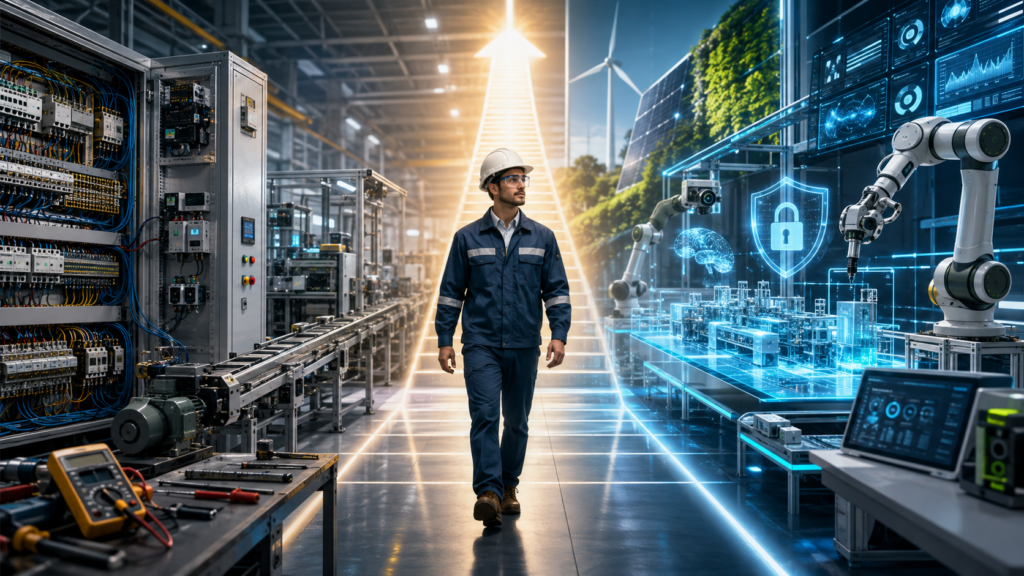
Industrial automation is still a good career in 2026.
It is not disappearing because of artificial intelligence, easier PLC software or robots that can be configured with less code. In fact, companies continue installing large numbers of robots, upgrading old production lines and connecting more equipment to industrial networks.
But the job is changing.
Knowing how to create a motor start-stop rung is no longer enough to stand out. The valuable automation professional now understands the complete system:
Electrical equipment
→ Sensors and actuators
→ PLC software
→ Industrial networks
→ Drives and motion
→ Safety
→ Data
→ Cybersecurity
→ Production process
AI will remove some repetitive engineering work. Virtual commissioning will move more testing into the office. Cybersecurity will become part of machine design rather than an optional IT discussion.
The people most likely to struggle are not those working in automation.
They are those who learn one PLC package, stop developing their skills and expect the same knowledge to remain enough for the next 20 years.
The Quick Verdict
| Question | Honest answer |
|---|---|
| Is automation work disappearing? | No |
| Are factories still investing in robots and control systems? | Yes |
| Will AI reduce some PLC programming work? | Yes |
| Will AI replace commissioning and troubleshooting soon? | Unlikely |
| Is basic ladder logic enough for a strong career? | No |
| Do you need to understand networking and cybersecurity? | Increasingly, yes |
| Is a degree always required? | No |
| Are practical electrical skills still valuable? | Extremely |
| Is the field easy to enter? | Not necessarily |
| Is continuous learning optional? | No |
My honest rating would be:
8/10 career
for someone willing to combine practical and digital skills

5/10 career
for someone who wants to learn one PLC platform and never update
The Automation Market Has Not Disappeared
Global industrial robot installations reached approximately 542,000 units in 2024, the second-highest annual result recorded. The worldwide operational stock rose to about 4.66 million industrial robots, an increase of nearly 9% from the previous year. Installations were almost flat compared with 2023, so this is not an endless straight-line boom—but annual deployments have remained above 500,000 for four consecutive years.
That matters because every automated installation creates work beyond mounting the robot itself:
- Electrical design
- Panel building
- PLC and robot programming
- Safety integration
- Networking
- Vision configuration
- Commissioning
- Maintenance
- Production support
- Future modifications
The number of programmers required for one standard machine may decline as engineering becomes more efficient. At the same time, the number of automated machines requiring integration and long-term support continues to grow.
Europe Still Has Technical Skill Shortages
The 2025 EURES labour-shortage report lists electrical engineering technicians, electrical engineers, electrical mechanics and related trades as shortage occupations across numerous European countries. Lithuania is among the countries reporting shortages for both electrical engineering technicians and electrical engineers.
EURES also identifies shortages in Lithuania for roles including process-control technicians, electrical engineering technicians, electrical engineers, electricians and industrial-machinery mechanics.
That does not mean every person completing a three-week PLC course will immediately receive five attractive job offers.
Employers commonly want combinations such as:
PLC knowledge
+
Electrical troubleshooting
+
Factory experience
+
Local-language ability
+
Willingness to travel or work shifts
The shortage is often for people who can take real responsibility—not simply people who have seen ladder logic before.
Engineering Outlook Is Also Positive Outside Europe
There is no single official occupation called “controls engineer” in every labour database. Electrical and industrial engineering are useful proxies.
The US Bureau of Labor Statistics projects employment between 2024 and 2034 to grow by:
- 7% for electrical and electronics engineers
- 11% for industrial engineers
Both projections exceed the overall occupational growth rate. These figures are not direct forecasts for every PLC or controls position, but they support the broader case that engineering work involving electrical systems, manufacturing efficiency and automation remains valuable.
What Is Actually Changing?
The field is not being removed.
Its boundaries are expanding.
1. AI Is Entering PLC and HMI Engineering
Generative AI is no longer limited to general-purpose chatbots.
Automation vendors are integrating AI into engineering environments for tasks such as:
- Generating Structured Text
- Creating HMI visualisations
- Configuring devices
- Explaining existing code
- Producing documentation
- Finding project inconsistencies
- Assisting with troubleshooting
Siemens, for example, now markets industrial AI tools that can generate automation code, assist with HMI engineering and work with project context inside TIA Portal. In April 2026, it announced general availability of an engineering agent intended to perform multi-step automation-engineering tasks rather than only provide suggestions. These are vendor claims and should not be mistaken for proof that autonomous engineering has become universal, but they clearly show the direction of commercial development.
What AI will probably handle well
AI is becoming useful for:
- Boilerplate code
- Repetitive tag creation
- Basic scaling blocks
- Alarm text
- Code comments
- Documentation drafts
- Converting written sequences into an initial program structure
- Explaining unfamiliar instructions
- Comparing project versions
- Searching manuals
These tasks consume real engineering time but do not always require deep judgement.
What AI still struggles with
A machine rarely fails in a clean, well-documented way.
The real problem may involve:
- A sensor installed slightly too far away
- An intermittent terminal connection
- Mechanical backlash
- A brake releasing too slowly
- An undocumented program modification
- A network fault appearing only when a VFD starts
- A safety relay wired differently from the schematic
- An operator using the machine in an unexpected way
AI can suggest possibilities.
Someone still has to open the panel, take measurements, understand the process and decide which possibility is real.
2. Pure PLC Programming Is Becoming Less Valuable
This does not mean PLC programming is becoming worthless.
It means that PLC programming by itself is becoming less distinctive.
Machine builders increasingly use:
- Standard software libraries
- Reusable machine modules
- Preconfigured drive objects
- Automatic HMI generation
- Code templates
- Vendor-tested function blocks
- Company programming standards
- AI-assisted code generation
A machine that previously required 300 hours of custom programming may eventually be completed with a reusable architecture and 100 hours of application-specific work.
The valuable engineer will not merely enter instructions faster.
They will know:
- Which architecture to use
- How to define machine states
- How to handle failure and recovery
- How to make diagnostics understandable
- How to test the sequence
- How to prove the change is safe
- How to maintain the system for the next decade
Programming speed matters.
Engineering judgement matters more.
3. Software-Defined Automation Is Becoming Real
Traditional automation normally links software tightly to specific physical PLC hardware.
That is beginning to change.
Virtual PLC products allow controller software to operate on industrial computing platforms rather than only inside a conventional dedicated PLC. Siemens’ S7-1500V, for example, runs as an application within its Industrial Edge environment and is centrally managed as part of a software-defined automation architecture.
This does not mean ordinary PLC hardware will vanish in 2026.
Dedicated controllers still offer major advantages:
- Predictable real-time execution
- Long product life
- Industrial environmental ratings
- Clear maintenance procedures
- Familiar certification paths
- Straightforward replacement
- Established safety platforms
The more realistic change is that automation engineers will encounter mixed architectures:
Traditional PLCs
+
Virtual controllers
+
Industrial PCs
+
Edge applications
+
Cloud services
Understanding only one hardware rack will gradually become limiting.
4. More Commissioning Happens Before the Machine Exists
Traditional commissioning often works like this:
Build machine
→ Install wiring
→ Download software
→ Discover sequence problems on site
→ Work late until machine runs
Virtual commissioning changes the order:
Create digital model
→ Connect real control software
→ Simulate sensors and movement
→ Test sequences and faults
→ Correct problems
→ Commission physical machine
Industrial digital-twin tools are already being marketed for testing PLC, HMI, robotics and production-system behaviour before physical deployment. Rockwell and Siemens both offer tools intended to support virtual factory acceptance testing and controls validation.
Virtual commissioning can catch:
- Impossible sequence transitions
- Missing interlocks
- Incorrect timing assumptions
- Robot collisions
- Poor alarm handling
- Production bottlenecks
- Restart problems
It does not find everything.
A digital model may not contain:
- Loose wiring
- Pneumatic leaks
- Sensor contamination
- Mechanical flex
- Real product variation
- Poorly adjusted brakes
- Human operating habits
On-site commissioning is not disappearing. More of the obvious software mistakes should simply be removed before the commissioning team arrives.
5. OT Cybersecurity Is Becoming Part of the Job
Years ago, an automation network might consist of several PLCs and an HMI connected to an unmanaged switch with no route outside the machine.
Modern systems may connect to:
- Manufacturing execution systems
- SCADA servers
- Remote-support platforms
- Cloud analytics
- Enterprise databases
- Vendor services
- Industrial edge devices
- Wireless networks
That connectivity creates value and risk.
The EU’s NIS2 framework has expanded cybersecurity risk-management and incident-reporting requirements for covered organisations. Member States were required to transpose it by October 2024, and the Commission proposed targeted amendments in January 2026 to clarify and simplify parts of its implementation.
The EU Cyber Resilience Act also creates lifecycle cybersecurity obligations for products with digital elements. Reporting obligations for actively exploited vulnerabilities and severe security incidents begin on 11 September 2026, while the main CRA obligations apply from 11 December 2027. This is particularly relevant to manufacturers and suppliers of connected automation products, machines and software.
The ISA/IEC 62443 standards provide a lifecycle framework for cybersecurity in industrial automation and control systems.
What controls professionals increasingly need to understand
You do not necessarily need to become a full-time cybersecurity specialist.
You should understand:
- Network segmentation
- Zones and conduits
- Managed switches
- Firewalls
- Secure remote access
- User accounts and permissions
- Backup and restore
- Patch management
- Asset inventories
- Disabling unused services
- Certificate management
- Incident response
- Why exposing a PLC directly to the internet is a poor idea
The future controls engineer cannot say:
Cybersecurity belongs to IT. I only write PLC code.
The PLC is now part of the cyber-physical system IT is trying to protect.
6. Industrial Networking Is Becoming a Core Skill
Earlier automation systems could be maintained using electrical drawings and a multimeter.
Those skills are still essential, but many faults now involve:
- IP addressing
- Duplicate addresses
- Incorrect subnet masks
- Managed-switch configuration
- Device names
- Network topology
- Time synchronisation
- Certificate problems
- Multicast traffic
- Remote-I/O timeouts
- Gateway configuration
Modern interoperability work also extends beyond one real-time control network. OPC UA, for example, provides a common information-exchange framework covering field devices, control systems, manufacturing systems and enterprise software. The OPC Foundation published an industrial-automation-specific part of the specification in 2025.
A good automation professional in 2026 should at least understand:
IP address
Subnet mask
Default gateway
MAC address
Switch port
VLAN
TCP and UDP
Client and server
Industrial protocol
You do not need to become a Cisco architect.
You should be able to tell whether a “PLC problem” is really a network problem.
7. Data Is Becoming Part of Automation
Factories want more than a machine that runs.
They increasingly want to know:
- How much it produced
- Why it stopped
- How much energy it used
- Which alarms occurred most often
- Whether cycle time is getting worse
- When a component is likely to fail
- Which recipe produced defective parts
- Whether operators are bypassing part of the process
This pushes automation work toward:
- OPC UA
- MQTT
- SQL databases
- Historians
- Edge computing
- Production dashboards
- Condition monitoring
- Energy monitoring
- Basic data analysis
Siemens describes Industrial Edge as a platform for IT–OT connectivity, maintenance, industrial data and analytics, reflecting the wider movement toward processing more plant information close to the equipment.
A controls engineer does not need to become a data scientist.
Knowing basic SQL, Python or another general programming language can still make you much more useful when PLC data must leave the PLC.
8. Code Quality Matters More
Older machines often contain one enormous ladder program with:
- Repeated logic
- Unclear memory addresses
- No state-machine structure
- Few comments
- Alarms scattered everywhere
- No version history
- No agreed programming standard
That approach becomes increasingly difficult as machines become connected and software-heavy.
Modern automation teams place more value on:
- Modular code
- Functions and function blocks
- User-defined types
- State machines
- Consistent naming
- Reusable libraries
- Automated code generation
- Version control
- Program comparison
- Software testing
- Documented release processes
This favours people who understand software-engineering principles without forgetting that a PLC controls physical equipment.
The goal is not to make PLC software look complicated.
The goal is to make complex machinery easier to understand.
9. Automation Is Moving Toward Flexible Production
Traditional automation was built around high volumes of one product.
Modern manufacturers often need:
- Smaller batches
- More product variants
- Faster changeovers
- Recipe-driven operation
- Reconfigurable robot cells
- Machine vision
- Automated guided vehicles
- Autonomous mobile robots
- Traceability
The World Economic Forum’s 2025 employer survey found that 58% of surveyed employers expected robotics and automation to transform their businesses by 2030, while 86% expected AI and information-processing technologies to have a transformative effect. The report also estimated that 39% of workers’ core skills would change by 2030. This is survey-based expectation rather than a guaranteed forecast, but it reinforces the need for continued upskilling.
Flexible automation requires more integration work, not merely more robot code.
Someone must coordinate:
Robot
+
PLC
+
Vision system
+
Conveyor
+
Safety system
+
Production database
+
Operator interface
10. Energy Management Is Becoming Part of Controls Work
Automation engineers are increasingly asked to improve:
- Motor efficiency
- Compressed-air use
- Pump and fan control
- Peak electrical demand
- Standby consumption
- Heat recovery
- Equipment scheduling
- Production energy per unit
The green and digital transitions are affecting engineering and technician skill requirements across Europe, with Cedefop identifying automation and digitalisation as forces changing both jobs and required competencies.
This creates opportunities for people who understand both automation and energy systems.
A VFD is no longer selected only because speed control is required. It may also be part of an energy-management strategy involving measurement, optimisation and reporting.
Will AI Replace Controls Engineers?
It will replace some controls-engineering tasks.
It is unlikely to replace the entire role.
Tasks most exposed to AI
The following work is relatively structured and repeatable:
- Generating tag lists
- Writing simple function blocks
- Creating basic HMI pages
- Translating sequence descriptions into draft code
- Producing alarm descriptions
- Creating documentation
- Searching manuals
- Explaining common fault codes
- Converting between programming languages
A company may need fewer engineering hours for these tasks.
Tasks less exposed to AI
The following work depends heavily on context, accountability and interaction with physical equipment:
- Understanding incomplete customer requirements
- Deciding how a machine should fail safely
- Selecting real hardware
- Diagnosing intermittent field faults
- Commissioning
- Managing unsafe or unexpected machine behaviour
- Coordinating several vendors
- Making decisions during production downtime
- Validating safety functions
- Accepting legal or technical responsibility
AI may assist with all of these.
Assistance is not the same as ownership.
When a machine unexpectedly moves during commissioning, the customer will not ask the chatbot to explain itself. The responsible engineer still needs to understand exactly why the movement occurred.
The likely outcome
The most realistic change is:
Smaller engineering teams
doing more work
with better software tools
One engineer may complete tasks that previously required two.
That raises the expected skill level.
It also creates demand for people who can supervise, validate and integrate AI-generated work safely.
What Is Not Changing?
Despite all the discussion about AI, digital twins and virtual PLCs, the foundations remain surprisingly familiar.
Machines still contain physical devices
You will still troubleshoot:
- Sensors
- Contactors
- Motors
- Solenoid valves
- Encoders
- Power supplies
- Relays
- Bearings
- Pneumatic cylinders
- Cables
- Terminals
A broken conductor does not become a cloud-computing problem because the machine has an OPC UA server.
Legacy systems will remain for years
Factories do not replace every PLC when a new software trend appears.
Automation professionals will continue encountering:
- Discontinued PLC families
- Old programming laptops
- Serial communication
- Undocumented logic
- Unsupported HMIs
- Obsolete networks
- Machines whose original builder no longer exists
Brownfield modernisation will remain valuable precisely because replacing a working production line is expensive and risky.
Safety still requires engineering judgement
An AI-generated emergency-stop routine does not prove that the complete safety function meets the required Performance Level or SIL.
Safety still depends on:
- Risk assessment
- Architecture
- Component reliability
- Diagnostic coverage
- Wiring
- Stopping performance
- Verification
- Validation
Production still values uptime
A theoretically elegant system that takes eight hours to recover after one sensor fails is not a good industrial system.
Factories value people who can:
- Diagnose quickly
- Work safely
- Communicate clearly
- Restore production
- Prevent recurrence
- Document the repair
Those abilities are difficult to automate fully.
The Best Automation Career Areas in 2026
1. Commissioning and system integration
Commissioning combines:
- PLC programming
- Electrical troubleshooting
- Networking
- Drives
- Machine understanding
- Customer communication
It is difficult to outsource completely and difficult to automate.
The disadvantages are travel, long days and deadline pressure.
2. Brownfield modernisation
Many factories need to replace:
- Obsolete PLCs
- Unsupported HMIs
- Old drives
- Legacy networks
- Poorly documented panels
Migration work requires understanding both the old and new systems.
That combination remains valuable.
3. OT cybersecurity
People who understand both industrial control and cybersecurity are still relatively uncommon.
Useful work includes:
- Network architecture
- Secure remote support
- Asset discovery
- Firewall configuration
- Backup strategy
- Incident response
- IEC 62443 implementation
- Product-security documentation
4. Functional safety
Machine builders and factories need people who can work properly with:
- ISO 13849
- IEC 62061
- Safety PLCs
- Safe motion
- Risk assessments
- Validation
- Safety documentation
This is not an area to learn solely through trial and error.
5. Motion control and robotics
Servo systems, coordinated motion, robots and machine vision remain harder to master than ordinary on-off control.
They also combine mechanical, electrical and software knowledge.
6. Process automation and instrumentation
Industries such as food, chemicals, pharmaceuticals, water treatment and energy need competence in:
- Instrumentation
- Analog signals
- PID control
- SCADA
- Redundancy
- Batch control
- Alarm management
These systems tend to have long operating lives and significant reliability requirements.
7. Industrial data and edge integration
People who can move information reliably between machines and business systems can work across:
- PLCs
- OPC UA
- MQTT
- SQL
- Historians
- Cloud platforms
- Dashboards
- Energy monitoring
The valuable part is understanding what the production data actually means—not merely displaying it on a chart.
Skills Worth Learning Now
Essential foundation
Learn these first:
- Electrical schematics
- AC and DC control circuits
- Sensors and actuators
- Contactors and overloads
- PLC scan cycle
- Ladder logic
- Structured Text
- VFD configuration
- Industrial safety
- Troubleshooting with a multimeter
Strong automation layer
Then add:
- One major PLC platform in depth
- HMI development
- Analog scaling
- Program architecture
- State machines
- Industrial Ethernet
- Remote I/O
- Servo fundamentals
- Safety relays and safety PLCs
- Proper program backup and version management
Future-proof layer
Finally, build competence in:
- OPC UA
- MQTT
- Managed switches
- OT cybersecurity
- IEC 62443 concepts
- SQL
- Basic Python
- Virtual commissioning
- Digital twins
- Reusable software libraries
- AI-assisted engineering
- Energy monitoring
Do not try to become an expert in all of them at once.
A strong combination could be:
Siemens PLCs
+
Electrical troubleshooting
+
PROFINET
+
VFDs
+
Machine safety
+
Basic SQL and OPC UA
That is already much more employable than knowing the menus of six different PLC packages superficially.
The EU Career Reality
Industrial automation can provide a good career in Europe, but the experience differs widely by country.
Salaries vary substantially
A controls role in Germany, the Netherlands, Denmark or Switzerland may pay very differently from a similar role in Lithuania, Poland, Romania or southern Europe.
Remote work does not eliminate the difference because automation frequently requires:
- Site visits
- Commissioning
- Factory access
- Local-language communication
- Physical troubleshooting
The best-paying opportunities often involve some combination of travel, advanced specialisation or responsibility for complete projects.
Local language still matters
Engineering tools and manuals are often available in English.
Operators, electricians and maintenance technicians may not work primarily in English.
Language skills can therefore affect employability more than another online PLC certificate.
Job titles are inconsistent
Search for:
- Automation engineer
- Controls engineer
- PLC programmer
- Commissioning engineer
- Electrical automation engineer
- Automation technician
- Process-control engineer
- Mechatronics engineer
- SCADA engineer
- Field-service engineer
Two jobs with different titles may involve almost identical work.
Two jobs called “automation engineer” may have almost nothing in common.
Practical experience carries major weight
An employer may prefer a technician who has commissioned machines for five years over a graduate who has only completed laboratory exercises.
Another employer may require a degree before considering either candidate.
The strongest position is usually:
Practical experience
+
Recognised education
+
A portfolio of completed work
Who May Not Enjoy This Career?
Industrial automation may be a poor fit when you strongly dislike:
- Continuous technical learning
- Production pressure
- Troubleshooting uncertain problems
- Working around machinery
- Occasional travel
- Responsibility for system behaviour
- Reading long manuals
- Being called when equipment fails
- Dealing with old and new technology simultaneously
It is also frustrating for someone who wants every problem to have one clean answer.
Real machine faults often look like this:
Mechanical issue
+
Electrical symptom
+
Software alarm
+
Outdated drawing
+
Operator description
Finding the cause is satisfying when you enjoy the process.
It is exhausting when you do not.
A Realistic Career Plan for 2026
First year
Focus on:
- Electrical fundamentals
- One PLC platform
- Ladder and Structured Text
- Sensors
- Motors and VFDs
- HMI basics
- Ethernet fundamentals
Build several complete simulated projects.
Years two and three
Seek responsibility for:
- PLC backups
- I/O commissioning
- Drive setup
- Small reviewed program changes
- Network troubleshooting
- Machine fault diagnosis
- Alarm improvements
- Technical documentation
Learn how equipment fails in reality.
Years three to five
Choose a direction:
- Controls engineering
- Commissioning
- Robotics
- Process control
- Functional safety
- OT cybersecurity
- Industrial data
- Electrical design
- Technical leadership
Specialisation raises your value, but keep the broad foundation.
Final Verdict
Industrial automation remains a good career in 2026.
Factories continue deploying robots and modernising production systems. Europe continues reporting shortages in relevant electrical and engineering occupations. Automation, AI and industrial digitalisation are changing required skills, but they are not removing the need for people who understand physical machinery and can take responsibility for it.
What is disappearing is the idea that controls work consists only of writing ladder logic.
The modern role increasingly looks like:
Electrical troubleshooting
+
PLC and HMI engineering
+
Networks
+
Safety
+
Cybersecurity
+
Data
+
System-level judgement
AI will make routine work faster.
Virtual commissioning will catch more mistakes before installation.
Software-based controllers will create new architectures.
Cybersecurity regulation will add responsibilities.
None of that changes the basic requirement:
Someone must understand what the machine is supposed to do, prove that it does it safely and fix it when reality disagrees with the design.
That remains a valuable skill.