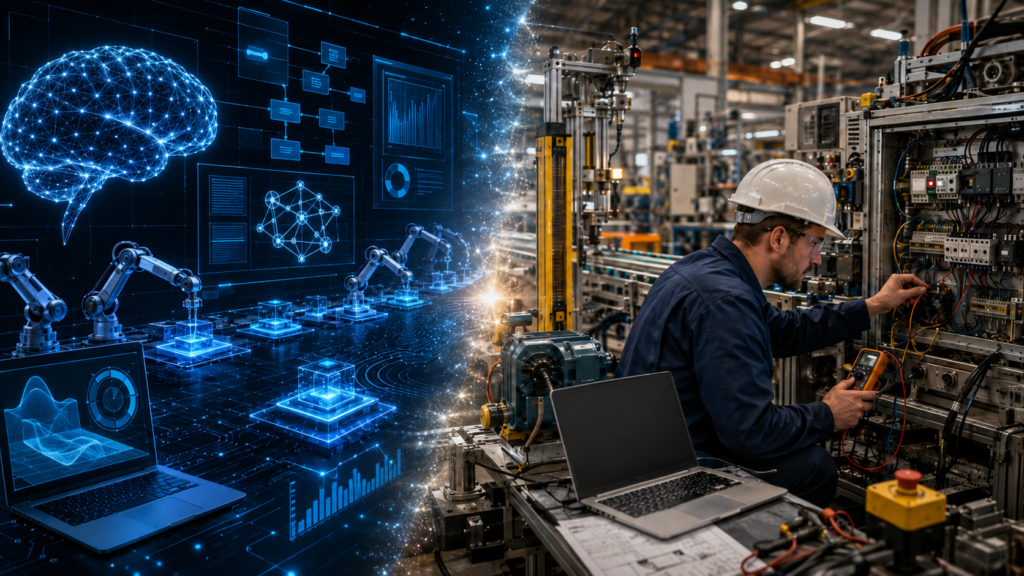
AI will not eliminate PLC programmers in the near future.
It will eliminate a growing amount of the repetitive work PLC programmers currently perform.
That distinction matters.
In 2026, industrial AI tools can already generate Structured Text, create program blocks, explain unfamiliar logic, search projects, draft HMI screens and correct some coding errors. Siemens, Rockwell Automation and CODESYS all now offer engineering tools with AI-assisted PLC-code generation or project interaction.
But creating code is only one part of industrial automation.
A production machine also requires someone to:
- Understand incomplete requirements
- Select suitable hardware
- Design the machine sequence
- Decide how faults should be handled
- Integrate safety systems
- Commission real equipment
- Diagnose electrical and mechanical problems
- Validate the complete system
- Accept responsibility when something goes wrong
AI is becoming good at producing pieces of an automation project.
It is much further from taking responsibility for the complete machine.
The Quick Answer
| PLC programming task | Automation potential |
|---|---|
| Creating basic timers, counters and scaling blocks | High |
| Generating standard motor or valve logic | High |
| Explaining existing code | High |
| Writing comments and documentation | High |
| Creating tag lists and repetitive objects | High |
| Searching a large project | High |
| Drafting alarm text | High |
| Converting a clear sequence into initial code | Moderate to high |
| Creating HMI templates | Moderate to high |
| Refactoring an existing project | Moderate |
| Generating test cases | Moderate |
| Designing a complete machine sequence | Moderate |
| Understanding vague customer requirements | Low |
| Troubleshooting an intermittent field fault | Low |
| Commissioning machinery | Low |
| Selecting and validating safety functions | Very low |
| Taking legal and engineering responsibility | Essentially none |
The people most exposed are those whose work consists mostly of copying standard logic from one project into another.
The people least exposed are those who combine programming with electrical knowledge, machine understanding, commissioning, safety and troubleshooting.
AI Is Already Inside PLC Engineering Software
This discussion is no longer theoretical.
Siemens
Siemens launched its Eigen Engineering Agent in 2026 as a purpose-built AI system connected to TIA Portal. Siemens says it can work with project structures, blocks, parameters and device relationships while performing tasks including PLC coding, HMI visualisation and device configuration.
Unlike a generic chatbot, the tool is designed to operate with the context of the actual automation project. Siemens says it was piloted with more than 100 companies across 19 countries before becoming generally available. Its performance figures are vendor-reported rather than independent proof, but the product demonstrates where engineering software is heading.
Rockwell Automation
FactoryTalk Design Studio Copilot can search project content, explain Add-On Instructions and create objects such as:
- AOI definitions
- Programs
- Routines
- Smart-object instances
Rockwell’s documentation also warns that the Copilot’s project representation must be updated after manual changes; otherwise, project-related requests may be inaccurate or fail. That is a small but important example of the wider problem: an AI assistant is only as reliable as the context it has been given.
CODESYS
The CODESYS Development System MCP Server connects external large-language models to the engineering environment. CODESYS says the system can generate PLC projects, POUs and IEC 61131-3 code, analyse existing applications and automatically detect or correct some coding errors.
It can communicate with cloud AI services or local language models, which is important for companies that cannot send proprietary machine software to an external cloud service.
The trend is clear:
Generic chatbot outside the project
→ AI assistant inside the engineering software
→ AI agent that can inspect and modify the project
That does not automatically mean the AI can engineer a safe, reliable machine.
It does mean that routine programming work will become faster.
What AI Can Automate Well
1. Boilerplate PLC Code
A large amount of machine software is repetitive.
Examples include:
- Motor start and stop blocks
- Valve-control blocks
- Alarm latches
- Analog scaling
- Runtime counters
- Maintenance timers
- Communication status handling
- Device-state structures
- Standard interlocks
- HMI command interfaces
An experienced company may already generate much of this work using libraries, spreadsheets, templates or scripts.
AI provides another interface for the same idea.
Instead of manually creating ten similar function blocks, the engineer may describe the required interface:
Create a motor function block with:

- Start and stop commands
- Ready and running feedback
- Fault feedback
- Start timeout
- Runtime accumulation
- Manual and automatic modes
- Reset command
- Status enumeration
AI can produce a useful first draft quickly.
The programmer still needs to verify:
- How commands are prioritised
- Whether reset behaviour is correct
- What happens when feedback is contradictory
- Whether the block restarts automatically
- How communication failure is handled
- Whether the code follows company standards
The typing is highly automatable.
The behavioural decisions are not.
2. Structured Text Generation
Structured Text resembles conventional text-based programming more closely than Ladder Diagram or Function Block Diagram. That makes it easier for language models to process.
Research has shown that general-purpose language models can generate syntactically valid IEC 61131-3 Structured Text for selected programming problems. One peer-reviewed ETFA study assessed 21 representative examples and found that the strongest tested model produced the most reliable syntactically correct ST expressing the requested functionality. However, this was a limited benchmark—not proof that arbitrary production systems can be generated automatically.
Research also identifies important difficulties:
- PLC code represents a small part of public programming data.
- IEC 61131-3 implementations differ between vendors.
- Proprietary function blocks may be unknown to a general model.
- Syntax can be correct while behaviour is wrong.
- The model may lack the surrounding project context.
Compiler feedback and specialised training can improve results, but researchers still treat verification as a necessary part of the workflow.
3. Explaining Existing Code
AI can be extremely useful when opening a project written by someone else.
It may help answer questions such as:
- What does this function block do?
- Where is this tag used?
- Which blocks control Station 4?
- What conditions prevent this motor from starting?
- Which alarms can stop this sequence?
- Explain this Structured Text loop.
- Summarise the states in this machine module.
This does not guarantee that the explanation is correct. It can still reduce the time required to understand a large project—especially when the AI has direct access to the complete project structure rather than a few copied networks.
This may be one of AI’s most valuable applications in brownfield factories.
Old machines commonly contain:
- Poorly documented programs
- Multiple programmers’ styles
- Obsolete instructions
- Unclear memory addresses
- Unused code
- Changes made during emergency breakdowns
An assistant that can search and summarise the whole application may save more time than one that generates new code.
4. Documentation
PLC programmers rarely enjoy documentation as much as programming.
AI can draft:
- Function-block descriptions
- Alarm lists
- I/O descriptions
- Sequence documents
- Test procedures
- Change summaries
- Operator instructions
- Code comments
- Commissioning checklists
- Software-release notes
This is highly automatable because the information often already exists somewhere in the project.
The engineer still needs to ensure that the documentation matches the actual implementation.
Automatically generated documentation that confidently describes yesterday’s program is worse than no documentation at all.
5. Tag and Object Creation
Large automation projects may contain thousands of repetitive objects:
- PLC tags
- HMI tags
- Alarm definitions
- Device structures
- Faceplates
- Network devices
- I/O channel definitions
- Recipe fields
This work is already frequently automated through Excel imports, scripts or engineering APIs.
AI makes the automation more accessible.
A programmer may provide an I/O list and ask the engineering agent to:
Create one device object for every motor.
Assign the correct I/O tags.
Create standard alarms.
Generate HMI faceplate instances.
Build the diagnostic structure.
Where the input information is structured and the company standard is clear, this work is a strong candidate for automation.
6. Program Search and Comparison
Finding all the code associated with one actuator can take time in a badly structured project.
AI-assisted tools can help locate:
- Tag references
- Cross-program dependencies
- Unused variables
- Duplicate logic
- Similar blocks
- Differences between implementations
- Possible naming inconsistencies
The AI may not need to write any code to provide substantial value.
Sometimes the most valuable answer is simply:
This output is commanded in four locations,
and two of them bypass the standard motor block.
7. Initial Fault Analysis
An AI assistant may combine:
- Drive fault code
- PLC alarm
- Recent event history
- Electrical schematic
- Device manual
- Machine documentation
It can then suggest a logical diagnostic sequence.
For example:
VFD reports external fault.
PLC shows safety permissive missing.
Motor contactor feedback remains on.

Check the contactor auxiliary feedback,
safety relay output and input mapping before replacing the drive.
This can help less experienced technicians avoid random part replacement.
Someone still needs to perform the physical measurements and confirm the cause.
What AI Can Partially Automate
Some work can be accelerated but not safely handed over completely.
Turning Requirements Into a Sequence
A customer might describe a machine like this:
The conveyor starts when the operator presses Start. The cylinder pushes the part into position, the clamp closes, the process runs and then everything returns home.
AI can create an initial state machine:
Idle
→ Check permissives
→ Start conveyor
→ Detect part
→ Extend stopper
→ Close clamp
→ Run process
→ Open clamp
→ Retract stopper
→ Complete cycle
That is the easy part.
The real engineering questions are:
- What happens if the part sensor activates too early?
- How long may the cylinder take?
- What happens after an emergency stop?
- Does the machine restart from its previous state?
- Can the operator remove a part manually?
- What if the clamp sensors disagree?
- Which outputs remain energised during a fault?
- How is trapped pneumatic energy handled?
- Which faults require maintenance access?
- Can production recover without losing the batch?
AI can suggest answers.
It cannot know the correct answers unless someone provides the machine, safety and process requirements.
HMI Generation
AI can generate:
- Standard device faceplates
- Navigation structures
- Alarm screens
- Diagnostic pages
- Setpoint forms
- Maintenance screens
The difficult part is designing an interface that operators can use correctly under pressure.
A useful HMI must answer:
Why is the machine stopped?
What condition is missing?
What should the operator do next?
What is safe to operate manually?
An automatically generated screen can technically contain all required tags while still being confusing.
Software Testing
AI can help produce test cases such as:
- Start with one permissive missing
- Remove feedback during operation
- Force contradictory limit switches
- Allow a timer to expire
- Interrupt communication
- Restore power during each sequence state
- Test maximum and minimum analog values
It may also help automate testing in a simulation or virtual commissioning environment.
But the test quality still depends on the requirements.
AI cannot test a behaviour nobody remembered to specify.
Refactoring Old Code
AI may help restructure:
- Repeated ladder networks
- Unclear state logic
- Global memory areas
- Poor variable names
- Large monolithic routines
- Repeated alarm code
Refactoring PLC code is riskier than refactoring an ordinary office application.
An apparently redundant contact may exist because of:
- Scan-order behaviour
- An old hardware workaround
- A field modification
- A timing issue
- A commissioning compromise
- An undocumented customer requirement
The code should not be “cleaned up” merely because the AI considers it inelegant.
What AI Cannot Reliably Replace
1. Understanding the Real Machine
A PLC program is not an isolated software product.
It controls:
- Motors
- Cylinders
- Valves
- Heaters
- Pumps
- Conveyors
- Robots
- Brakes
- Clamps
- Cutting tools
- High-pressure systems
To design good logic, someone must understand how those components interact physically.
Consider a motor that fails to reach operating speed.
The cause could be:
- Incorrect acceleration ramp
- Mechanical overload
- Brake not releasing
- Low supply voltage
- Wrong motor connection
- Incorrect nameplate data
- Damaged bearing
- Process material blocking the machine
- Incorrect speed feedback
- Poorly tuned motion control
The PLC alarm may simply say:
Motor start timeoutAI can list possibilities.
A competent person must determine which possibility exists on this particular machine.
2. Working With Incomplete Requirements
Automation projects rarely begin with a perfect specification.
The customer may provide:
- An old drawing
- A short email
- A similar previous machine
- A spreadsheet containing I/O
- Verbal descriptions from several departments
- Requirements that contradict each other
Programming often begins before every decision has been made.
A human engineer negotiates, asks questions and identifies hidden assumptions.
AI may make those assumptions silently.
That is dangerous because plausible code can conceal an undefined requirement.
3. Commissioning
Commissioning involves more than downloading software.
It includes:
- Checking field wiring
- Testing I/O
- Confirming motor directions
- Adjusting sensors
- Configuring drives
- Tuning motion
- Testing faults
- Measuring stopping behaviour
- Coordinating mechanics and pneumatics
- Training operators
- Managing last-minute customer changes
The machine may behave differently from the simulation because:
- A cylinder is slower than expected.
- Product variation changes sensor timing.
- A conveyor slips.
- A valve is installed backwards.
- A motor brake releases late.
- A network cable passes beside a VFD output.
- The mechanical drawing does not match the finished machine.
AI can support the commissioning engineer.
It cannot climb inside the guarded area, measure the signal and discover that the sensor bracket vibrates when the conveyor runs.
4. Intermittent Troubleshooting
Intermittent industrial faults are especially resistant to complete automation.
The fault may occur:
- Once every three shifts
- Only when the machine is warm
- When two motors accelerate together
- During one particular product recipe
- After a cleaner washes the machine
- When an operator follows an unusual sequence
- Only when a damaged cable flexes
The programmer may need to:
- Interview operators.
- Study the fault history.
- Add temporary diagnostic logic.
- Trend several values.
- Measure the physical circuit.
- Wait for the event.
- Separate the symptom from the original cause.
AI can help analyse collected data.
It cannot guarantee that the collected data includes the signal that matters.
5. Safety Engineering
AI-generated code does not automatically make a safety function valid.
ISO 13849-1:2023 provides requirements and methodology for designing and integrating safety-related parts of control systems, including their software. The safety function must be engineered and validated as part of the complete control system—not accepted because generated code compiles successfully.
A safe stop may depend on:
- Risk assessment
- Required Performance Level
- Sensor architecture
- Fault detection
- Safety outputs
- Contactors or safe drive functions
- Stopping time
- Mechanical hazards
- Restart prevention
- Validation testing
AI may assist with documentation or standard function selection.
A competent person still needs to verify that the actual machine reaches and maintains a safe state.
This is particularly important because unsafe AI-generated logic may look professional.
6. Engineering Responsibility
When an AI-generated routine causes a production loss or unsafe movement, the AI does not attend the incident meeting.
The responsible organisation still needs someone to answer:
- Who reviewed the code?
- Which requirements were used?
- How was it tested?
- Who approved the change?
- Which version was commissioned?
- Were safety functions affected?
- Why was the behaviour considered acceptable?
AI can generate work.
It cannot own the engineering decision.
Why PLC Programming Is Difficult to Automate Completely
Vendor Differences
IEC 61131-3 provides common language concepts, but real implementations differ.
The same general task may use different:
- Data types
- Libraries
- Timer implementations
- Motion instructions
- Safety blocks
- Communication functions
- Project structures
- Import formats
Research on vendor-aware PLC assistants identifies proprietary dialects, project-specific blocks and limited public training data as major challenges for generic models. Providing project documentation and compiling generated code improves performance, but this requires a specialised workflow rather than a simple prompt in a general chatbot.
Graphical Languages
AI works most naturally with text.
Ladder Diagram, Function Block Diagram and Sequential Function Chart contain graphical structure that may not be represented cleanly in ordinary text.
Research has found that basic Structured Text generation is more mature, while automatic generation of graphical PLC languages remains harder. One study found that generating even simple Ladder Diagram applications remained challenging with prompt-only approaches.
Vendor-integrated tools can reduce this problem because they interact with the engineering project’s internal object model rather than trying to draw ladder logic as text.
Cyclic Execution
PLC logic runs repeatedly.
A routine that appears correct in isolation may behave differently because of:
- Scan order
- Retained data
- One-shot conditions
- Task priorities
- Interrupts
- Asynchronous communication
- Input and output updates
- Previous-cycle states
An AI may generate correct syntax without understanding the timing behaviour of the complete project.
Physical Consequences
A bad website function may display the wrong value.
A bad PLC function may:
- Start a motor unexpectedly
- Release a clamp
- Overfill a tank
- Damage a product
- Crash a robot
- Overheat equipment
- Defeat a process interlock
The acceptable verification standard must therefore be higher.
Long Equipment Lifetimes
Industrial machines may operate for 15, 20 or 30 years.
The programmer must consider:
- Whether maintenance can understand the program
- Whether replacement hardware will be available
- How backups are stored
- How future modifications will be managed
- Whether the AI tool will still exist
- Whether generated code depends on undocumented libraries
The fastest way to generate code today may not be the best way to support the machine in 2040.
Which PLC Programmers Are Most at Risk?
The Copy-and-Paste Programmer
This person mainly:
- Copies blocks from an older project
- Changes addresses
- Renames tags
- Creates repetitive HMI objects
- Adds standard alarms
- Produces basic documentation
Much of this work is highly automatable.
The role may not disappear, but one person using AI and engineering templates may complete work that previously required several junior programmers.
The Basic Machine Programmer
This person programs relatively standard:
- Conveyors
- Pumps
- Fans
- Valves
- Simple sequencing
- Basic HMI controls
AI can generate a significant percentage of the initial application.
The programmer remains valuable when they can review the sequence, handle exceptions and commission the equipment.
Someone who can only produce the first draft is more exposed.
The Maintenance PLC Technician
Maintenance work is less exposed because it involves the physical machine.
A technician must still:
- Identify the correct PLC
- Connect safely
- Understand existing logic
- Measure field signals
- Check drives and sensors
- Diagnose intermittent failures
- Avoid making the breakdown worse
AI can make the technician faster.
It cannot replace the need to physically investigate the equipment.
The Commissioning Engineer
Commissioning is difficult to automate because it combines software, electrical, mechanical and human problems.
AI will increasingly help with:
- I/O checklists
- Code explanations
- Parameter recommendations
- Test generation
- Fault analysis
- Documentation
The commissioning engineer still owns the final system behaviour.
This role is likely to be enhanced more than replaced.
The Safety or Motion Specialist
Specialists in areas such as:
- Functional safety
- Coordinated motion
- Servo tuning
- Robotics
- Process control
- Industrial cybersecurity
are relatively protected because their work requires deeper system knowledge and validation.
AI may substantially increase their productivity, but the consequences of errors make unsupervised replacement unlikely.
The Controls Architect
A senior controls engineer determines:
- Software structure
- Hardware architecture
- Company standards
- Reusable libraries
- Failure behaviour
- Testing strategy
- System interfaces
AI can produce work inside this framework.
Someone still needs to define the framework.
Will Companies Need Fewer PLC Programmers?
Probably fewer programming hours per machine.
That does not necessarily mean fewer people across the entire automation industry.
AI tools may allow companies to:
- Deliver more machines
- Quote smaller projects profitably
- Upgrade legacy equipment faster
- Improve documentation
- Build better diagnostics
- Standardise software
- Reduce commissioning time
The likely change is:
Five programmers producing five projects
may become
three programmers producing eight projects
That example is illustrative, not a forecast.
The important point is that productivity and employment are not the same measurement.
Demand may continue while the expected output per programmer rises.
Junior roles are likely to change the most. Employers may expect a new programmer to use AI, templates and automated testing from the beginning rather than spending months manually reproducing standard code.
Can Someone With No PLC Knowledge Use AI to Program a Machine?
They can generate code.
That does not mean they can engineer a machine.
A beginner may ask AI to create:
Start-stop control for a conveyor
with an emergency-stop input.
The AI may produce working ladder or Structured Text.
But a competent programmer should immediately question the requirement:
- Is the emergency stop connected to a safety relay or safety PLC?
- Is a standard input being incorrectly used as a safety function?
- Should the conveyor restart when the E-stop is released?
- Is a manual reset required?
- How are contactor faults detected?
- What happens during communication failure?
- Is Safe Torque Off being used?
- What stopping time is required?
The beginner may not know that these questions exist.
This is the central risk of AI-assisted programming:
AI can give inexperienced people the ability to produce code that looks more competent than their understanding.
That can be useful for learning.
It can be dangerous in production.
A Safe AI-Assisted PLC Workflow
AI-generated logic should be treated like code written by an unverified subcontractor.
It may be excellent.
It still needs review.
Step 1: Define the requirements
Document:
- Inputs
- Outputs
- Operating modes
- Normal sequence
- Interlocks
- Permissives
- Timeouts
- Fault responses
- Reset behaviour
- Power-recovery behaviour
- Safety boundaries
Do not begin with:
Write the PLC program for my machine.Step 2: Generate small modules
Ask AI to generate isolated components such as:
- One motor block
- One analog-scaling block
- One alarm function
- One sequence state
- One data structure
Small outputs are easier to understand and test.
Step 3: Compile the code
Compilation confirms syntax and some structural rules.
It does not prove that the behaviour is correct.
Research into PLC-code generation increasingly uses compiler feedback because syntax errors remain a significant limitation of unaided generation.
Step 4: Review every line
The reviewer must understand:
- Every condition
- Every assignment
- Every timer
- Every retained value
- Every state transition
- Every command priority
Do not deploy AI-generated code that nobody on the team can explain.
Step 5: Test normal operation
Simulate or test:
- Start
- Stop
- Manual mode
- Automatic mode
- Reset
- Complete cycle
- Recipe changes
- Power-up
- Normal shutdown
Step 6: Test failures
Test:
- Missing feedback
- Stuck sensor
- Contradictory sensors
- Drive fault
- Communication loss
- Timeout
- Emergency stop
- Guard opening
- Low air pressure
- Power interruption
- Recovery from every sequence state
The failure tests are usually more important than the normal-cycle test.
Step 7: Commission under control
During physical commissioning:
- Remove unintended start commands.
- Test one device at a time.
- Confirm motor direction.
- Verify sensor polarity.
- Confirm feedback.
- Restrict machine access.
- Follow the approved safety procedure.
- Record changes.
Step 8: Save the final source and history
Preserve:
- Final PLC project
- AI-generated draft
- Reviewed version
- Test records
- Change description
- Approvals
- Software version
- Parameter backups
The company must be able to maintain the machine without repeating the original AI conversation.
Dangerous Ways to Use AI for PLC Programming
Pasting confidential projects into a public chatbot
PLC projects may reveal:
- Proprietary machine design
- Production processes
- Network addresses
- Safety architecture
- Customer information
- Passwords or credentials
- Vulnerabilities
Use only company-approved services and understand how submitted data is handled.
Local or on-premises AI is becoming relevant partly because industrial companies often cannot send sensitive project information to public cloud models.
Assuming code is correct because it compiles
Compilation proves that the software recognises the syntax.
It does not prove:
- Correct machine behaviour
- Correct scan-cycle behaviour
- Safe restart
- Correct fault recovery
- Proper hardware selection
- Compliance with safety requirements
Asking AI to rewrite an entire working project
A production PLC project contains years of assumptions and modifications.
A full rewrite may remove:
- Timing workarounds
- Legacy-device handling
- Customer-specific behaviour
- Rare but important recovery logic
Refactor in controlled sections with regression testing.
Downloading generated code directly
Never use the production PLC as the first test environment.
Use:
- Offline review
- Compiler checks
- Simulation
- Test bench
- Digital twin
- Factory acceptance testing
before controlled commissioning.
Using AI as a safety authority
AI may help explain a safety standard or draft a test sheet.
It should not be treated as the competent person who selected, designed or validated the safety function.
Letting AI hide weak fundamentals
A programmer should still understand:
- PLC scan cycle
- Data types
- Timers
- One-shots
- State machines
- Interlocks
- Electrical circuits
- Industrial networks
- Drives
- Safety principles
AI should increase capability.
It should not replace the ability to recognise a bad answer.
Skills That Become More Valuable Because of AI
Requirements Engineering
When code becomes easier to generate, clearly defining what the code must do becomes more valuable.
A precise engineer can use AI effectively.
A vague engineer receives a faster version of the wrong machine.
Machine and Process Knowledge
Understanding the physical process is difficult for a general AI model to obtain.
Learn:
- Mechanical sequences
- Pneumatics
- Hydraulics
- Motors and drives
- Sensors
- Product flow
- Operator behaviour
- Failure modes
Electrical Troubleshooting
A programmer who can also use a multimeter, read a schematic and trace a control circuit remains highly useful.
AI cannot remotely tighten a loose terminal.
Software Architecture
Learn how to organise:
- Device modules
- State machines
- Equipment phases
- Data structures
- Alarm systems
- Reusable libraries
- Interfaces
- Version control
AI-generated code needs a well-designed place to live.
Verification and Testing
The ability to prove that software behaves correctly will become more important than manually typing it.
Learn:
- Simulation
- Unit testing
- Regression testing
- Virtual commissioning
- Fault injection
- Test documentation
Functional Safety
Safety competence remains valuable because automation tools do not remove the need for risk assessment and validation.
Industrial Networking
Modern PLC systems are connected through:
- PROFINET
- EtherNet/IP
- EtherCAT
- Modbus TCP
- OPC UA
- Industrial Ethernet switches
A person who can separate a code problem from a network problem is difficult to replace.
Commissioning
Commissioning combines every discipline:
Software
+
Electrical
+
Mechanical
+
Process
+
Safety
+
People
It will remain one of the strongest ways to make yourself valuable.
What PLC Programming May Look Like by 2030
The likely workflow is not:
Engineer writes every network manually.It is more likely to become:
Engineer defines requirements and architecture
→ AI builds initial project
→ Engineering software validates syntax and standards
→ Simulation generates and runs tests
→ Engineer reviews exceptions
→ Team commissions the physical system
AI agents will probably gain better access to:
- Complete project context
- Company libraries
- Electrical drawings
- Device manuals
- I/O lists
- Digital twins
- Test frameworks
- Version-control history
- Past projects
The more context they receive, the more useful they become.
That still leaves a critical human role:
Decide what the machine should do
and whether the result is acceptable.
Final Verdict
Will AI replace PLC programmers?
It will replace parts of PLC programming.
It will automate much of the repetitive work involved in:
- Standard code generation
- Project scaffolding
- Tag creation
- Documentation
- Code explanation
- Project searching
- Basic error correction
- Initial test generation
It will not soon replace the complete professional who can:
- Understand the machine
- Translate vague requirements
- Design reliable sequences
- Troubleshoot electrical and mechanical faults
- Integrate safety
- Commission equipment
- Validate real behaviour
- Take responsibility for the finished system
The most exposed person is the programmer whose only value is typing standard ladder logic.
The least exposed person is the controls professional who understands the entire chain:
Process requirement
→ Electrical design
→ PLC and HMI software
→ Network
→ Safety system
→ Physical machine
→ Testing and commissioning
Do not compete with AI on how quickly you can type a timer.
Use AI to type the timer.
Then build the skills required to know whether that timer belongs there at all.