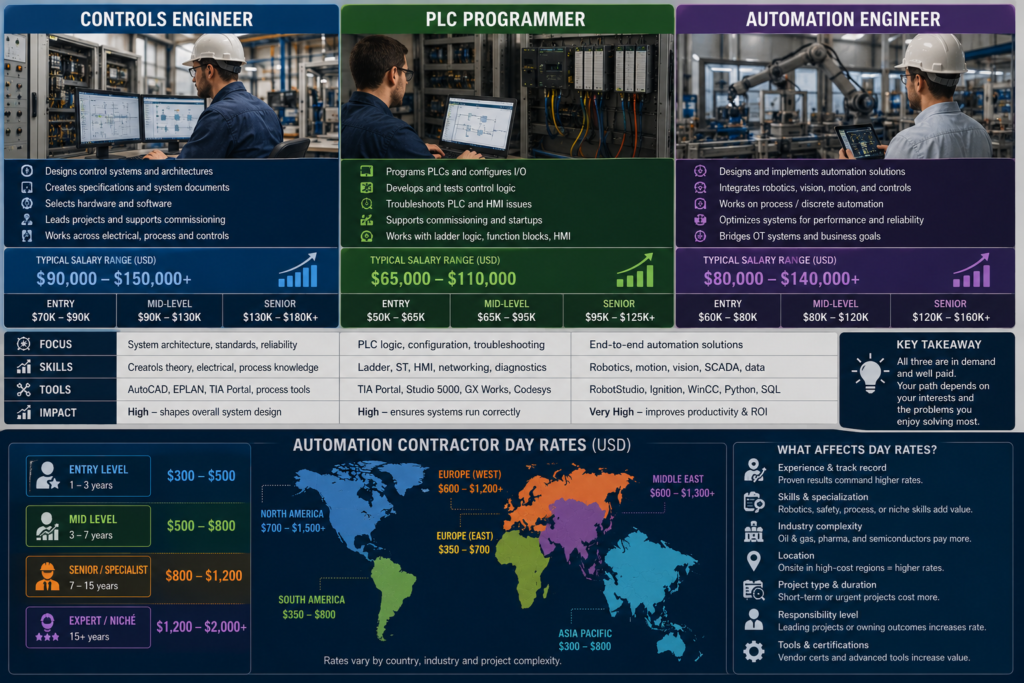
Automation contractor rates can look surprisingly high compared with permanent salaries.
A controls engineer earning €55,000 per year may see a freelancer quoting €700 per day and assume the contractor earns several times more.
The comparison is misleading.
A day rate must cover periods without work, holidays, illness, insurance, accounting, software licences, hardware, training, travel administration and the risk of invoices being paid late—or not at all.
The rate also changes according to what the contractor is actually being hired to do. Writing several HMI screens remotely is not priced the same as modifying safety-related PLC software during a weekend production shutdown.
Rate note: Contractor-rate information is less standardised than employee salary data. The figures below are market benchmarks drawn from 2026 recruitment data and active contract listings, not government-mandated rates.
Typical Automation Contractor Rates in 2026
| Market and experience | Typical contractor rate |
|---|---|
| Continental Europe: junior to mid-level PLC engineer | €420–€550 per day |
| Continental Europe: experienced automation engineer | €550–€725 per day |
| Continental Europe: senior or lead controls engineer | €725–€950 per day |
| European specialist contractor | €840–€1,000+ per day |
| United Kingdom automation engineer median | £500 per day |
| Ireland engineering-contractor benchmark | About €479 per day |
| United States contractor pay | Roughly $39–$75 per hour |
| United States customer bill rate | Roughly $75–$135 per hour |
A 2026 European recruitment benchmark places junior-to-mid PLC contractors at €420–€550 per day, experienced engineers at €550–€725 and senior controls engineers at €725–€950. Specialists dealing with complex systems, regulated industries or multi-site projects may exceed €1,000 per day.
In the UK, advertised automation-engineer contracts had a median of £500 per day during the six months ending 6 August 2026. The 25th percentile was £411, the 75th percentile £600 and the 90th percentile £650.
Ireland’s wider engineering-contractor benchmark was approximately €479 per day, while the median across all contractor categories in the same guide was €500.
US Rates Are Usually Quoted Per Hour
US automation contracts are more commonly advertised using hourly rates.
Current market data places contractor pay for PLC programmers, controls engineers and robotics integrators broadly between $39 and $75 per hour, depending on experience, platform knowledge and travel requirements.
However, the amount paid by the customer may be higher than the amount received by the individual contractor.
One US automation marketplace reports:
- Controls and PLC contractor bill rates of $75–$135 per hour
- Contractor pay rates of $60–$108 per hour
- A median customer bill rate of approximately $95 per hour
The difference may cover agency fees, insurance, administration and other contract-management costs.
An eight-hour day at $75 per hour equals $600, but many commissioning contracts do not use ordinary eight-hour schedules. One current Allen-Bradley troubleshooting contract offered $72 per hour, $108 overtime, paid travel time and per diem, with twelve-hour shifts planned.
That package cannot be compared directly with a remote programmer billing for eight predictable office hours.
Why Day Rates Vary So Much
1. Platform knowledge
A contractor who can only monitor basic ladder logic will normally charge less than someone who can independently deliver:
- Siemens TIA Portal and WinCC
- Allen-Bradley Studio 5000 and FactoryTalk
- Safety PLC programming
- Servo motion
- Robotics
- SCADA
- Industrial networking
- Database or MES integration
Clients pay more when one contractor can handle several parts of the project without waiting for additional specialists.
2. Commissioning responsibility
Offline programming is relatively predictable.
Commissioning is not.
During site commissioning, the contractor may need to resolve:
- Incorrect field wiring
- Missing devices
- Mechanical timing problems
- Network failures
- Drive faults
- Customer changes
- Production-quality issues
- Undocumented safety behaviour
A contractor who can carry a project from offline programming through production ramp-up is normally worth more than someone delivering code that another engineer must commission.
A 2026 cross-border Siemens contract involving programming in Germany and commissioning in Texas offered $75 per hour with travel and expenses paid. It required at least five years of PLC and hardware-commissioning experience, Siemens Safety, drives and several PLC languages.
3. Industry risk
Rates tend to rise where mistakes are especially expensive.
Examples include:
- Pharmaceuticals
- Semiconductor manufacturing
- Energy
- Automotive production
- Chemical processing
- Water infrastructure
- High-speed logistics
- Regulated food production
Stopping a small standalone machine is different from stopping an entire production facility.
Regulated industries may also require validation documents, controlled software releases, test records and knowledge of sector-specific standards.
The customer is paying not only for programming time, but for reduced project risk.
4. Urgency and shutdown work
Planned work months in advance usually gives the customer more choice.
A request such as:
We need an experienced Siemens programmer at the plant tomorrow because production cannot restart
will command a higher rate.
Weekend shutdowns, night work and holiday commissioning may include:
- Premium hourly rates
- Overtime
- Minimum daily charges
- Travel-day payments
- Standby fees
Contractors should define these terms before arriving on site.
5. Project duration
A twelve-month contract offers more predictable utilisation than a three-day emergency job.
Contractors may accept a lower daily rate for:
- Long guaranteed assignments
- Reliable weekly hours
- Short travel distance
- Fast payment
- Low sales and administrative effort
Short projects often need a higher rate because the contractor must repeatedly find new work, prepare quotations and absorb gaps between assignments.
6. Travel and expenses
A €700 day rate can mean very different things depending on whether the client also pays for:
- Flights
- Hotels
- Rental cars
- Mileage
- Meals
- Travel time
- Weekend travel
- Visas
- Local transport
A lower rate with all expenses paid may be better than a higher “all-inclusive” rate for an expensive international location.
The contract should state whether travel days are billed at the full rate, a reduced rate or not at all.
7. Tax and employment status
Tax treatment affects what the contractor keeps.
In the UK, the off-payroll working rules—commonly called IR35—can apply when someone provides services through an intermediary but would effectively be considered an employee if engaged directly. Where the rules apply, income tax and National Insurance deductions may be made from the contractor’s fees. The assessment is made contract by contract.
That is why UK advertisements often specify whether a role is considered inside or outside IR35.
Other countries have their own rules concerning self-employment, disguised employment, VAT and social insurance.
A headline rate is not take-home income.
What the Day Rate Must Cover
A freelancer’s invoice must fund more than personal salary.
Typical business costs include:
- Professional liability insurance
- Public liability insurance
- Accounting
- Taxes and social contributions
- PLC and HMI licences
- Engineering laptop
- Test equipment
- Training
- Vehicle and travel costs
- Unpaid quotations
- Contract negotiation
- Holidays
- Sick leave
- Time between projects
- Bad-debt risk
Suppose a contractor wants €100,000 of annual business revenue and expects only 180 genuinely billable days:
€100,000 ÷ 180 days
= approximately €556 per day
That does not mean the contractor receives €100,000 as personal income. Business expenses and taxes still come from that revenue.
This is why converting a permanent annual salary into 260 working days produces an unrealistically low freelance rate.
What Should a New Automation Contractor Charge?
A contractor should not choose a rate only by copying the highest number seen online.
The rate should reflect:
- Work that can be delivered independently
- Relevant platform experience
- Industry knowledge
- Commissioning responsibility
- Liability
- Location
- Contract length
- Included expenses
- Current local demand
A new independent contractor with solid PLC experience but limited project ownership may fall near the lower European range of €420–€550 per day.
An experienced engineer who can independently program, commission and document complete systems may reasonably target €550–€725.
Senior contractors handling safety, motion, process control, regulated plants or project leadership may enter the €725–€1,000+ range.
Charging a senior-specialist rate without senior-specialist ability usually results in one short contract and no repeat customer.
Final Verdict
A realistic 2026 automation-contractor range is approximately:
General PLC and automation work:
€420–€725 per day

Senior controls and commissioning:
€725–€950 per day

Niche or high-risk specialist work:
€840–€1,000+ per day
The UK market centres around approximately £500 per day, while US contractors frequently work at $39–$75 per hour before considering overtime, travel and the difference between customer bill rate and contractor pay.
The highest rate does not always produce the best contract.
A slightly lower rate may be worthwhile when the project offers guaranteed months of work, paid expenses, sensible hours and reliable payment.
A high rate may be justified when the contractor must travel immediately, work nights, assume commissioning responsibility and solve problems that are costing the customer thousands of euros per hour.
Customers are not paying only for PLC code.
They are paying for the ability to enter a difficult project, make correct decisions and leave the machine operating reliably.