An automation technician’s salary depends on more than PLC knowledge.
Two technicians may both troubleshoot ControlLogix systems, VFDs and industrial networks, yet one earns considerably more because they work in an industry where every hour of downtime is expensive, tightly regulated or potentially dangerous.
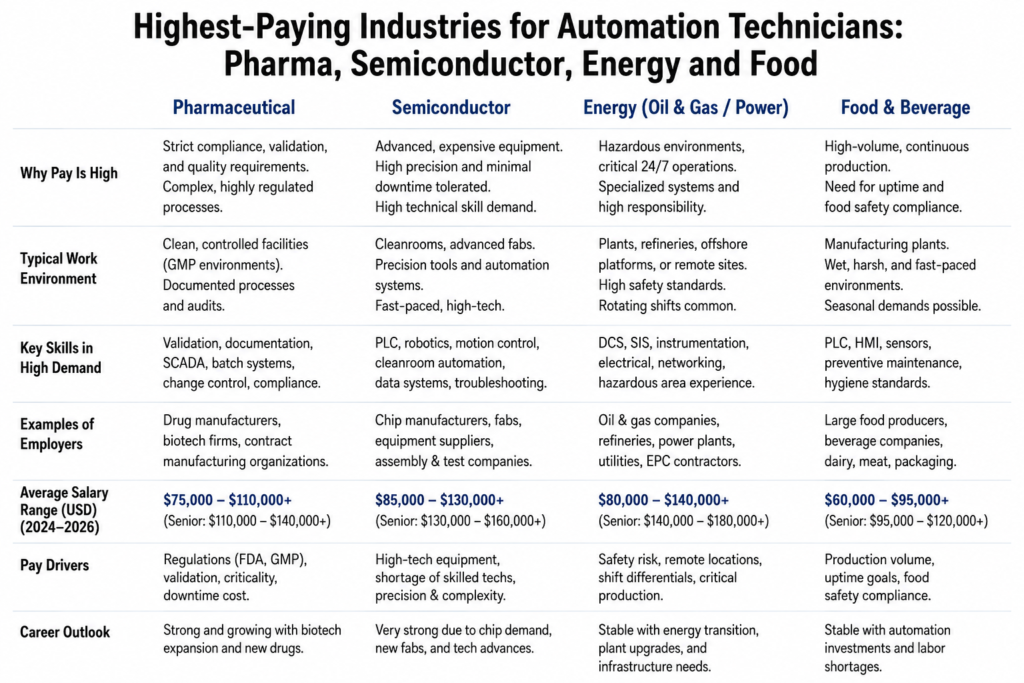
The industries that commonly offer the strongest pay include:
- Energy and utilities
- Pharmaceutical and biotechnology manufacturing
- Semiconductor manufacturing
- Food and beverage production
The order is not universal. An experienced food-factory electrical technician on a night shift may earn more than an entry-level semiconductor equipment technician. A nuclear instrumentation technician may earn more than both.
Salary note: “Automation technician” is not one standard statistical occupation. The comparisons below use current employer advertisements and related official categories such as mechatronics technicians, electrical engineering technicians and industrial machinery mechanics.
Quick Pay Comparison
| Industry | Current US examples or benchmarks | Main reason for higher pay |
|---|---|---|
| Energy and utilities | Around $89,000–$123,000 in related technical categories | Critical infrastructure, hazards and 24-hour operation |
| Pharma and biotechnology | Current automation role: $86,686–$117,280 | Regulation, validation and high-value production |
| Semiconductor | Current equipment role: roughly $23.55–$33.85 per hour | Complex equipment, cleanrooms and continuous production |
| Food and beverage | Current automation role: $42 plus $1.50 shift premium per hour | High-speed production, shifts and broad troubleshooting |
These examples come from different locations and job structures. They show the available range, not a guaranteed national salary.
1. Energy and Utilities
Energy is often the strongest-paying sector for experienced technicians.
This includes:
- Power generation
- Electrical transmission and distribution
- Nuclear facilities
- Wind farms
- Oil and gas
- Water utilities
- Gas distribution
- Renewable-energy plants
The work may involve PLCs, DCS platforms, protection relays, turbines, instrumentation, control valves, high-voltage systems and safety-critical processes.
Official US industry data illustrates the premium. In electric power generation, transmission and distribution, industrial machinery mechanics had an annual mean wage of approximately $95,200. Electrical and electronic engineering technicians averaged $88,920, while the smaller electro-mechanical and mechatronics technician category averaged $122,590.
A current Constellation Energy electrical-technician vacancy listed starting pay of $48.51 per hour, equivalent to approximately $100,900 for 2,080 hours before overtime. The role covered plant instrumentation, protective relays, control devices and electrically operated valves.
Energy pays more because the technician may face:
- Serious electrical and process hazards
- Strict operating procedures
- On-call responsibility
- Difficult access or remote locations
- Expensive outages
- Regulatory requirements
- Night, weekend and emergency work
The best-paying energy positions are rarely basic PLC-monitoring jobs. They usually require instrumentation, electrical protection, process control or specialist plant knowledge.
2. Pharmaceutical and Biotechnology Manufacturing
Pharma combines industrial automation with strict documentation and regulatory control.
Automation technicians may support:
- Packaging and inspection machines
- Batch processes
- Clean utilities
- Filling systems
- Vision inspection
- Serialization
- Building automation
- SCADA and historians
- Siemens, Rockwell or DeltaV systems
A current Amgen automation-technician position in Ohio advertised $86,685.55 to $117,280.45 per year. The role involved PLC and HMI troubleshooting, packaging equipment, inspection systems, regulatory support and work under current Good Manufacturing Practice requirements.
A separate Amgen equipment-maintenance position involving electrical and process-automation issues advertised $68,500.65 to $92,677.35.
Older but directly comparable US industry data placed pharmaceutical industrial machinery mechanics at approximately $69,470, electrical and electronic engineering technicians at $78,590, and mechatronics technicians at $73,400 annually.
The higher end of pharma pay reflects skills beyond ordinary maintenance:
- GMP change control
- Validation
- Audit-ready documentation
- Data integrity
- Calibration
- Deviation investigations
- Corrective and preventive actions
- Controlled software releases
A five-minute software change may require a risk assessment, test protocol, approval and documented verification.
That bureaucracy can be frustrating. It is also one reason experienced pharma automation technicians are valuable.
3. Semiconductor Manufacturing
Semiconductor plants operate highly automated equipment in controlled cleanroom environments.
Technicians may maintain:
- Wafer-processing equipment
- Vacuum systems
- Chemical-delivery systems
- Robotics
- Motion systems
- Machine vision
- Facilities automation
- Gas and water systems
- Process-control equipment
The work can be technically demanding, but semiconductor manufacturing does not automatically pay every technician more than other industries.
A current TSMC equipment-technician position in Washington listed a full hourly range of approximately $23.55 to $33.85, with typical new-hire rates between $23.55 and $31.24. Benefits included incentives, profit sharing and retirement contributions.
Official semiconductor-manufacturing data showed annual means of approximately:
- $69,180 for industrial machinery mechanics
- $69,370 for electrical and electronic engineering technicians
- $64,620 for mechatronics technicians
Pay can rise significantly with expertise in:
- Lithography or etching tools
- Vacuum and gas systems
- Advanced process controls
- Equipment communication
- Robotics
- Facilities controls
- Yield and uptime improvement
Semiconductor work may also include compressed workweeks, night shifts, cleanroom clothing and long periods spent supporting one specialised equipment family.
The strongest earnings often appear when a technician progresses into equipment engineering, controls engineering or advanced process-support work.
4. Food and Beverage Manufacturing
Food manufacturing is sometimes dismissed as a lower-paying automation sector.
That is not always accurate.
Modern food plants contain:
- High-speed packaging lines
- Robots and vision systems
- Conveyors
- Ovens and refrigeration
- Batch processes
- CIP systems
- VFDs and servos
- PLC-controlled utilities
A current Nestlé electrical and automation technician vacancy offered $42 per hour, plus a $1.50 hourly night-shift premium, quarterly bonus potential and benefits. The position required experience with ControlLogix, GuardLogix, PLC-5, PowerFlex drives and Kinetix servos.
Another Nestlé maintenance posting listed a progression from $27.28 to $41.36 per hour, depending on technician level.
Broad food-manufacturing data showed annual means of approximately $60,750 for industrial machinery mechanics, $69,710 for electrical engineering technicians and $74,810 for mechatronics technicians.
Food automation can pay well because plants need technicians who combine:
- Electrical troubleshooting
- PLC diagnostics
- Pneumatics
- Mechanical maintenance
- VFDs and servos
- Instrumentation
- Hygienic-production awareness
The disadvantage is that the best-paid positions frequently involve nights, weekends, twelve-hour shifts and work during short maintenance windows.
What Actually Determines Your Salary?
Industry matters, but several other factors can be equally important.
Shift and overtime
Night premiums, weekend work and overtime can add substantially to annual earnings.
A lower base rate with regular overtime may produce more total income than a higher salary with no additional hours.
Technical breadth
A technician who only replaces sensors normally earns less than someone who can troubleshoot:
PLC
+ HMI
+ VFD
+ Servo
+ Industrial network
+ Instrumentation
+ Electrical circuits
Regulation and risk
Pharma pays for compliance knowledge.
Energy pays for critical infrastructure and hazard exposure.
Semiconductor companies pay for highly specialised process-equipment knowledge.
Food manufacturers pay more when one technician can keep high-speed production running across several disciplines.
Location
A high salary in California, Switzerland or Denmark may not produce the best disposable income after housing and taxes.
Compare the complete package:
- Base salary
- Shift premium
- Overtime
- Bonus
- Pension
- Health coverage
- Travel
- On-call duty
- Cost of living
Final Verdict
For the highest technician-level ceiling, energy and utilities are often the strongest option.
Pharma and biotechnology can also pay exceptionally well, particularly when the role includes PLC ownership, validation and regulated-system support.
Semiconductor manufacturing provides advanced technical experience and a path into equipment engineering, but entry-level technician pay is not automatically higher than every other manufacturing sector.
Food and beverage is the underrated option. Experienced electrical and automation technicians can earn excellent hourly rates, although the strongest packages commonly involve shift work.
The real salary advantage comes from combining a high-value industry with scarce skills:
PLC troubleshooting
+
Instrumentation
+
Networks
+
Drives and motion
+
Regulatory or process knowledge
+
Independent system ownership
Changing industries may raise your salary.
Becoming the technician who can safely own the most difficult systems raises it further.