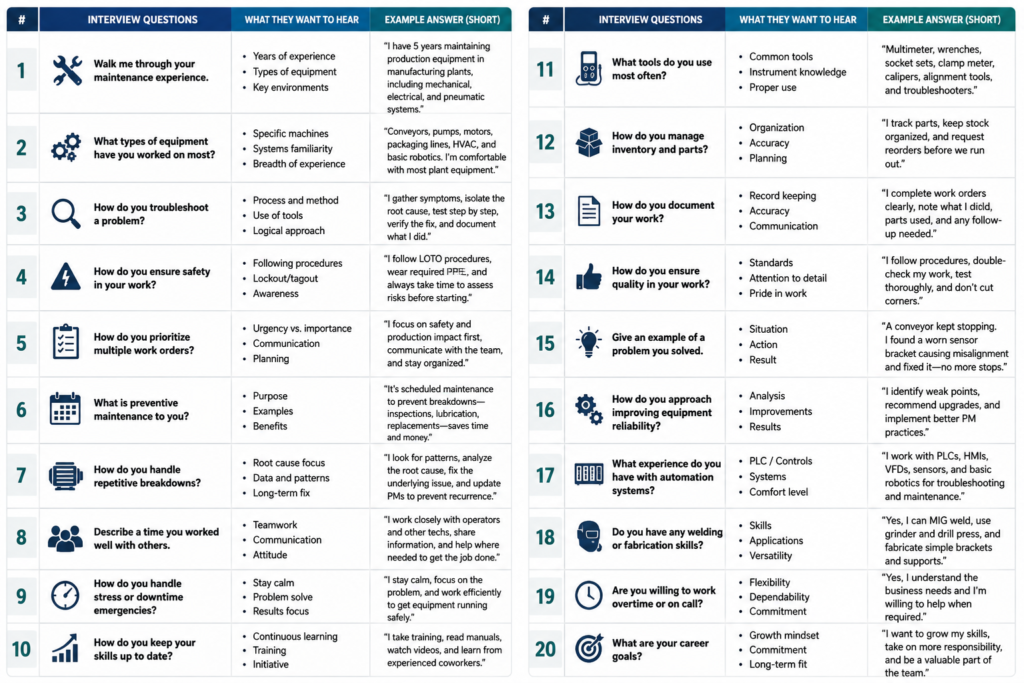
A maintenance technician interview is rarely only a test of technical knowledge.
Employers also want to know whether you can:
- Work safely under pressure
- Diagnose faults logically
- Prioritise production problems
- Communicate with operators
- Document repairs
- Prevent repeat failures
- Recognise when a problem exceeds your authority
This set is deliberately different from PLC-focused interview questions. It covers general industrial maintenance, including mechanical systems, electrical faults, preventive maintenance, safety, teamwork and problem-solving.
Use the sample answers as frameworks rather than scripts. A credible answer based on one real repair is stronger than a polished speech that sounds memorised.
1. Tell Us About Your Maintenance Experience
Sample answer:
I have experience maintaining industrial production equipment, including motors, conveyors, bearings, sensors, pneumatic systems, contactors and variable-frequency drives. My work has included breakdown response, preventive maintenance, fault finding and documenting repairs. I normally begin by confirming the symptom, checking the machine safely and then separating electrical, mechanical and control-system causes.
Keep your introduction relevant to the machinery used by the employer.
2. How Do You Approach a Machine Breakdown?
Sample answer:
I first make sure the machine is in a safe condition and speak with the operator to understand what happened before the failure. I check alarms and obvious physical signs, then divide the system into sections. I verify the power supply, safety conditions, control signals, mechanical condition and actuator response. I avoid replacing components until I have evidence that they are faulty.
A good troubleshooting structure is:
Confirm the symptom
→ Make the equipment safe
→ Gather information
→ Divide the system
→ Measure and test
→ Repair
→ Verify operation
→ Document the cause
3. How Do You Prioritise Several Maintenance Requests?
Sample answer:
I prioritise safety first, followed by faults that stop critical production or risk damaging equipment. I then consider how many people or processes are affected, whether a temporary safe workaround exists and how long the repair may take. I communicate the priorities so production understands why one job is being handled before another.
A leaking guard-door switch affecting a complete line normally takes priority over a noncritical indicator lamp.
4. What Would You Do Before Working Inside a Machine?
Sample answer:
I would follow the site’s isolation and lockout procedure. I identify every energy source, including electrical, pneumatic, hydraulic, gravity and stored mechanical energy. I isolate them, apply my lock where required, release stored energy and verify that the isolation is effective before beginning work.
Do not answer only with “switch off the main isolator.” Many machines retain pressure, elevated loads or stored electrical energy after the supply is disconnected.
5. Describe a Difficult Fault You Found
Use the STAR method:
- Situation
- Task
- Action
- Result
Sample answer:
A conveyor stopped intermittently, but it restarted before maintenance arrived. I reviewed the operator’s description and inspected the cable route. By flexing the sensor cable while monitoring the signal, I found an internal break near a moving section. I replaced and rerouted the cable, secured it against repeated bending and recorded the cause. The fault did not return.
The interviewer wants to hear your reasoning, not only the final component replaced.
6. What Is the Difference Between Corrective and Preventive Maintenance?
Sample answer:
Corrective maintenance repairs equipment after a fault has occurred. Preventive maintenance is performed at planned intervals to reduce the chance of failure, such as lubrication, inspection, cleaning and scheduled replacement. Predictive or condition-based maintenance uses measurements such as vibration, temperature or current to decide when intervention is necessary.
A good technician understands that excessive preventive replacement can also waste time and introduce new faults.
7. How Do You Prevent a Fault From Happening Again?
Sample answer:
After restoring the machine, I look for the underlying cause rather than stopping at the failed component. I check whether the failure resulted from contamination, heat, vibration, incorrect adjustment, poor cable routing, overloading or unsuitable maintenance intervals. I then recommend a permanent action, update the documentation and inspect similar equipment where appropriate.
Replacing a failed bearing is corrective work.
Finding the misalignment that destroyed it is root-cause work.
8. How Do You Diagnose a Motor That Will Not Start?
Sample answer:
I first confirm that starting the motor is safe. I check the supply, protective devices, overload status and control voltage. I verify whether the contactor or drive receives a start command, then check the output to the motor. If electrical power is present, I inspect the brake, coupling, driven load and mechanical condition. I also compare the measured values with the motor nameplate and drawings.
The key is separating:
No start command
No electrical output
Electrical output but no rotation
Motor rotates but process does not move
Each condition points toward a different fault area.
9. What Checks Would You Make on a Repeatedly Tripping Overload?
Sample answer:
I would not simply increase the overload setting. I would compare the setting with the motor nameplate, measure current on all phases and inspect for phase imbalance, low voltage, mechanical binding, excessive load, poor cooling and frequent starts. I would also check the contactor, cable connections and whether the motor is correctly connected for the supply voltage.
Increasing protection settings without finding the cause can turn a nuisance trip into a damaged motor.
10. How Do You Troubleshoot Pneumatic Equipment?
Sample answer:
I check whether adequate air pressure reaches the machine, then follow the circuit through the isolation valve, regulator, control valve, tubing and cylinder. I look for leaks, restrictions, damaged tubing, contaminated silencers and mechanical binding. I verify whether the solenoid is receiving the correct electrical command and whether the valve changes state.
Do not assume every cylinder problem is pneumatic. The cylinder may be commanded correctly but mechanically blocked.
11. What Is Your Experience With Bearings?
Sample answer:
I check bearings for noise, vibration, temperature, play and lubrication condition. When replacing one, I confirm the correct bearing type, inspect the shaft and housing, use the correct fitting method and avoid transmitting installation force through the rolling elements. I also check alignment, loading and contamination so the replacement does not fail for the same reason.
A hammer and optimism are not a bearing-installation method.
12. How Do You Use Electrical Drawings During Troubleshooting?
Sample answer:
I use the drawing to trace the circuit from the supply through protection, control devices, terminals and the load. I compare the documented wire numbers and device references with the physical machine. I also remember that drawings may be outdated, so I verify the actual circuit before making assumptions and record any confirmed differences.
Hiring managers value technicians who can read drawings without blindly trusting them.
13. What Would You Do if the Drawing Did Not Match the Machine?
Sample answer:
I would not immediately rewire the machine to match the drawing. I would verify whether the physical circuit is an approved modification, compare available revisions and speak with the responsible engineer or supervisor. Once the correct arrangement is confirmed, I would ensure the documentation is updated through the proper change process.
The machine may be wrong.
The drawing may be wrong.
Occasionally, both have been wrong for years.
14. How Do You Handle Pressure From Production?
Sample answer:
I understand that downtime is expensive, but I do not bypass safety procedures or make unverified changes to save a few minutes. I explain what I am checking, provide realistic updates and restore the machine only after confirming that it can operate safely. Where a temporary repair is appropriate, I document its limits and arrange a permanent correction.
Employers want urgency without recklessness.
15. How Do You Communicate With Machine Operators?
Sample answer:
I ask what the machine was doing, which product or recipe was running, whether unusual noise or behaviour appeared and what happened immediately before the stop. Operators often notice patterns that are not visible from the alarm screen. I avoid blaming them and explain the repair in practical terms after the machine is restored.
The operator is often your best fault-history recorder.
Treating them like an obstacle wastes useful information.
16. How Do You Use a CMMS?
Sample answer:
I use the maintenance system to review equipment history, receive and close work orders, record parts used and document the fault and repair. I try to enter the actual failure mode rather than writing only “fixed.” Good records help identify repeat faults, justify improvements and plan spare-parts requirements.
Weak entry:
Machine repaired.
Better entry:
Replaced failed conveyor drive-end bearing. Found coupling misalignment and corrected it before restart.
17. What Do You Do After Completing a Repair?
Sample answer:
I remove tools and temporary connections, restore guards, verify that isolations are cleared correctly and test the machine in a controlled manner. I observe at least one complete operating cycle where practical, confirm the repair with production and document the cause, work performed and any follow-up required.
The job is not complete when the component has been fitted.
It is complete when the equipment has been tested, returned safely and recorded properly.
18. What Would You Do if You Could Not Find the Fault?
Sample answer:
I would summarise what has been tested, what has been ruled out and what evidence remains. I would then escalate to the appropriate specialist rather than continue changing parts without a plan. While waiting, I would collect useful information such as measurements, alarm history, drawings and the exact conditions under which the fault appears.
Knowing when to escalate is not weakness.
Hiding uncertainty and creating additional faults is.
Questions You Can Ask the Employer
Near the end of the interview, ask practical questions such as:
- What types of machines and control systems does the site use?
- Is the maintenance team mechanically, electrically or multiskilled?
- How is breakdown work divided between technicians and engineers?
- What is the shift and on-call structure?
- How much planned maintenance is completed compared with emergency work?
- Are technicians permitted to make PLC or drive changes?
- What training is available?
- What are the most common recurring equipment problems?
These questions help you determine whether the position offers genuine technical development or only nonstop emergency repairs.
Final Interview Advice
Use real examples whenever possible.
A strong answer normally contains:
Specific machine
+
Clear symptom
+
Logical testing
+
Confirmed cause
+
Safe repair
+
Measured result
Avoid claiming that you always solve faults immediately. Experienced managers know that intermittent industrial failures are not always cooperative.
They are looking for someone who works safely, thinks clearly and leaves equipment more reliable than they found it.