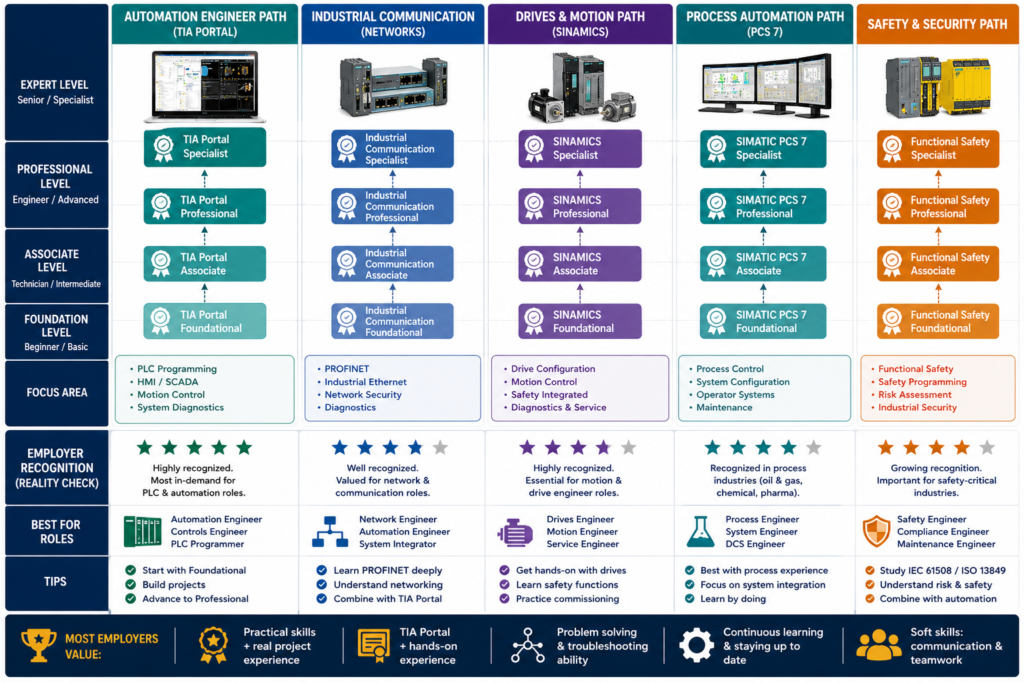
“Siemens certified” can mean several completely different things.
One candidate has completed a short online course. Another attended a five-day SITRAIN class. A third passed a practical examination and holds the formal title Siemens Certified Programmer in TIA Portal.
Those credentials do not carry the same weight.
Employers usually care less about the Siemens logo on a PDF and more about three questions:
- Was the training delivered or assessed by Siemens?
- Did you pass a genuine examination?
- Can you apply the knowledge on real equipment?
The strongest Siemens credentials support practical experience. They do not replace it.
The Main Siemens Training and Certification Options
| Path | Best suited to | Employer recognition |
|---|---|---|
| Siemens Certified Programmer in TIA Portal | PLC programmers and controls engineers | High for Siemens-focused programming roles |
| Certified Service Technician Level 1 | Maintenance and service technicians | High for troubleshooting roles |
| Certified Service Technician Level 2 | Advanced service and commissioning staff | High for senior service roles |
| Automation Engineer for SIMATIC Safety | Safety PLC programmers | Strong but specialised |
| SMSCP mechatronics certification | Students and junior technicians | Useful at entry level |
| SCE educational certificates | Students and self-learners | Useful supporting evidence |
| SITRAIN course-completion certificate | Anyone learning one Siemens product | Moderate; proves training, not full certification |
| Third-party Siemens course certificate | Beginners and self-learners | Depends heavily on the provider |
There is no single universal “Siemens PLC certification.” The correct path depends on whether you want to program systems, maintain them or specialise in safety.
1. Siemens Certified Programmer in TIA Portal
For someone seeking PLC programmer, controls engineer or automation engineer work, this is normally the most relevant Siemens credential.
The standard programming path is built around:
- TIA-PRO1
- TIA-PRO2
- TIA-PRO3
- Certification examination
The courses progress from the basic use of SIMATIC S7-1500 and TIA Portal to advanced program structures, function blocks, SCL, sequencing, diagnostics and HMI-related work. Siemens describes the three programming courses as preparation for certification as a Siemens Certified Programmer, based on the TIA Portal.
The examination is not merely a multiple-choice quiz. Current SITRAIN descriptions show that the candidate must work with SIMATIC S7 programming, TIA Portal and distributed I/O. One German examination format uses a practical plant model containing an S7-1500 controller, ET 200SP I/O, a touch panel, a SINAMICS drive and a conveyor model.
Who should take it?
This path makes sense when your target work includes:
- Developing complete PLC programs
- Designing reusable function blocks
- Creating machine sequences
- Integrating distributed I/O
- Supporting HMI development
- Commissioning new equipment
- Reviewing or standardising Siemens code
It is the most recognisable Siemens credential for a person marketing themselves primarily as a PLC programmer.
However, employers will still ask what you have actually programmed. A certificate cannot explain how you handled a failed sensor, unexpected power recovery or a machine that behaved differently from the simulation.
2. Siemens Certified Service Technician Level 1
The service path is more relevant to maintenance technicians, service engineers and people who troubleshoot existing equipment.
The Level 1 route is generally based on:
- TIA-SERV1
- TIA-SERV2
- Certified Service Technician Level 1 examination
Siemens describes TIA-SERV1 and TIA-SERV2 as the two courses preparing candidates for Level 1 certification. The training covers SIMATIC systems, hardware configuration, diagnostics, software troubleshooting, distributed I/O and related service tasks in TIA Portal.
This credential fits someone who needs to:
- Connect to an existing PLC
- Diagnose hardware and software faults
- Interpret diagnostic information
- Commission replacement devices
- Troubleshoot PROFINET-connected equipment
- Work safely with existing programs
- Restore systems from backups
For a factory maintenance technician, this path can be more useful than the programmer route.
A maintenance employer may care more about whether you can restore a failed remote-I/O station at 03:00 than whether you can design an elegant reusable software library from zero.
3. Siemens Certified Service Technician Level 2
Level 2 extends the service route into more advanced troubleshooting and commissioning.
The broader learning path generally includes:
- TIA-SERV1
- TIA-SERV2
- TIA-SERV3
- Level 1 and Level 2 assessments
Siemens states that TIA-SERV3 is the third course preparing candidates for Siemens Certified Service Technician Level 2. It includes commissioning, software debugging, error evaluation and diagnostics involving PLCs, distributed I/O and HMI systems.
Level 2 is most appropriate for:
- Senior maintenance technicians
- Field-service engineers
- Commissioning technicians
- Technical-support specialists
- People responsible for complex Siemens production equipment
This route signals deeper diagnostic capability than completing one introductory service course.
It still does not prove that you understand every machine, process or electrical system. It proves competence within a defined Siemens training and assessment framework.
4. Siemens Certified Automation Engineer for SIMATIC Safety
Siemens also offers a specialist certification for configuring and programming fail-safe controllers using SIMATIC Safety.
The assessment is aimed at programmers, commissioning engineers and engineering personnel. It evaluates knowledge of configuring and programming fail-safe systems, including S7-1500F-related work in TIA Portal.
This can be valuable for work involving:
- S7-1500F controllers
- Fail-safe I/O
- PROFIsafe
- Emergency-stop functions
- Guard monitoring
- Safety-related PLC logic
- Machine commissioning
However, this is a vendor-specific engineering credential. It should not be presented as proof that you alone are qualified to complete an entire machine risk assessment, determine the required Performance Level or SIL, validate every safety function or approve CE compliance.
Safety programming is only one part of functional safety.
The credential is strongest when combined with machine-safety standards knowledge, documented project experience and clearly defined validation responsibilities.
5. Siemens Mechatronic Systems Certification Program
The Siemens Mechatronic Systems Certification Program, usually shortened to SMSCP, is broader than a PLC-programming qualification.
It is delivered through approved partner schools and combines electrical, mechanical and automation knowledge using a systems-based troubleshooting approach. Only partner institutions that meet Siemens requirements can provide the associated certification examinations.
SMSCP is useful for:
- Vocational students
- Apprentices
- Entry-level maintenance technicians
- Mechatronics students
- People entering automated manufacturing
It can demonstrate that a beginner understands how mechanical, electrical and control elements interact.
It is not the same as being a Siemens Certified Programmer in TIA Portal. An SMSCP graduate may have strong mechatronic fundamentals but still need dedicated TIA Portal programming experience.
6. SCE Certificates and Educational Training
Siemens Automation Cooperates with Education, or SCE, provides educational material, training documents, learning systems and PLC exercises.
SCE resources can be excellent for learning:
- S7-1200 and S7-1500
- TIA Portal
- PLC programming
- HMI fundamentals
- Networking
- Drives
- Automation-system concepts
Siemens describes the SCE material as modular training content for educational institutions and self-study.
In the United States, SCE also offers Automation Fundamentals certificates at levels including Basics, Programmer, Troubleshooter and Advanced Automation. These are useful educational credentials, particularly for students and entry-level applicants.
However, free SCE study material does not automatically make someone a SITRAIN-certified programmer or service technician.
Use SCE to build skills and projects. Describe the completed modules accurately rather than upgrading them into a professional certification title.
Course Certificate vs Certification
This distinction matters on your CV.
After attending a SITRAIN course, you may receive proof that you completed the training. That is useful, but it does not necessarily mean you passed a certification examination.
Write:
SIMATIC Programming 1 in TIA Portal — SITRAIN
when you completed TIA-PRO1.
Write:
Siemens Certified Programmer in TIA Portal — SITRAIN
only when you passed the relevant certification assessment.
Similarly, a certificate from Udemy, a local training centre or another online provider proves that you completed that provider’s course. It is not an official Siemens certification unless the provider is delivering the authorised Siemens program and the credential is issued through the relevant Siemens structure.
Which Credentials Do Employers Actually Recognise?
Current job advertisements show that Siemens Certified Programmer is recognised, but it is usually preferred rather than universally required.
Recent PLC and controls listings have specifically named:
- Siemens Certified Programmer in TIA Portal
- Siemens or Allen-Bradley programming certifications
- Siemens certification as an advantage
- Vendor certification alongside commissioning and troubleshooting experience
For example, a recent Swisslog controls-software vacancy specifically listed Siemens Certified Programmer credentials, while other current automation advertisements treat Siemens certification as preferred supporting evidence.
Most employers still prioritise:
- Relevant Siemens platform experience
- Real PLC troubleshooting or programming
- Commissioning history
- Electrical and network knowledge
- Ability to work independently
- Certification
Certification becomes especially useful when:
- You have limited professional experience.
- Two candidates have otherwise similar backgrounds.
- The employer is a Siemens-focused system integrator.
- A customer or partner program values certified staff.
- You are moving from maintenance into programming.
- Your existing experience is difficult to demonstrate.
It becomes less important when one candidate has a certificate but no real projects, while another has successfully commissioned multiple S7-1500 systems.
Which Path Should You Choose?
Maintenance technician: Start with TIA-SERV1 and TIA-SERV2, then consider Service Technician Level 1.
Senior service or commissioning technician: Continue toward Service Technician Level 2.
PLC programmer or controls engineer: Follow the TIA-PRO1, TIA-PRO2 and TIA-PRO3 path toward Siemens Certified Programmer.
Safety PLC specialist: Add the SIMATIC Safety certification after gaining solid standard PLC experience.
Student or complete beginner: Use SCE material, an SCE certificate where available or SMSCP through a partner school.
Do not collect certificates without applying the material.
After every course, build or document something:
- A PLC sequence
- An HMI project
- A fault-diagnostic exercise
- A distributed-I/O configuration
- A drive integration
- A commissioning checklist
- A tested backup-and-restore procedure
Final Verdict
The Siemens credentials employers are most likely to recognise are the assessed SITRAIN qualifications:
- Siemens Certified Programmer in TIA Portal
- Siemens Certified Service Technician Level 1
- Siemens Certified Service Technician Level 2
- Siemens Certified Automation Engineer for SIMATIC Safety
SMSCP and SCE certificates are useful for students and entry-level candidates, while individual course-completion certificates show focused training.
The best credential is the one aligned with the job you actually want.
A maintenance technician does not automatically need the full programmer path. A PLC developer should not rely only on a basic service course. A safety credential should follow—not replace—strong standard automation fundamentals.
Employers recognise Siemens certification.
They promote and hire people who can use it when the machine is not behaving like the training model.