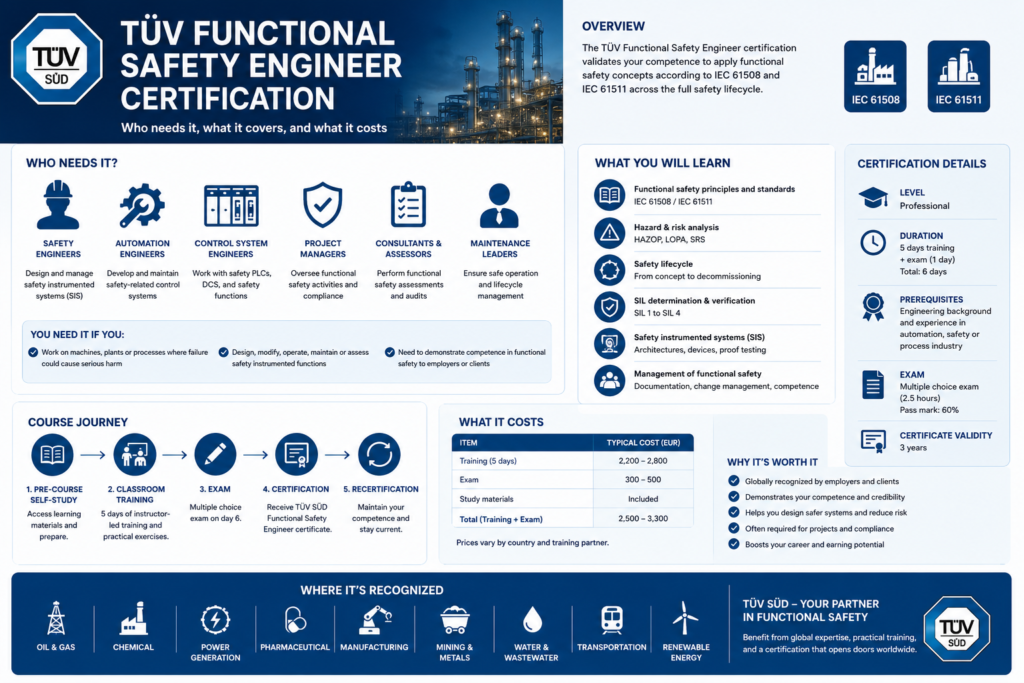
The TÜV Functional Safety Engineer certificate is one of the better-known safety qualifications in industrial automation.
It is also widely misunderstood.
Passing the course does not automatically make someone legally responsible for every safety system, qualified to approve an entire machine or competent to validate unfamiliar equipment alone. It is a personnel certification showing that the holder has completed an approved programme, passed an examination and met defined education and experience requirements within a particular functional-safety field.
For the right controls engineer, machine-safety specialist or consultant, it can be highly valuable.
For an ordinary maintenance technician who occasionally replaces safety relays, it may be an expensive qualification that sees little practical use.
There Is More Than One TÜV Certification
“TÜV certified” is not one universal credential.
Different TÜV organisations operate separate training and certification programmes. TÜV Rheinland’s programme awards titles such as:
- Functional Safety Engineer — Machinery
- Functional Safety Engineer — Safety Instrumented Systems
- Functional Safety Engineer — Hardware/Software Design
- Functional Safety Engineer — Process Hazard and Risk Analysis
- Automotive functional-safety qualifications
TÜV SÜD operates its own Functional Safety Certification Programme with Professional, Engineer and Expert levels.
These qualifications may cover related standards, but they are not the same certificate. Before registering, check:
- The issuing TÜV organisation
- The application area
- Standards covered
- Experience requirements
- Whether the examination is included
- Certificate validity and renewal requirements
For industrial machinery and factory automation, the relevant TÜV Rheinland route is normally Functional Safety of Machinery.
What the Machinery Course Covers
The machinery programme focuses on designing and demonstrating the safety of machine-control systems.
Typical subjects include:
- Machinery risk assessment
- Definition of safety functions
- Emergency-stop and guard-monitoring principles
- Safety-device selection
- Safety-related control architectures
- Performance Levels and Safety Integrity Levels
- Diagnostic coverage
- Common-cause failures
- Hardware reliability calculations
- Safety-related software
- Verification and validation
- Technical documentation
The TÜV Rheinland machinery course is based primarily on ISO 13849 and IEC 62061. Its current five-day format includes four training days followed by a three-hour examination containing multiple-choice and open questions.
The current international editions include ISO 13849-1:2023 and IEC 62061:2021, with IEC amendments consolidated through 2026. These standards address the design, integration and validation of safety-related machine-control systems.
This is not primarily a safety-PLC programming course. You may discuss safety controllers and application software, but the central subject is the complete safety lifecycle—not how to place an emergency-stop instruction into one particular manufacturer’s software.
Who Actually Needs It?
Machine-safety engineers
The certification is relevant when you regularly design or review safety-related control systems.
That may include determining how safety functions will be implemented, selecting architectures, calculating achieved Performance Levels and preparing validation evidence.
Senior controls engineers and system integrators
It becomes useful when your responsibility extends beyond standard PLC programming into:
- Safety PLC architecture
- Guarding-system integration
- Machine risk reduction
- Safety requirements
- Design reviews
- Validation planning
- Customer compliance documentation
A controls engineer who only receives an approved safety design and programs it under supervision may not need the full qualification immediately.
Functional-safety consultants
Consultants conducting machinery risk assessments, safety-system reviews or validation work benefit substantially from an externally recognised qualification.
Current vacancies confirm that employers recognise it in specialist roles. A recent Rockwell Automation functional-safety consultant position listed TÜV Functional Safety Engineer certification, or progress toward it, as preferred—but also required at least five years of controls or machine-safety experience.
ABB has similarly listed TÜV or equivalent Functional Safety Engineer or Professional certification as highly desirable alongside several years of relevant safety-engineering experience.
That combination is important:
Certification supports professional experience. It does not replace it.
Engineers working with safety instrumented systems
Process plants require a different path from machine builders.
Oil, gas, chemical, pharmaceutical and similar process industries commonly work with IEC 61508 and IEC 61511, Safety Integrity Levels, Safety Instrumented Functions and complete SIS lifecycle management.
Someone in that sector should choose a Safety Instrumented Systems course rather than the machinery programme. A machinery certificate does not automatically demonstrate SIS competence.
Who Probably Does Not Need It Yet?
The certificate may be unnecessary for:
- Junior automation technicians
- Electricians beginning PLC training
- Maintenance technicians who only replace approved safety components
- PLC programmers with no safety-design responsibility
- People looking for general machine-safety awareness
- Beginners with no practical industrial experience
A shorter machine-safety, risk-assessment or manufacturer-specific safety course may provide a better return initially.
TÜV Rheinland also offers Functional Safety Technician routes. These can be more suitable for technicians involved in installation, servicing and maintenance without full engineering-design responsibility.
Experience and Education Requirements
For the TÜV Rheinland FS Engineer certificate, candidates generally need:
- At least three years of practical professional experience in functional safety
- An engineering or other relevant technical university degree
- Attendance throughout the complete course
- A passing examination result
Candidates who do not yet have the required experience may attend the training and take the examination. When they pass, the certificate can be issued after they later obtain the necessary three years of functional-safety experience.
This means a beginner can complete the academic portion, but they should not assume they will immediately receive the full FS Engineer credential.
The certificate is also application-specific. Someone certified in machinery should not present themselves as TÜV-certified in automotive systems, process SIS design or safety-product development unless they hold the corresponding qualification.
What Does It Cost in 2026?
Prices vary by country, provider, format and certification scheme.
Current official examples include:
| Course example | 2026 advertised cost |
|---|---|
| TÜV Rheinland Germany, Machinery with exam | €2,690 plus VAT |
| TÜV Rheinland Germany, Machinery without exam | €2,390 plus VAT |
| Rockwell-delivered TÜV Rheinland machinery course with exam | €2,600 plus VAT |
| TÜV Rheinland North America, online machinery course with exam | $3,360 |
| TÜV Rheinland North America, course without exam | $2,960 |
The German fee includes the examination, course materials, lunch and refreshments. The required ISO 13849 and IEC 62061 standards must be brought separately, so access to the standards may add to the total cost.
The Rockwell-delivered version lists €2,600 plus VAT with the exam and €2,300 without it.
For the 2026 North American online programme, TÜV Rheinland lists $3,360 with the examination and $2,960 without it.
The real self-funded expense may also include:
- VAT
- Standards
- Travel
- Accommodation
- Meals
- Several days away from paid work
- Examination resits where necessary
A practical European budget can therefore exceed €3,000 even when the advertised course price is slightly lower.
Does the Certificate Expire?
The TÜV Rheinland FS Engineer certificate is valid for five years.
For the first extension, holders must provide evidence of continued work and functional-safety project experience in the certified application area. TÜV Rheinland currently lists the first five-year extension fee as €400. A later extension requires another examination and proof of continued experience.
This prevents the certificate from becoming a permanent title held by someone who stopped performing safety work years ago.
Is It Worth Paying for Yourself?
It is usually worth taking when:
- Your employer pays for it.
- You already design safety-related machine controls.
- You conduct risk assessments or validation.
- A target employer explicitly requests TÜV certification.
- You are moving into machine-safety consulting.
- Customers require evidence of specialist competence.
- The certificate supports an immediate promotion or responsibility increase.
Self-funding is harder to justify when you have little functional-safety experience and no opportunity to apply the material afterward.
A €2,500–€3,500 course is unlikely to transform a general maintenance CV by itself. The same money may initially produce more career value through PLC training, electrical qualifications, practical safety courses and real project experience.
What the Certificate Does Not Prove
Holding the qualification does not automatically prove that you can:
- Perform every type of machinery risk assessment
- Design any safety system without review
- Validate your own work independently
- Approve CE conformity alone
- Program every safety PLC platform
- Ignore local legal or company competency requirements
- Accept responsibility beyond your experience
Functional safety depends on competent people, defined lifecycle processes, suitable independence, accurate calculations, documented testing and correct application of relevant standards.
A certificate is one part of that evidence.
Final Verdict
The TÜV Functional Safety Engineer certificate is most valuable for experienced controls engineers, system integrators, machine-safety specialists and consultants who already carry meaningful responsibility for safety-related systems.
For machinery work, expect approximately €2,600–€2,700 plus VAT in Europe, or around $3,360 in North America, based on current 2026 TÜV Rheinland examples. Additional costs may include standards, travel and accommodation.
It is recognised by employers, but specialist vacancies usually request it alongside several years of practical experience—not instead of experience.
The best time to pursue it is when your work already includes:
Risk assessment → safety-function design → calculation → implementation → verification → validation
At that point, TÜV certification gives formal structure and external recognition to responsibilities you are already beginning to carry.