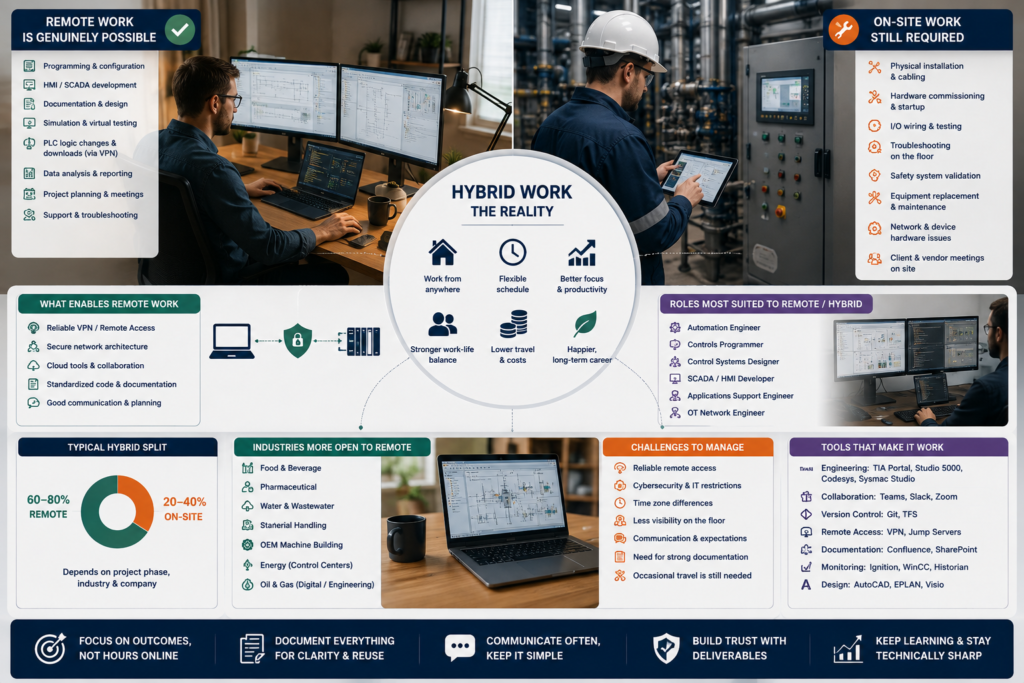
Industrial automation is a physical industry.
PLCs control real motors. Sensors detect real products. Servo drives move real machinery. When a conveyor jams or a safety gate will not reset, somebody eventually has to stand beside the equipment.
That does not mean automation engineers must work in a factory every day.
PLC development, SCADA engineering, documentation, remote support and software testing can often be completed from home. The realistic arrangement, however, is usually hybrid work with occasional site visits, not permanent remote work with zero contact with machinery.
Current job listings show fully remote roles in PLC support, SCADA, IIoT and control-system design, while field-service and commissioning positions are more commonly advertised as hybrid positions involving remote engineering plus customer travel.
What Can Be Done Remotely?
| Task | Remote suitability | Main limitation |
|---|---|---|
| Offline PLC programming | High | Requires accurate specifications and eventual machine testing |
| HMI and SCADA development | High | Field tags and graphics still need verification |
| Electrical design | High | Installation conditions must be checked |
| Documentation | Very high | Depends on receiving current project information |
| Remote troubleshooting | Moderate to high | Requires a capable person at the machine |
| Industrial networking | Moderate | Physical cables, switches and ports may need inspection |
| Factory acceptance testing | Moderate | Works best with simulation or remote test equipment |
| I/O commissioning | Low | Someone must activate and observe each field device |
| Safety validation | Low | Physical behaviour must be tested on site |
| Mechanical troubleshooting | Very low | Cameras and phone calls reveal only so much |
Offline PLC Programming
A large portion of PLC software can be written away from the machine.
An engineer can develop:
- Equipment function blocks
- Machine sequences
- Alarm logic
- Analogue scaling
- Recipe handling
- Communication interfaces
- Diagnostic routines
- HMI tags
- Simulation code
This works best when the engineer receives a complete package containing:
- Electrical drawings
- I/O list
- Functional specification
- Equipment descriptions
- Network architecture
- Safety requirements
- Motor and drive information
- Mechanical sequence
The problem is that project information is rarely perfect.
A drawing may show four sensors while the installed machine has five. A cylinder may take twice as long to move as expected. The customer may change the operating sequence after the software is already written.
Remote PLC development is therefore practical, but it usually ends with on-site commissioning or support from a competent local technician.
SCADA, HMI and Data Work
SCADA engineering is one of the most remote-friendly areas of industrial automation.
Remote tasks may include:
- Building process graphics
- Creating alarm structures
- Configuring historical trends
- Developing reports
- Managing tags
- Writing SQL queries
- Setting up OPC UA connections
- Creating dashboards
- Reviewing server architecture
- Testing user permissions
A current sample of remote vacancies includes Ignition SCADA development, oil-and-gas control-system support, IIoT engineering and remote PLC programming. Some positions still include field work or commissioning, but the main engineering workload can be performed away from the plant.
SCADA work becomes even more remote-friendly when the engineer supports several sites from a central operations centre.
The limitation is that displays must represent the real process accurately. A beautifully designed valve graphic is not useful when it is connected to the wrong PLC tag.
Remote Technical Support
Automation manufacturers, system integrators and large industrial companies employ remote-support engineers who assist customers through phone, video, diagnostic files and secure remote connections.
Rockwell Automation explicitly lists remote-support engineering among its application and field-engineering career paths.
A remote-support engineer may:
- Review PLC diagnostics
- Analyse drive fault histories
- Compare project versions
- Guide a technician through measurements
- Restore configuration files
- Review network information
- Explain fault codes
- Escalate suspected hardware failures
- Prepare corrected software
This arrangement works only when someone competent is physically present.
The on-site technician may need to:
- Measure voltage
- Observe LEDs
- Check motor direction
- Move a sensor
- Confirm air pressure
- Inspect a network cable
- Apply an isolation
- Test the repaired machine
A productive remote session sounds like this:
“Measure the voltage between terminal 24 and 0 V while the output is commanded.”
An unproductive session sounds like this:
“The machine is broken. Can you look at the PLC?”
Electrical Design and Project Engineering
Controls design can often be performed under a hybrid arrangement.
An engineer working from home may:
- Select control hardware
- Create schematics
- Prepare panel layouts
- Develop bills of materials
- Review contractor drawings
- Produce network diagrams
- Write functional specifications
- Prepare FAT and SAT documents
- Manage software revisions
Site visits are still needed to confirm dimensions, cable routes, environmental conditions and the state of existing equipment.
Hybrid design work is especially practical for experienced engineers who already understand plant installations. A junior engineer may need more time beside panels and machinery before being able to design reliably from drawings alone.
What Cannot Be Fully Remote?
Physical I/O Commissioning
Someone must activate every sensor and confirm that the correct PLC input changes.
Someone must command every output and verify that the intended device responds.
Remote engineers can monitor the program, but they cannot see whether:
- The wrong cylinder extends
- A motor rotates backwards
- A valve is physically stuck
- A sensor bracket is misaligned
- Two field cables have been exchanged
Safety-System Testing
Safety functions cannot be validated only by watching PLC tags remotely.
Guard doors, emergency stops, light curtains, safe drive functions and reset behaviour must be tested against the real machine and documented under the project’s safety process.
Remote support may assist with diagnosis, but physical testing and clearly assigned responsibility remain essential.
Mechanical Fault Finding
A video call can show a stationary conveyor.
It may not reveal:
- A seized bearing
- Incorrect chain tension
- Misalignment
- Intermittent vibration
- A loose coupling
- Product contact occurring only at full speed
The farther a problem moves from software and toward physical equipment, the less effective fully remote work becomes.
Remote Work Does Not Mean Remote Access to Everything
Connecting to an office computer is one thing. Connecting through the internet to equipment capable of moving machinery is another.
NIST describes OT as systems that interact with or directly change the physical environment, and its OT security guidance emphasises that safety, reliability and operational requirements must be considered alongside ordinary cybersecurity.
Remote PLC access can be extremely useful, but it also creates a route through which control logic could be viewed or modified. NIST has demonstrated how unprotected remote capabilities can enable unauthorised PLC downloads, logic changes and unexpected connections between control-system devices.
A responsible remote-access arrangement should include controls such as:
- Approved VPN or secure gateway
- Individual user accounts
- Multifactor authentication
- Time-limited access
- Permission from the site
- Activity logging
- Controlled engineering workstations
- Current backups
- An on-site contact
- A defined change and testing procedure
- Access removal when support ends
A PLC should not be exposed directly to the public internet because an engineer wants a more convenient home-office setup.
NIST released additional final guidance specifically addressing OT remote-access architecture in June 2026, reflecting how important secure remote support has become in industrial environments.
Why Experience Matters More in Remote Roles
Remote work often requires greater independence, not less.
An employer cannot easily place a senior technician beside you whenever the problem becomes confusing. You may need to understand:
- PLC software
- Electrical circuits
- SCADA
- Networking
- Windows systems
- Databases
- Customer communication
- Change control
- Remote-access security
That is why many genuinely remote industrial-automation jobs are aimed at experienced engineers.
Entry-level remote SCADA roles do exist, but fully remote beginner PLC roles are less convincing because new technicians need exposure to real wiring, devices and machine behaviour. A current vacancy sample includes junior remote SCADA work, while remote PLC-support listings commonly request experienced control-system engineers.
The Most Realistic Career Paths
The best routes toward remote or hybrid automation work are:
SCADA and IIoT engineer
Focus on Ignition, WinCC, FactoryTalk, OPC UA, SQL, historians and reporting.
Remote support engineer
Build strong diagnostic knowledge around one manufacturer or product family.
Controls design engineer
Develop PLC software, electrical designs and project documentation remotely, then attend commissioning when required.
OT network or cybersecurity engineer
Work with managed networks, remote access, segmentation, firewalls, asset management and secure plant connectivity.
Application engineer
Support customers through system design, software demonstrations, troubleshooting and occasional site visits.
Automation contractor
Complete offline development from home and travel to customers for installation, testing and startup.
Read “Remote” Job Advertisements Carefully
A role described as remote may still require:
- 20% to 50% travel
- Several weeks at a customer site
- Factory acceptance testing
- Weekend commissioning
- Residence within a specific country
- Work during the customer’s time zone
- Emergency remote support
- Occasional office attendance
Also search carefully. The title automation engineer is frequently used for software-test automation rather than industrial controls.
Use terms such as:
- Remote PLC engineer
- Remote SCADA engineer
- Controls engineer with travel
- OT engineer
- Industrial network engineer
- Remote support engineer
- Ignition developer
- Control-system application engineer
Final Verdict
Fully remote industrial-automation work is genuinely possible, particularly in:
SCADA, software development, technical support, documentation, system design, IIoT and IT/OT engineering.
Hybrid work is more common for traditional controls engineering:
Program at home → review remotely → travel for commissioning → provide remote support afterward.
Maintenance technicians, field-service engineers and commissioning staff will still spend substantial time beside real machinery.
The more your work depends on software, data and design, the easier it is to perform remotely.
The more it depends on wiring, movement, safety and physical verification, the more likely somebody needs to be standing in the plant.
Remote work has reached industrial automation.
It has not yet invented a way to tighten a loose terminal through Microsoft Teams.