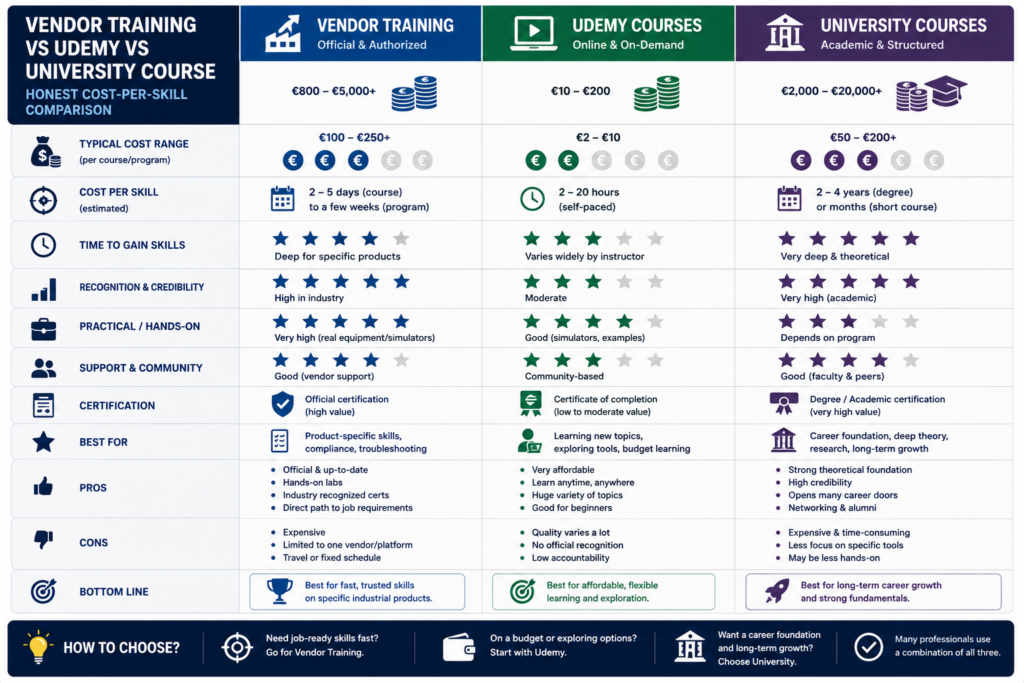
Industrial automation training ranges from inexpensive online videos to vendor courses costing several thousand euros. At the other end sits university education, which may require years of study and a much larger total investment.
The obvious question is: which option gives you the most useful skill for your money?
There is no universal winner. Vendor training, Udemy courses, and university programmes solve different problems. The best choice depends on whether you need to troubleshoot one PLC platform next month, enter the automation industry, or build an engineering career that may eventually extend beyond PLC programming.
A fair comparison must include more than the advertised fee. You also need to count study time, software access, hardware requirements, instructor support, recognition by employers, and how much of the material you will actually use.
Vendor Training: Expensive but Highly Specific
Vendor training is delivered by manufacturers such as Siemens, Rockwell Automation, Beckhoff, Schneider Electric, Omron, Mitsubishi Electric, or their authorised training partners.
These courses usually focus on a particular product family and job task. A Siemens course might teach programming an S7-1500 in TIA Portal. A Rockwell course might cover ControlLogix troubleshooting, FactoryTalk View development, EtherNet/IP configuration, or GuardLogix safety applications.
The largest advantage is focus. You are not paying for a broad introduction to computing or electrical engineering. You are paying to work through the tools, terminology, hardware, and recommended methods used on a particular platform.
The price reflects that specialisation. As current examples, Rockwell Automation’s UK calendar lists remote introductory Logix courses at £981 and longer remote troubleshooting or project-development courses at £1,638. Its accelerated Logix5000 programmer certificate course is listed at £2,306 remotely, while some classroom options exceed €3,000.
A five-day Siemens TIA Portal Programming 1 course in Poland was listed at 4,500 PLN before tax, while a specialised three-day Siemens online course in Germany was listed at €1,860 before tax.
That is a high cost per training day. However, cost per day is not the same as cost per useful skill.
Suppose a company already uses ControlLogix and sends a maintenance engineer on an official troubleshooting course. If that engineer later shortens one production breakdown by several hours, the course may recover a meaningful part of its cost.
Vendor training offers the best value when:
- You already work with that manufacturer’s equipment
- Your employer pays for the course
- You need a specific skill immediately
- You have enough experience to understand the material
- The course includes realistic exercises or hardware access
It offers weaker value when you are unemployed, uncertain which PLC brand to learn, or paying personally without access to the software afterward.
A five-day course cannot turn a complete beginner into an independent controls engineer. It can provide a structured route through the platform, but real competence still requires project work and troubleshooting experience.
Udemy: Lowest Financial Risk
Udemy and similar online marketplaces sit at the opposite end of the price range.
The main advantage is accessibility. You can explore ladder logic, TIA Portal, Studio 5000, HMI development, SCADA, industrial networking, electrical drawing, or Python without committing thousands of euros.
Udemy uses country-specific pricing, and marketplace prices can vary according to location and current offers. Individual course purchases provide continuing access while the course remains available under the platform’s terms. Udemy also offers subscription access to selected content.
The financial risk is therefore low. Buy one suitable course, install a simulator or trial package, and find out whether the subject interests you.
However, low price does not automatically mean good value.
A €15 course that you never finish has produced no usable skill. A course that teaches you to copy an instructor’s program without understanding it may create false confidence. Some automation courses also use outdated software versions, skip electrical fundamentals, or show only perfect examples without realistic faults.
The best Udemy courses provide:
- A complete project rather than disconnected lectures
- Downloadable exercises
- Explanations of why the logic works
- Fault-finding examples
- HMI and PLC integration
- Manual and automatic operating modes
- Assignments that require independent work
Udemy offers excellent cost per skill when you treat the course as a starting point rather than the complete education.
For every hour spent watching, spend another hour building something. Change the sequence. Add an alarm. Break the communication. Simulate a failed sensor. Then explain how the program responds.
Without this extra work, you may finish twenty hours of video and still be unable to start an empty PLC project.
University: Highest Time Commitment, Broadest Foundation
A university engineering course is not simply an expensive PLC class.
Its purpose is broader. Depending on the programme, you may study mathematics, circuit analysis, electronics, control theory, programming, signals, power systems, project management, communication, and engineering design.
This creates an important distinction. A university degree may have poor cost per immediate PLC skill but strong cost per long-term engineering capability.
As one current reference point, The Open University lists a typical 60-credit module fee of £4,088. Its part-time MSc in Engineering requires 180 credits and normally takes three years at approximately 16–20 study hours per week.
A student could spend months studying mathematical modelling or engineering analysis without learning how to replace a failed PROFINET device. That may appear inefficient to someone who needs practical maintenance skills.
However, the university student may develop a stronger understanding of feedback control, system behaviour, signal processing, electrical principles, research, documentation, and structured problem-solving.
University education also provides a recognised qualification. This matters for employers that require an engineering degree, regulated career routes, postgraduate study, or future progression into design, management, consulting, or specialised engineering.
University offers the best value when:
- You need a recognised engineering qualification
- You want broad career options
- Employers in your target market require a degree
- You are interested in theory as well as practical work
- Grants, public funding, or employer support reduce your cost
It offers weaker value if your only goal is to learn one PLC platform quickly.
The Hidden Costs People Ignore
Course fees are only one part of the comparison.
Vendor training may require travel, accommodation, time away from work, and continued access to expensive software. A course can teach Studio 5000 effectively, but practising afterward may be difficult if you do not have a licence or suitable hardware.
Udemy has a different hidden cost: unstructured time. You may spend weeks comparing courses, installing software, solving compatibility problems, and watching repeated beginner material.
University has the largest opportunity cost. Several years of assignments and examinations represent thousands of study hours. That may be worthwhile, but it should not be described as the fastest way to become productive with PLCs.
Completion probability matters as well. Instructor-led vendor training places you in a scheduled environment with defined exercises. University provides deadlines, tutor support, and assessment. Self-paced online learning is flexible, but that flexibility makes it easy to postpone.
Honest Cost-per-Skill Verdict
For learning one specific PLC platform, Udemy normally provides the lowest initial cost. It is the sensible place to begin when you are paying personally and still exploring automation.
For becoming productive on equipment already used by your employer, vendor training may provide the fastest return. Rockwell’s certificate routes, for example, combine multiple practical courses with assessment and are specifically designed around Logix, drives, or motion competencies.
For building a long-term engineering career, university offers the widest foundation and the strongest formal credential. It is also the slowest and most expensive route if judged only by how quickly it teaches practical PLC programming.
The most effective approach is often a combination.
Start with an affordable online course to learn the interface and basic logic. Build two or three serious simulation projects. Use vendor training when you begin working with a specific platform and can apply the material immediately. Choose university education when the qualification and engineering foundation support your longer-term career goals.
Do not select training based only on the number of video hours, the prestige of the provider, or the certificate displayed at the end.
Ask a more practical question:
What will I be able to design, program, test, or troubleshoot after completing this training that I cannot do today?
That answer tells you far more about value than the course price alone.