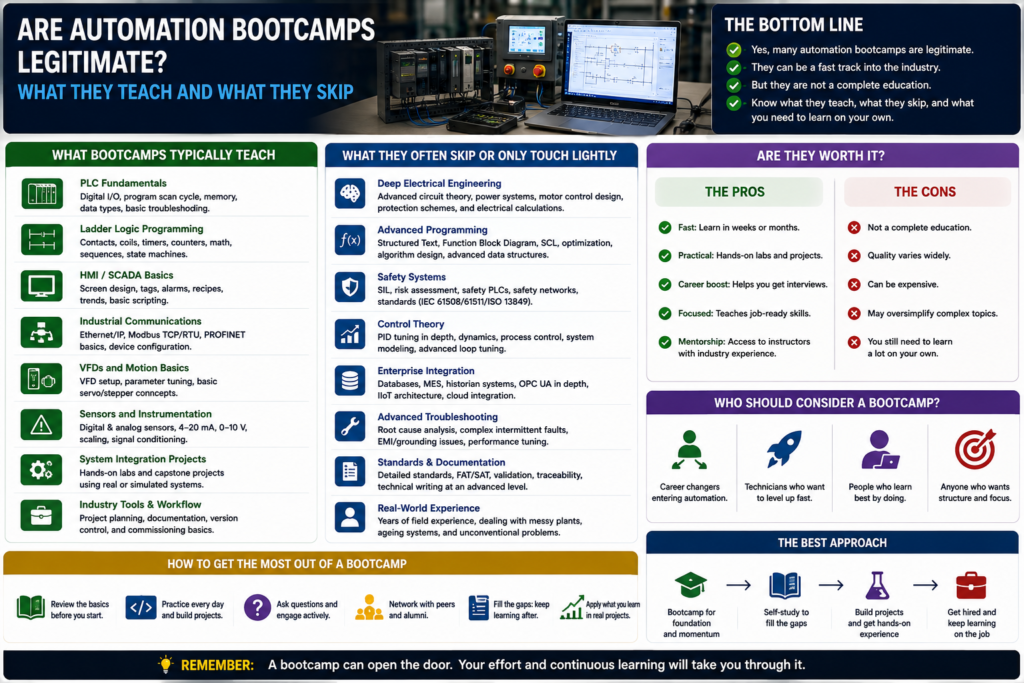
Automation bootcamps can be legitimate, useful training programmes. They can also be ordinary collections of recorded videos wrapped in aggressive marketing and promises of becoming a “job-ready automation engineer” within a few weeks.
The word bootcamp does not represent one recognised qualification or standardised curriculum. One programme may include instructor support, real hardware, assessed projects, and troubleshooting exercises. Another may simply bundle several online courses and issue a certificate after the videos are completed.
The right question is not whether automation bootcamps are legitimate as a category. It is whether a particular bootcamp teaches useful skills at a reasonable price—and whether its promises match what can realistically be achieved.
What Automation Bootcamps Usually Teach
Most PLC and industrial automation bootcamps begin with fundamental electrical and control concepts.
A typical curriculum may include:
- Industrial sensors and actuators
- Electrical schematic reading
- Digital inputs and outputs
- Ladder Logic and Function Block Diagram
- Timers, counters, comparisons, and arithmetic
- PLC hardware configuration
- HMI and SCADA development
- Industrial communication protocols
- VFD or servo control
- Basic troubleshooting
Some programmes also introduce Structured Text, Python, OPC UA, databases, robotics, or industrial networking.
For example, one current commercial PLC bootcamp advertises 79 hours of training across Siemens ladder programming, HMI and SCADA, Modbus, PROFINET, OPC UA, Structured Control Language, motion control, electrical diagrams, and Python. It includes project-based lessons and separate completion certificates for its modules.
That is a substantial syllabus. However, covering a topic is not the same as developing professional competence in it.
A learner might understand what PROFINET does after a lesson without being able to diagnose an intermittent network fault in a production plant. They may create an HMI screen without knowing how to design alarms that operators can use during a real breakdown.
What Good Bootcamps Do Well
A good bootcamp provides structure.
Instead of jumping randomly between YouTube videos, students follow a planned progression from basic logic to complete machine projects. This is particularly valuable for career changers who do not know what they need to learn.
The strongest programmes also make students build systems rather than merely watch demonstrations. A practical introductory PLC course offered by the UK Manufacturing Technology Centre, for example, finishes with students designing, building, and programming an industrial conveyor control project. It also includes ladder logic, function blocks, HMI basics, and fault-finding.
Projects should include more than a perfect automatic sequence. Students need to practise manual controls, interlocks, alarms, actuator timeouts, invalid sensor combinations, communication failures, and recovery after interruption.
Instructor access can also make a major difference. A capable instructor can explain why a program behaves unexpectedly, review the student’s architecture, and identify unsafe or unreliable logic before it becomes a habit.
For someone who struggles with unstructured self-study, this support may justify paying considerably more than the cost of an ordinary video course.
What Bootcamps Commonly Skip
The largest weakness is usually physical experience.
Simulation can teach logic, sequencing, HMI development, and program structure. It cannot fully reproduce loose terminals, damaged cables, electrical noise, incorrect sensor wiring, failing contactors, voltage drops, mechanical jams, or devices that behave differently from their manuals.
Real automation work also involves commissioning. Current entry-level commissioning roles may combine PLC and HMI programming with hardware and software commissioning, electrical verification, equipment adjustments, technical support, and documentation.
These responsibilities are difficult to compress into an online bootcamp.
Bootcamps may also give limited attention to:
- Electrical panel design and protection
- Machine safety and risk assessment
- Lockout and safe testing procedures
- Software version control
- Factory and site acceptance testing
- Customer communication
- Quoting and project scope
- Legacy PLC systems
- Maintenance under production pressure
- Formal engineering theory
Safety is particularly important. Learning how to create an emergency-stop status bit in a simulated PLC is not the same as designing or validating a safety function.
A responsible bootcamp should clearly explain where ordinary PLC training ends and safety engineering begins.
A Certificate Is Not the Main Outcome
Most bootcamp certificates only confirm that the learner completed the provider’s programme. They should not automatically be treated as equivalent to a university qualification or an assessed manufacturer certification.
Official vendor certificate programmes may require a defined series of courses, practical exercises, and a final assessment. Rockwell Automation’s Logix, Drives, and Motion certificate programmes follow that model.
Some Siemens SITRAIN certifications also include both theoretical and practical examinations. One current programme uses a practical TIA Portal system containing an S7-1500 PLC, distributed I/O, HMI, drive, and conveyor model.
A bootcamp certificate can still be useful on a junior applicant’s CV, but the accompanying project evidence matters more.
Employers will want to know what you programmed, how you tested it, which faults you introduced, and whether you can explain your decisions.
Warning Signs
Be cautious when a bootcamp:
- Guarantees employment without explaining the conditions
- Claims complete beginners will become senior engineers
- Uses permanent countdown timers or enormous artificial discounts
- Calls its certificate “industry recognised” without naming who recognises it
- Provides no detailed syllabus
- Does not identify the instructors
- Shows no sample lessons or student projects
- Avoids explaining software and hardware requirements
- Covers many PLC brands in very little time
- Teaches only by copying completed programs
“Learn Siemens, Allen-Bradley, robotics, SCADA, motion control, safety, networking, and cybersecurity in four weeks” is not a credible path to mastery.
A beginner may receive a useful introduction to those subjects, but independent professional ability requires substantially more practice.
How to Evaluate a Bootcamp
Before enrolling, ask to see the complete curriculum and at least one substantial project.
Confirm whether the programme includes live instruction, individual feedback, assessments, hardware access, software licences, downloadable files, and technical support.
Check whether students create projects from an empty program or simply follow the instructor click by click.
A strong final project should contain manual and automatic modes, interlocks, alarms, HMI screens, fault simulation, program documentation, and a test procedure. It should be something the student can demonstrate during an interview.
Also investigate the instructor’s background. Practical experience commissioning, maintaining, or integrating industrial equipment is more relevant than a large social-media audience.
The Honest Verdict
Automation bootcamps are legitimate when they provide structured, technically accurate, project-based education and make realistic claims about the outcome.
They can help a student, electrician, maintenance technician, or career changer build a foundation faster than completely unstructured self-study.
They cannot replace years of field experience, a full engineering education, or the judgement developed while commissioning and troubleshooting real machinery.
The best bootcamp does not promise to turn you into an automation engineer overnight. It gives you enough structure, practice, and feedback to become a stronger beginner—and enough project evidence to compete for an entry-level opportunity.