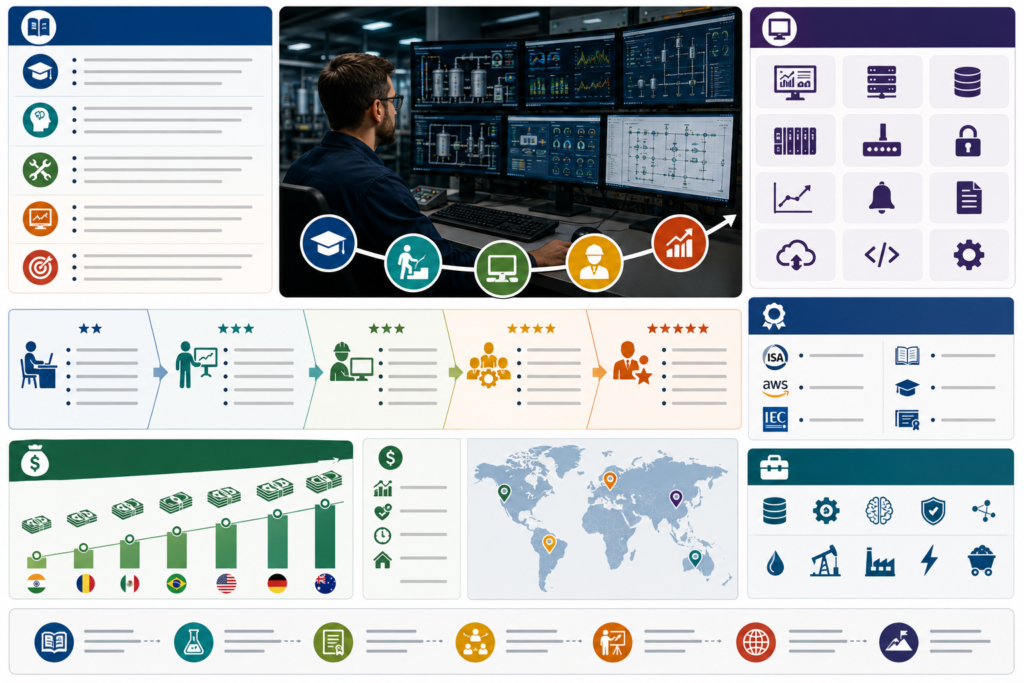
A SCADA engineer develops and supports systems that allow operators to monitor industrial processes, view alarms, analyse trends, and control equipment from a central interface.
SCADA stands for Supervisory Control and Data Acquisition. These systems are used in manufacturing, water treatment, power generation, renewable energy, oil and gas, transportation, data centres, and other critical infrastructure.
The job sits between industrial automation and information technology. A SCADA engineer may work with PLCs and field instruments one day, then databases, servers, user accounts, and network security the next.
What Does a SCADA Engineer Actually Do?
The responsibilities depend heavily on the industry.
A factory-based engineer might create HMI screens, configure alarms, collect production data, troubleshoot PLC communication, and support machine commissioning.
A water or electricity utility may operate hundreds of remote sites. Its SCADA engineers work with remote terminal units, radio or cellular communication, telemetry, redundant servers, and control centres.
Typical responsibilities include:
- Developing HMI and SCADA screens
- Configuring tags, alarms, trends, and historians
- Connecting PLCs, RTUs, meters, and instruments
- Troubleshooting communication problems
- Managing SCADA servers and databases
- Creating user accounts and access levels
- Supporting commissioning and system upgrades
- Maintaining backups and technical documentation
- Applying software patches
- Working with IT and operational technology teams
Current SCADA service roles can involve supporting several platforms, performing remote and on-site troubleshooting, managing patches, upgrading existing installations, and communicating directly with operators and plant managers.
The Most Common Route Into SCADA
Many SCADA engineers begin in another industrial role.
Common starting positions include:
- PLC programmer
- Automation technician
- Electrical engineer
- Instrumentation technician
- Controls engineer
- Systems integrator
- Industrial IT technician
- SCADA operator
A maintenance technician may begin by diagnosing PLC and HMI faults. A PLC programmer may gradually take responsibility for alarms, trends, data collection, and server-based applications. An IT specialist may enter through Windows servers, networking, virtualization, and cybersecurity.
A relevant engineering or technical degree can help, but practical experience often matters just as much. Current controls roles frequently ask for both SCADA software knowledge and hands-on experience with PLCs, panel wiring, field I/O, instrumentation, commissioning, and troubleshooting.
Skills You Need First
Begin with industrial automation fundamentals.
You should understand:
- Digital and analog PLC signals
- Ladder Logic or Structured Text
- Sensors, motors, valves, and VFDs
- Electrical drawings and I/O lists
- Interlocks and machine sequences
- Alarm conditions
- Industrial communication protocols
You do not need to become an expert PLC programmer before learning SCADA, but you must understand where the displayed data comes from.
When a screen shows that a pump is stopped, you should know how to determine whether the issue is the SCADA command, PLC logic, communication link, drive, field wiring, or pump itself.
Learn One Major SCADA Platform
Do not try to master every platform at once.
Popular systems include:
- Inductive Automation Ignition
- Siemens WinCC
- Rockwell FactoryTalk View
- AVEVA System Platform, formerly Wonderware
- GE Vernova iFIX
- VTScada
- Schneider Electric EcoStruxure systems
- COPA-DATA zenon
Ignition is a practical learning choice because it combines HMI development, alarming, historians, databases, scripting, reporting, and web-based visualization.
Siemens WinCC is useful when working in a Siemens-heavy environment. FactoryTalk is common alongside Allen-Bradley controllers. AVEVA, iFIX, and VTScada remain widely used in existing industrial installations. Current SCADA vacancies frequently mention several of these platforms rather than requiring one universal system.
Once you understand tags, alarms, templates, trends, scripting, security, and communication on one platform, learning another becomes easier.
Add Networking and Data Skills
This is where a SCADA engineer begins to differ from a traditional PLC programmer.
Learn the fundamentals of:
- IP addressing and subnetting
- Ethernet switches and firewalls
- OPC UA
- Modbus TCP
- EtherNet/IP and PROFINET
- MQTT
- SQL databases
- Windows Server
- Virtual machines
- Redundant servers
- Backup and recovery
Basic SQL is especially valuable. You should be able to retrieve production records, investigate missing data, and understand how a historian or reporting system stores information.
Python, Java, C#, PowerShell, or platform-specific scripting can help with data processing, automation, reporting, and integration. You do not need to become a full-time software developer, but stronger programming skills expand the projects you can handle.
Do Not Ignore Cybersecurity
Modern SCADA systems are often connected to plant networks, remote sites, business systems, and cloud services.
Learn about:
- Network segmentation
- Least-privilege access
- User authentication
- Secure remote access
- Patch management
- Application allow-listing
- Backup testing
- Logging and audit trails
- IT and OT responsibilities
Cybersecurity does not mean installing updates blindly. A patch that is safe on an office computer may disrupt an unsupported industrial application. Changes need testing, backups, rollback plans, and coordination with production.
Current SCADA service roles increasingly combine system support with industrial networking and operational-technology cybersecurity.
Build a SCADA Portfolio
A useful portfolio project might simulate a water pumping station, production line, energy system, or batch process.
Include:
- PLC or simulated data source
- Overview and equipment screens
- Alarm priorities and acknowledgement
- Historical trends
- User access levels
- SQL data storage
- Reports or production calculations
- Communication-loss detection
- Server backup procedure
- Network diagram
Do not only show attractive graphics. Explain what happens when a PLC disconnects, a value becomes invalid, the database stops responding, or an operator enters an incorrect setpoint.
Reliability and diagnostics are more impressive than animation.
A Realistic Career Progression
A typical path might be:
Junior SCADA or controls engineer: Builds screens, creates tags, tests alarms, and assists with commissioning.
SCADA engineer: Develops complete applications, integrates PLCs, manages servers, troubleshoots networks, and works directly with customers or operators.
Senior or lead SCADA engineer: Designs system architecture, manages redundancy and cybersecurity, develops standards, reviews projects, and leads commissioning.
SCADA architect or OT specialist: Designs large multi-site systems, migrations, data infrastructure, remote access, and long-term technology strategies.
Other progression routes include project management, OT cybersecurity, industrial data engineering, control-system consulting, or engineering management.
What Does a SCADA Engineer Earn?
Pay varies significantly by country, industry, travel, on-call requirements, and whether the role is mainly HMI programming or full OT infrastructure engineering.
As of August 2026, ZipRecruiter estimates average US PLC/SCADA engineer pay at approximately $97,700 per year, with most reported salaries between roughly $80,000 and $119,000.
Indeed reports an average of approximately £50,400 per year for SCADA engineers in the United Kingdom, while vacancy analysis from IT Jobs Watch reports a higher median of £67,500. Different methodologies and job mixes explain part of that gap.
A current SCADA and communications engineering vacancy in Vilnius listed a gross monthly range of €3,050 to €4,570. Experienced European specialists working on Ignition, AVEVA, renewable-energy, or data-centre projects may see offers approaching €70,000–€80,000 annually, particularly when significant travel is involved.
The highest pay usually goes to engineers who combine SCADA development with PLC knowledge, networking, servers, databases, cybersecurity, commissioning, and responsibility for critical systems.
The Honest Verdict
SCADA engineering is a strong career for someone who enjoys both industrial equipment and computer systems.
The fastest route is usually to build solid PLC and electrical fundamentals, learn one major SCADA platform, and then add networking, SQL, servers, and cybersecurity.
Knowing how to draw an HMI screen may get you started. Knowing how to keep a complete industrial monitoring and control system reliable, secure, diagnosable, and recoverable is what makes you valuable.