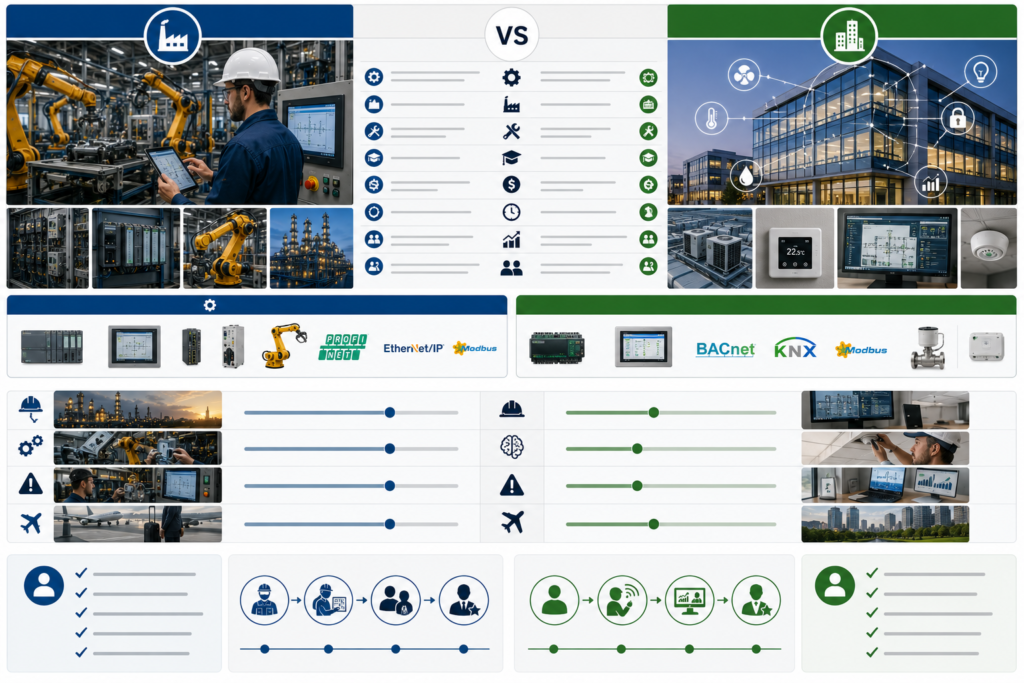
Building automation and industrial automation use similar control principles, but they solve different problems.
A building-management system controls services such as heating, ventilation, air conditioning, lighting, energy monitoring, and sometimes access or fire-system interfaces. Industrial automation controls machinery and production processes such as conveyors, packaging lines, robots, pumps, mixing systems, and assembly equipment.
Both careers involve controllers, sensors, communication networks, software, commissioning, and troubleshooting. The better choice depends less on which field is “more advanced” and more on the equipment, environment, and type of pressure you prefer.
What Building-Automation Engineers Control
A BMS engineer or technician mainly works with commercial and institutional buildings, including offices, hospitals, laboratories, data centres, hotels, shopping centres, and universities.
Typical controlled equipment includes:
- Air-handling units
- Chillers and boilers
- Pumps and fans
- Variable-air-volume boxes
- Heat pumps
- Room temperature controls
- Lighting systems
- Energy meters
- Indoor-air-quality sensors
Modern BMS roles combine HVAC knowledge with software configuration, network integration, graphics, alarms, schedules, trends, and energy optimisation. Current job descriptions regularly request experience with platforms such as Tridium Niagara, Johnson Controls Metasys, Siemens Desigo, and protocols including BACnet and Modbus.
A large part of the job is understanding how a building should behave. You may need to determine why a room is too hot, why a chiller starts unnecessarily, or why an air-handling unit uses excessive energy.
The problem may involve software, but it could also be a stuck damper, incorrect temperature sensor, leaking valve, failed actuator, badly designed sequence, or mechanical HVAC problem.
What Industrial-Automation Engineers Control
Industrial automation is centred on production machinery and processes.
Typical equipment includes:
- Conveyors
- Packaging machines
- Industrial robots
- Assembly systems
- Filling and mixing equipment
- VFDs and servo drives
- Production lines
- Water-treatment systems
- Process plants
The main tools are usually PLCs, HMIs, SCADA systems, industrial networks, drives, robots, and safety-control equipment.
Current industrial automation positions commonly require PLC and HMI programming, commissioning, communication integration, electrical troubleshooting, testing, and production support. Siemens roles, for example, combine PLC, HMI, SCADA, robotics, motion control, startup, and on-site fault-finding.
The central question is often not whether a building is comfortable, but whether a machine can complete its cycle safely and reliably.
A production line may stop because of a failed sensor, mechanical jam, missing PLC interlock, drive fault, robot alarm, network problem, or damaged cable. Every minute of downtime may have a visible production cost.
The Programming Is Different
Building automation commonly uses Direct Digital Control controllers and graphical programming tools. The software is often based around HVAC sequences, schedules, setpoints, alarms, and equipment coordination.
You may write logic such as:
- Start ventilation according to occupancy
- Maintain supply-air temperature
- Alternate duty and standby pumps
- Reset pressure according to demand
- Reduce energy consumption overnight
- Disable heating when windows are open
Industrial automation more often uses IEC 61131-3 languages such as Ladder Diagram, Function Block Diagram, and Structured Text.
The logic may involve fast machine sequences, product tracking, motion, recipes, safety permissions, actuator timeouts, and precise coordination between several machines.
BMS programming is not automatically easier. A large hospital or data centre can have thousands of points, complicated plant sequences, redundancy, energy targets, and integration between several contractors. However, the logic is generally slower and more focused on continuous environmental control than high-speed machine movement.
Working Environment and Travel
BMS work is often performed in occupied buildings, plant rooms, rooftops, electrical rooms, and construction sites.
You may work around mechanical contractors, electricians, commissioning agents, consultants, and facility managers. Customer communication is important because the people reporting problems may not have controls knowledge.
Some BMS roles offer relatively predictable daytime work and limited travel, especially when you are permanently assigned to one large site. One current Johnson Controls position, for example, advertises weekday daytime hours, limited travel, and work primarily at one facility. Other project roles can require significant site travel and commissioning work.
Industrial automation can be less predictable.
Factory-based automation technicians may work shifts, support night breakdowns, and participate in weekend shutdowns. Engineers employed by integrators or machine builders may travel nationally or internationally for commissioning.
Industrial sites are generally noisier, faster-moving, and more production-driven. When a line stops, several managers may immediately want to know when it will restart.
BMS has pressure too. A failed control system in a hospital, laboratory, pharmaceutical facility, or data centre can be critical. The pressure is simply connected to building operation, temperature, air quality, or essential services rather than product output.
Which Skills Matter Most?
Building automation suits people interested in:
- HVAC and mechanical systems
- Energy efficiency
- BACnet and building networks
- Graphical interfaces and trends
- Long-term system optimisation
- Working with facility teams
- Commercial buildings and construction projects
Industrial automation suits people interested in:
- PLC programming
- Electrical troubleshooting
- Machine sequences
- Motors, VFDs, and servo systems
- Robots and motion control
- Production processes
- Fast breakdown diagnosis
BMS technicians need enough mechanical understanding to know how chillers, boilers, pumps, dampers, valves, and air-handling systems should operate. Current technician positions frequently combine controls work with point-to-point testing, HVAC troubleshooting, preventive maintenance, commissioning, and drawing interpretation.
Industrial automation technicians usually need stronger knowledge of machine electrical systems, PLC logic, sensors, actuators, safety circuits, and production sequences.
Both careers increasingly require IP networking, cybersecurity awareness, system backups, documentation, and communication with non-technical customers.
Which Field Is Easier to Enter?
Electricians and HVAC technicians often have a natural route into building automation. They already understand wiring, heating systems, mechanical equipment, and site work.
Maintenance technicians, PLC programmers, machine electricians, and instrumentation technicians often transition more naturally into industrial automation.
Formal engineering education helps, but technician-level positions in both fields may accept technical-school qualifications combined with relevant practical experience. Current BMS vacancies list backgrounds including HVAC, electrical, electronics, instrumentation, and mechanical engineering technology.
The easiest field to enter is usually the one where you can obtain real equipment access and experienced supervision.
Can You Switch Later?
Many skills transfer between the two fields.
Both use sensors, analog signals, controllers, networks, alarms, trends, electrical drawings, and commissioning procedures. Someone experienced with Modbus, BACnet/IP, control loops, and field troubleshooting already has useful foundations for industrial control.
However, switching still requires filling gaps.
A BMS engineer moving into industrial automation may need to learn PLC architecture, machine safety, faster sequences, servo control, and production commissioning.
An industrial automation engineer entering BMS may need to learn HVAC fundamentals, BACnet object structures, building specifications, energy optimisation, and the major BMS software platforms.
The Honest Verdict
Choose building automation when you enjoy HVAC, energy management, large building systems, customer interaction, and slower processes that must operate efficiently over months or years.
Choose industrial automation when you enjoy machinery, PLC logic, electrical fault-finding, production processes, robots, and solving urgent equipment problems.
Neither career is universally better. A complex data-centre BMS can be more demanding than a simple conveyor, while an integrated robotic production line can be far more complicated than a small office-building control system.
Look at the employers near you before choosing. The best career path is usually the one that gives you access to real systems, practical training, and progressively more responsibility—not simply the one with the more impressive job title.