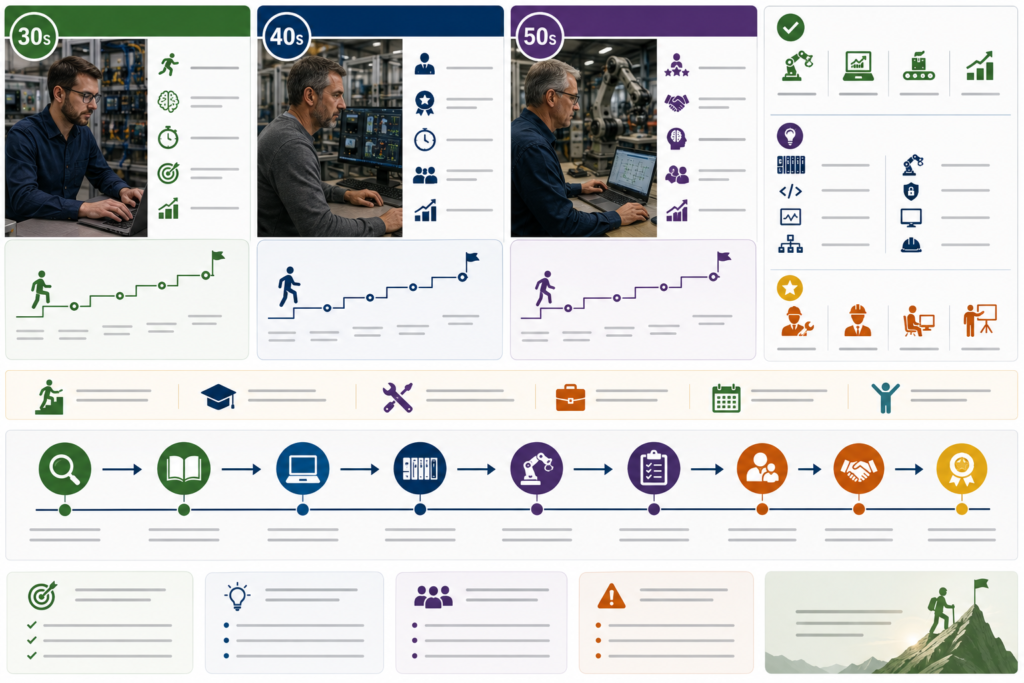
Changing careers into industrial automation at 30, 40, or 50 is realistic. The route, however, will not look the same for everyone.
A 30-year-old may be able to accept a junior position and spend several years building experience. A 40-year-old may need to transfer existing electrical, mechanical, IT, or management skills without taking a large salary reduction. A 50-year-old may be better suited to a specialist, service, training, estimating, or project-support route than starting from zero as a travelling commissioning engineer.
Age is rarely the main obstacle. The larger questions are whether you can demonstrate relevant skills, accept the initial learning period, and choose an entry route that makes use of your previous experience.
Automation Is Broader Than PLC Programming
Many career changers assume they must become full-time PLC programmers. Industrial automation includes far more roles:
- Automation maintenance technician
- PLC programmer
- Controls engineer
- Instrumentation technician
- SCADA engineer
- Robotics technician
- Panel builder or electrical designer
- Commissioning technician
- Field service engineer
- Building-automation technician
- Automation estimator or project coordinator
This matters because your previous career may already overlap with one of these positions.
An electrician understands control wiring, motors, protection, drawings, and safe isolation. A mechanic understands machine behaviour and failure patterns. An IT technician understands networks, servers, backups, and cybersecurity. A production operator understands how machines are actually used.
The fastest career change normally builds on that existing knowledge rather than discarding it.
The Job Market Is Not Limited to Young Graduates
Industrial facilities need people who can maintain increasingly automated equipment. As one indicator, the US Bureau of Labor Statistics projects employment for industrial machinery mechanics and related roles to grow by 13% between 2024 and 2034, with approximately 54,200 openings annually. It specifically connects part of that demand to the continued adoption of automated manufacturing machinery. (bls.gov)
This does not mean every person who completes an online PLC course will immediately find an automation job. Employers still want electrical knowledge, troubleshooting ability, safe working habits, and evidence that you can apply the theory.
Your first position may also be automation-adjacent rather than your ideal controls-engineering role.
Changing at 30
At 30, you still have plenty of time to build a complete automation career.
You may be able to enter through:
- Junior automation technician work
- Industrial electrical maintenance
- Panel wiring
- Field service
- PLC support
- A technical college or engineering programme
The main risk is spending too long collecting courses without gaining practical experience.
Learn the fundamentals, build several projects, and begin applying before you feel completely ready. A useful portfolio might include a PLC-controlled conveyor, HMI, analog signal, alarms, manual and automatic modes, and fault simulation.
At this age, accepting a slightly lower-paid role may be worthwhile when it provides genuine access to PLCs, drives, robots, and experienced engineers. Judge the job by what you will be able to do after two years, not only by the first month’s salary.
Changing at 40
At 40, the technical transition remains realistic, but the financial calculation becomes more important.
You may have a mortgage, children, or a salary that is difficult to replace with junior-level pay. Your goal should be to avoid competing as a complete beginner.
An experienced maintenance mechanic could move toward automation maintenance. An electrician could add PLC diagnostics and drive commissioning. An IT specialist could target SCADA, operational-technology networking, or industrial cybersecurity.
Management, documentation, quoting, customer communication, and project coordination are also valuable. A 40-year-old career changer may not program as quickly as a recent graduate initially, but may be much better at handling customers, organising work, recognising risk, and remaining calm during breakdowns.
Look for hybrid roles where your previous experience has immediate value while you develop automation skills.
Changing at 50
Starting at 50 is possible, but the choice of role matters greatly.
International commissioning, constant callouts, heavy physical work, and long periods away from home may be unattractive. That does not exclude you from automation.
Potential routes include:
- Factory-based controls maintenance
- Building-management systems
- Instrumentation and calibration
- PLC and HMI support
- Electrical design or estimating
- Panel testing
- Technical training
- Documentation and compliance
- Project coordination
- Technical sales or application support
Experience can be a major advantage in plants where judgement matters as much as programming speed.
Be realistic about the learning period. You may need to study alongside your current job and accept that employers will not initially treat unrelated seniority as senior automation experience.
However, you do not need twenty years in the field to become useful. You need a clearly defined technical area in which you can solve real problems reliably.
Do You Need a Degree?
A degree can help when applying for controls-engineering, design, consultancy, or management positions. Some employers use it as a screening requirement.
It is not the only route into technician-level work. Maintenance, installation, field service, panel building, and instrumentation positions may accept vocational qualifications combined with practical experience.
US occupational guidance, for example, lists an associate-level qualification as the typical entry education for electro-mechanical and mechatronics technicians, while industrial machinery mechanics often enter through technical training and substantial workplace learning. (bls.gov) (bls.gov)
Study job advertisements in your local area before enrolling in a long programme. Identify whether employers repeatedly request a degree, electrical qualification, specific PLC platform, or practical maintenance experience.
A Realistic Transition Plan
Begin with electrical control fundamentals, sensors, motors, relays, VFDs, PLC inputs and outputs, and schematic reading.
Learn one PLC environment rather than five. Build complete projects containing operating modes, interlocks, alarms, HMI controls, and fault recovery.
Then search for positions that move you one step closer:
- Production operator to maintenance assistant
- Electrician to automation technician
- Mechanic to mechatronics maintenance
- IT technician to SCADA support
- Panel builder to PLC testing
- Maintenance technician to controls specialist
ISA currently provides automation training for multiple experience levels, including introductory material covering industrial measurement and control. Free and low-cost resources can therefore be used to test your interest before committing to expensive education. (isa.org)
The Honest Verdict
A career change into automation is realistic at 30, 40, or 50, but it is not an instant transformation.
At 30, optimise for experience and long-term growth. At 40, build on transferable skills and protect your income. At 50, target roles where judgement, reliability, and previous industry experience provide an advantage.
Do not try to erase your previous career. Connect it to automation.
Employers do not only need young programmers. They need people who understand equipment, diagnose faults systematically, communicate clearly, document changes, and can be trusted around expensive machinery.