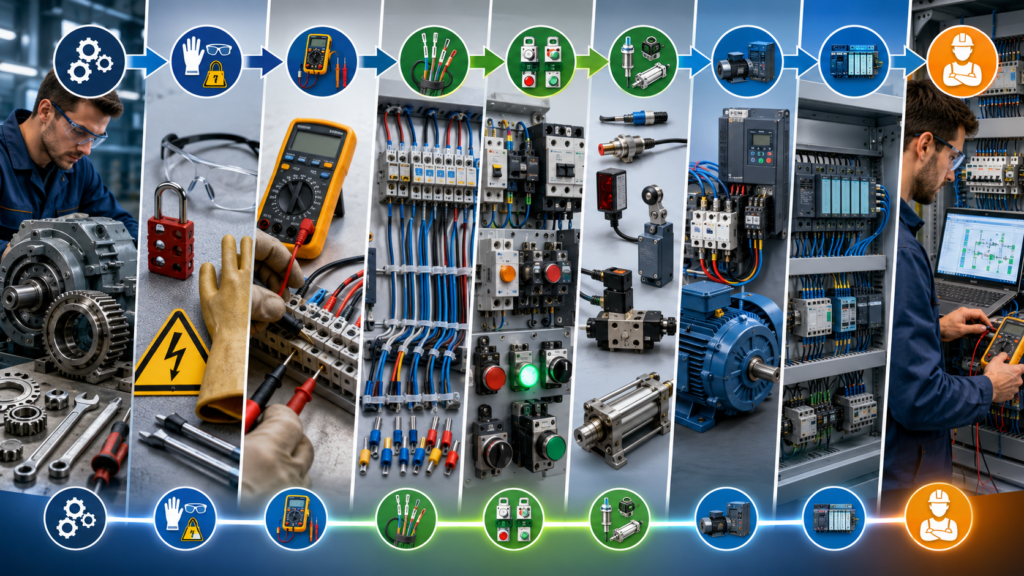
A mechanical technician does not need to become an electrical engineer before becoming useful around industrial control systems.
The fastest route is to learn electrical subjects in the order they appear during real machine faults. Start with safety and measurement, move into control circuits, then learn motors, sensors, drives, and PLC signals.
Avoid beginning with advanced electronics, complex calculations, or PLC programming. Those subjects make more sense after you understand how electricity moves through a real machine.
1. Learn Electrical Safety First
Before testing anything, learn how electrical hazards are controlled.
You should understand:
- Electrical isolation and lockout procedures
- Verification that a circuit is de-energised
- Stored energy in capacitors and drives
- Protective earthing
- Correct test-equipment categories
- When live testing is permitted
- Which tasks require an authorised electrician
Turning off a selector switch does not necessarily isolate a machine. Control voltage, incoming power, UPS supplies, external signals, and drive DC buses may remain energised.
Your first objective is not to work independently inside live panels. It is to recognise hazards, follow site procedures, and know when to stop.
2. Understand Voltage, Current, Resistance, and Continuity
Learn the basic relationship between voltage, current, and resistance, but keep the focus practical.
You should understand that:
- Voltage is electrical potential between two points
- Current flows through a complete circuit
- Resistance restricts current
- An open circuit prevents current flow
- A short circuit creates an unintended low-resistance path
Then learn to use a multimeter properly.
Practise measuring:
- AC and DC voltage
- Resistance on isolated circuits
- Continuity
- Supply voltage at a component
- Voltage across a contact
- Voltage drop along a circuit
A common beginner mistake is measuring voltage to the wrong reference point. Another is using continuity mode on an energised circuit.
Do not use resistance or continuity mode until the circuit is safely isolated and verified.
3. Learn to Read Basic Electrical Schematics
Do not begin with a complete 200-page machine drawing. Start with one simple control circuit.
Learn the symbols for:
- Normally open and normally closed contacts
- Pushbuttons
- Relays and contactors
- Overload contacts
- Fuses and circuit breakers
- Coils
- Motors
- Sensors
- PLC inputs and outputs
- Terminal blocks
Follow the circuit from the supply, through every condition, to the load and back to the return path.
For example, a contactor coil may depend on a stop button, overload contact, guard switch, start button, and holding contact. If the contactor does not energise, check the circuit condition by condition rather than replacing the contactor immediately.
Being able to trace one control circuit accurately is more useful than memorising dozens of electrical symbols.
4. Master 24 V DC Control Circuits
Most modern industrial sensors, PLC inputs, relays, and control devices use 24 V DC.
Learn:
- Positive and negative supply rails
- PNP and NPN sensor concepts
- Sourcing and sinking inputs
- Relay isolation
- Input commons
- Output commons
- Fuse protection
- Correct polarity
Build a low-voltage practice circuit using a 24 V DC supply, pushbuttons, relay, indicator lamp, and sensor.
Useful exercises include:
- Start-stop relay control
- Lamp controlled by a proximity sensor
- Relay controlled by a PLC output
- Fault caused by a missing common
- Fault caused by a blown fuse
- Fault caused by reversed sensor polarity
These exercises teach the structure behind many real machine faults without exposing you to mains voltage.
5. Learn Relays, Contactors, and Motor Starters
Mechanical technicians frequently encounter motors that will not start, stop unexpectedly, or trip after running.
Learn how a basic motor starter works, including:
- Contactor coil
- Main contacts
- Auxiliary contacts
- Motor-protection device
- Overload relay
- Control fuse
- Start and stop circuit
- Electrical interlocking
Understand the difference between the control circuit and the power circuit.
A motor may have healthy three-phase power available, but the contactor coil may not receive its control voltage. Alternatively, the contactor may pull in while one power phase is missing.
Do not test three-phase systems independently until trained and authorised. Initially, focus on reading diagrams, recognising components, and understanding the expected sequence.
6. Learn Industrial Sensors
Sensors create many faults that are wrongly blamed on PLCs.
Study the main types:
- Inductive proximity sensors
- Photoelectric sensors
- Capacitive sensors
- Mechanical limit switches
- Pressure switches
- Level switches
- Temperature sensors
- Encoders
For each sensor, learn:
- What it detects
- Required supply voltage
- Output type
- Normal LED indication
- Sensing distance
- Alignment requirements
- Common failure modes
Many “electrical” sensor problems are mechanical. The target may be misaligned, the bracket loose, the lens dirty, or the sensor too far away.
A good technician checks both the signal and the physical installation.
7. Learn PLC Inputs and Outputs Before PLC Programming
Before writing ladder logic, understand how the PLC connects to the machine.
You should be able to answer:
- Which sensor activates this input?
- Which output controls this relay or valve?
- Is the input LED changing?
- Is the PLC commanding the output?
- Is voltage present at the output terminal?
- Is an interlock blocking the command?
Learn how to monitor PLC logic online without changing it.
The ability to follow a motor command through the PLC program is far more useful to a maintenance technician than immediately learning to build a large program.
Do not force PLC outputs casually. A forced output can move equipment unexpectedly and may bypass normal sequence conditions.
8. Add Solenoids, Pneumatics, and Feedback
Mechanical technicians often understand cylinders and valves physically but need to connect that knowledge to the electrical control system.
Learn how a solenoid valve is energised and how cylinder-position sensors confirm movement.
A typical sequence may be:
- PLC energises the valve.
- Cylinder extends.
- Extended-position sensor activates.
- PLC continues the sequence.
If the sensor never activates, the problem could be electrical, pneumatic, mechanical, or caused by an incorrect PLC condition.
This is where your mechanical experience becomes a major advantage. You can evaluate both the command and the actual movement.
9. Learn VFD Basics
Variable-frequency drives combine power electronics, motor control, parameters, and communication.
Begin with:
- Drive input and output sections
- Run command
- Speed reference
- Ready and fault signals
- Acceleration and deceleration
- Motor-nameplate parameters
- Local and remote modes
- Fault-history reading
Do not start by changing random parameters. Record existing values and understand why a change is required.
A motor that does not run may be waiting for a PLC command, missing a safety input, operating in local mode, or carrying an active drive fault.
10. Finish With Structured Troubleshooting
Use the same process for every electrical fault:
- Confirm the symptom.
- Identify the expected sequence.
- Check the electrical drawing.
- Verify the power supply.
- Check permissions and safety conditions.
- Follow the signal from input to logic to output.
- Inspect the physical device.
- Test one theory at a time.
- Record the confirmed cause.
Avoid replacing components based on suspicion. Measurements should guide the repair.
The fastest path for a mechanical technician is therefore:
Safety → multimeter use → schematic reading → 24 V DC control → relays and contactors → sensors → PLC I/O → solenoids → drives → structured troubleshooting.
This sequence makes you useful early while building the foundation for PLC programming, industrial networking, and deeper automation work later.
Your mechanical background is not something to leave behind. The best maintenance technicians understand both what the controller commands and what the machine physically does.