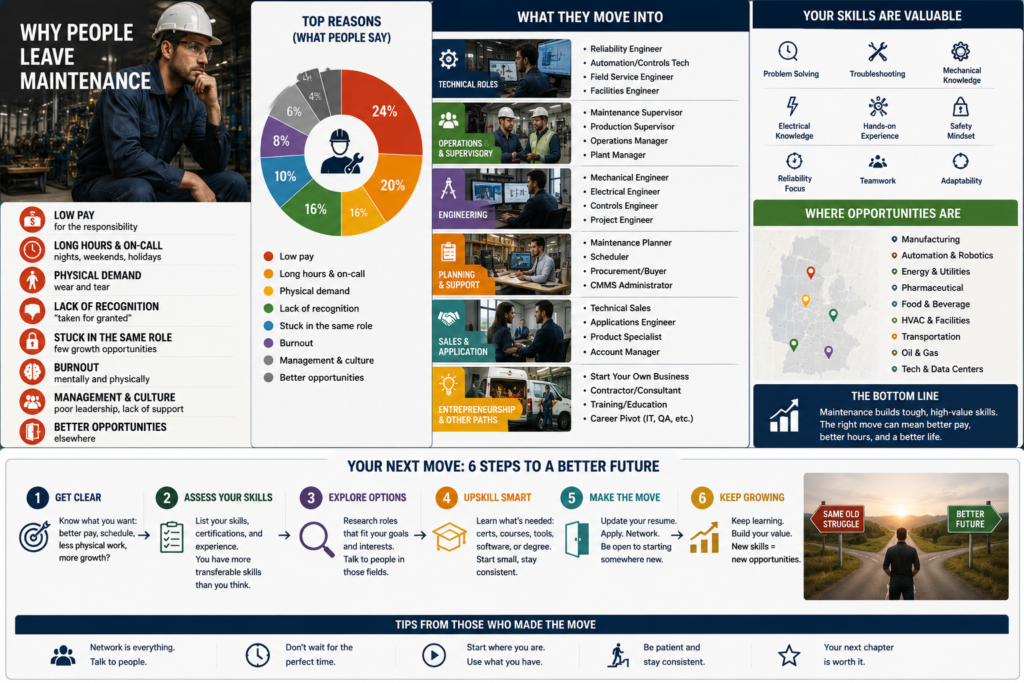
Industrial maintenance can be one of the best technical training grounds in manufacturing.
Technicians learn electrical systems, mechanics, pneumatics, hydraulics, PLCs, drives, sensors, production processes, and troubleshooting under real pressure. Few jobs expose someone to such a wide range of equipment.
Yet many capable technicians eventually leave.
They do not always leave because they dislike repairing machines. More often, they become tired of the working conditions surrounding the work: unpredictable callouts, night shifts, production pressure, poor planning, limited advancement, and responsibility without enough authority or resources.
The good news is that maintenance experience transfers into many other careers.
Constant Reactive Work Becomes Exhausting
Some maintenance departments spend nearly every day responding to emergencies.
Preventive work is postponed because production cannot release the machine. Spare parts are not ordered until something fails. Temporary repairs become permanent. The same recurring fault returns every few weeks, but nobody approves the time or money required to eliminate its root cause.
For a while, being the person who saves production can feel rewarding. Eventually, it becomes frustrating.
Technicians realise they are not improving the plant. They are repeatedly restoring equipment that has been allowed to become unreliable.
Many leave for reliability engineering, maintenance planning, or project roles because they want to prevent breakdowns instead of spending their entire career reacting to them.
Shift Work and Callouts Affect Life Outside Work
Factories often run continuously. Maintenance support may therefore include nights, rotating shifts, weekends, holiday coverage, and emergency callouts.
A schedule that feels manageable at 22 may become much harder after starting a family, developing health problems, or simply wanting a normal routine.
Sleep disruption is not the only issue. Technicians may find it difficult to plan social events, training, travel, or regular exercise. Even when they are officially off duty, they may expect a call because nobody else understands a particular machine.
This pushes some people toward design, estimating, technical support, training, or office-based engineering positions with more predictable hours.
Pay Does Not Always Match Responsibility
A maintenance technician may be responsible for equipment worth millions of euros. One incorrect decision can cause extended downtime, damaged machinery, lost product, or a safety incident.
Despite this responsibility, some companies treat maintenance as an expense that should be minimised.
A technician may gradually take on PLC programming, robot recovery, contractor supervision, spare-parts management, and on-call coverage without receiving a formal promotion.
The quickest salary increase may then come from leaving.
Automation integrators, equipment manufacturers, utilities, data centres, pharmaceutical plants, and specialised service companies may pay more for the same electrical and troubleshooting abilities.
The Physical Work Accumulates
Maintenance can be physically demanding.
Technicians climb ladders, crawl under machines, work in awkward cabinets, lift motors, kneel on concrete, and operate in hot, cold, noisy, oily, or dusty environments.
Good employers provide lifting equipment, suitable tools, staffing, and safe procedures. Poor workplaces rely on technicians to improvise.
After years of this work, some people move into roles that still use their technical knowledge but place less strain on the body.
Common destinations include maintenance planning, technical purchasing, estimating, inspection, training, engineering support, and service coordination.
Production Pressure Can Destroy Job Satisfaction
When a line stops, the technician may be surrounded by operators, supervisors, and managers asking when it will run again.
The pressure itself is not always the problem. Experienced technicians often enjoy urgent fault-finding.
The problem begins when management expects certainty before the cause is known, discourages proper isolation, or pressures technicians to bypass alarms and interlocks.
A workplace where production consistently overrides safe engineering judgement eventually loses its best people.
Many technicians move to companies with better technical standards, even when the new job title is similar. Sometimes the right career move is not leaving maintenance completely—it is finding a better maintenance department.
There May Be No Clear Promotion Route
In a small factory, the career structure may consist of technician, senior technician, and maintenance manager.
The senior role may involve the same shifts and breakdowns with slightly more pay. The management role may replace technical work with staffing, budgets, and meetings.
A skilled technician who wants deeper technical development may have nowhere to go.
This is why many move into automation, controls, instrumentation, robotics, or field service. These fields offer specialist paths without requiring an immediate move into people management.
Where Maintenance Technicians Commonly Move
Automation or Controls Technician
This is one of the most natural transitions for someone already diagnosing PLC inputs, outputs, sensors, drives, and communication faults.
The main skill gaps are normally PLC programming, HMI development, industrial networking, software backups, and structured program design.
Reliability Engineering
Reliability roles focus on repeated failures, equipment history, preventive strategies, condition monitoring, and root-cause analysis.
Experienced technicians bring practical knowledge that purely theoretical engineers may lack. Additional skills in data analysis, vibration, lubrication, thermography, and failure analysis can strengthen the transition.
Maintenance Planning
A planner prepares jobs before technicians begin them.
The role can involve defining the scope, identifying parts, estimating labour, arranging permits, scheduling shutdowns, and improving maintenance records.
It suits technicians who are organised, understand how work is actually performed, and want more predictable hours.
Field Service or Commissioning
Machine builders and equipment vendors value technicians who can troubleshoot independently and communicate with customers.
The work may pay more and provide rapid technical development. The trade-off is travel, irregular hours, and pressure at customer sites.
This route works best for people who want variety and do not mind spending time away from home.
Instrumentation and Control
Technicians with experience in sensors, analog signals, calibration, valves, and PLC systems can move into process instrumentation.
Typical industries include water treatment, energy, chemicals, food production, pharmaceuticals, and oil and gas.
Electrical Design, Panel Building, or Estimating
A technician who understands how panels fail in the field can become a strong designer or estimator.
Useful additional skills include electrical CAD, component selection, standards, bills of materials, pricing, and project documentation.
This route offers a more office-based career while retaining a connection to real machinery.
Technical Sales or Application Engineering
Equipment manufacturers need people who can understand customer problems and recommend suitable products.
A former maintenance technician can often speak more credibly with customers than someone who only knows the catalogue.
The role may include product selection, demonstrations, quotations, training, and troubleshooting support.
Maintenance Management
Some technicians move into supervision or management because they want greater influence over staffing, spares, preventive maintenance, and investment decisions.
The challenge is that management requires different skills. Being the best fault-finder does not automatically make someone good at handling budgets, conflicts, performance, and long-term planning.
How to Leave Without Starting Over
Do not describe your maintenance years as “just fixing machines.”
Translate the experience into professional skills:
- Diagnosed electrical and mechanical faults
- Reduced recurring downtime
- Supported PLCs, robots, and VFDs
- Planned shutdown work
- Trained junior technicians
- Managed contractors
- Improved spare-parts availability
- Created drawings and backups
- Led root-cause investigations
- Worked safely under production pressure
Then identify the missing skills for the target role and close those gaps deliberately.
A move into automation may require a portfolio project. Planning may require stronger CMMS and scheduling skills. Reliability may require failure-analysis and condition-monitoring knowledge. Estimating may require Excel, CAD, and commercial experience.
The Honest Verdict
People often leave maintenance because the job combines high responsibility with weak planning, difficult schedules, physical strain, and limited progression.
But maintenance is rarely wasted experience.
It can lead into automation, reliability, planning, commissioning, instrumentation, design, management, technical sales, or independent service work.
The best move does not throw away your practical background. It places that experience in a role where it is better paid, better supported, or more compatible with the life you want.