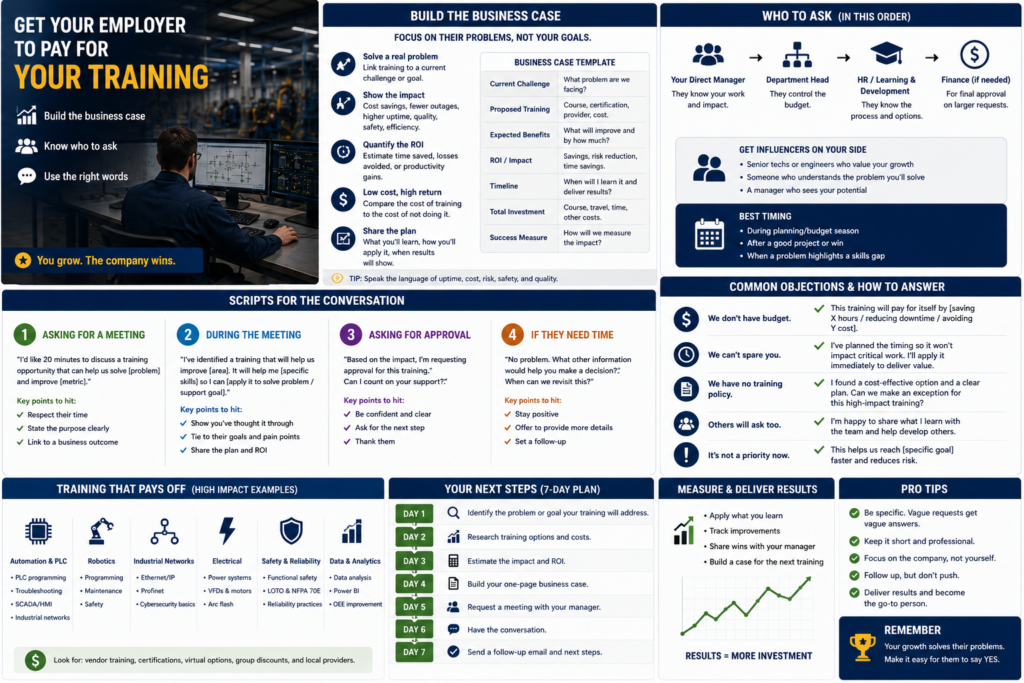
Professional training can be expensive. A recognised PLC course, electrical qualification, robotics programme, or functional-safety certification may cost hundreds or thousands of euros before travel and time away from work are included.
Many employees assume their company will reject the request, so they never ask. Others ask casually—“Can the company pay for this course?”—without explaining why the investment would benefit the business.
The strongest request is not based on personal development alone. It connects the training to a real operational problem, upcoming project, skill shortage, compliance requirement, or external cost.
You are not asking the company to buy you a certificate. You are proposing an investment that should reduce risk or produce useful capability.
Choose Training the Business Can Use
A request is easier to approve when the course relates directly to your current role.
Good examples include:
- Siemens TIA Portal training when the plant uses S7-1200 or S7-1500 PLCs
- VFD training when technicians repeatedly call external drive specialists
- Robot maintenance training for a factory with FANUC, KUKA, or ABB cells
- Instrumentation training when the plant relies on 4–20 mA transmitters and control valves
- SCADA training before a planned system upgrade
- Functional-safety training for engineers responsible for machine modifications
- Electrical testing or authorisation required for assigned work
A course may be valuable to your long-term career but difficult to justify to your present employer if it has little connection to the company’s equipment.
Start with training that solves an obvious business need. Once management sees that the first investment produced results, future requests become easier.
Find the Business Problem First
Before discussing the course, identify what the company currently loses because the skill is missing.
Possible problems include:
- Frequent dependence on external contractors
- Long breakdowns while waiting for specialist support
- Only one employee understanding a critical system
- Repeated faults that are not properly diagnosed
- Upcoming equipment installation
- Obsolete technology requiring migration
- Poor software backup and recovery procedures
- Compliance or customer requirements
- Lack of holiday or night-shift coverage
Suppose a contractor charges €1,200 for each site visit and the company uses them six times per year. A €2,000 training course becomes easier to defend if it would allow the maintenance team to handle several of those faults internally.
Do not invent savings you cannot prove. Use maintenance records, contractor invoices, downtime history, project plans, or actual support calls where possible.
Calculate the Complete Cost
Your manager may need more than the advertised course price.
Prepare a simple total containing:
- Course fee
- VAT or taxes
- Travel
- Accommodation
- Examination fee
- Training materials
- Time away from normal duties
- Software or equipment required afterward
Then explain what the company receives.
For example:
The complete cost would be approximately €1,850, including the course, travel, and examination. Afterward, I would be able to diagnose common S7-1500 hardware and software faults, verify backups, and support the new line without immediately escalating every issue to the integrator.
This sounds more credible than presenting a €1,300 course and allowing management to discover another €600 in costs later.
Ask the Right Person
Your direct manager is normally the best starting point because they understand your responsibilities and can support the request.
Depending on the company, approval may also involve:
- Maintenance manager
- Engineering manager
- Plant manager
- Human resources
- Learning and development
- Health and safety
- Finance
- Project manager
Do not bypass your manager and send an expensive request directly to the managing director unless that is normal in your organisation.
Your manager may not control the training budget, but they can help connect the request to plant priorities and present it to the person who does.
Ask how training decisions are made before submitting a formal proposal.
Time the Request Properly
The best time to ask is before the business urgently needs the skill.
Good opportunities include:
- Annual budget planning
- Performance reviews
- Before a new machine arrives
- After repeated contractor callouts
- During succession planning
- Before taking on additional responsibility
- After successfully completing a relevant project
Avoid asking during a major breakdown when the manager is focused entirely on restoring production. Mention the skill gap during the incident, then schedule a separate discussion afterward.
Script for Requesting a Meeting
Could we schedule 20 minutes to discuss training related to the new production line? I have identified a course that would improve our internal PLC troubleshooting capability and reduce how often we need external support. I have prepared the cost, course content, and how I would apply it here.
This signals that you are bringing a business proposal rather than asking for an informal favour.
Script for the Main Conversation
We currently depend on external support for several Siemens PLC faults and program changes. During the last six months, we used outside support on three occasions, and response time extended two of those stoppages.
I found a five-day TIA Portal service and troubleshooting course costing €1,600, with approximately €250 in travel expenses. The course covers hardware diagnostics, online monitoring, program comparison, backup recovery, and communication faults—all directly relevant to our equipment.
After completing it, I would create a backup-verification procedure and a short troubleshooting guide for the maintenance team. I would like the company to fund the course and allow me to attend during working time.
Then allow the manager to respond. Do not undermine the request by immediately offering to pay for half before hearing their position.
Script for a Certification Request
Certifications can be harder to justify when management views them as something that mainly improves your CV.
Focus on capability and business requirements:
Several of our upcoming projects include safety PLC modifications and validation work. I believe the TÜV functional-safety programme would help us review these projects more competently and communicate more effectively with the external safety specialists.
The total cost is approximately €3,000. I am not suggesting that the certificate would replace independent validation, but it would improve our internal understanding, specification quality, and review process.
Be honest about what the certification does and does not authorise you to do.
When the Manager Says It Is Too Expensive
Do not end the discussion immediately.
Respond with:
I understand the full course may not fit the current budget. Would the company consider a lower-cost online course this quarter, followed by the official training during the next budget cycle?
Other alternatives include:
- Virtual instead of classroom training
- Local provider instead of international travel
- Splitting the course across two budget periods
- Employer paying the fee while you study partly outside work
- Training delivered internally to several employees
- Vendor training included with a new equipment purchase
- Funding the examination after you complete self-study
A smaller approval can establish a track record for later requests.
Offer a Clear Return to the Team
Management may worry that the knowledge will remain with one person.
Propose useful deliverables:
- Internal presentation
- Troubleshooting checklist
- Updated maintenance procedure
- Verified software backups
- Short training session for colleagues
- Standard program template
- Course notes stored in company systems
- Improvement project using the new skill
Avoid promising that one course will make you the company expert. Instead, state what you should realistically be able to do afterward.
Training Repayment Agreements
Some employers require employees to repay part of an expensive course if they leave within a defined period.
Do not sign automatically. Review:
- Total amount covered
- Repayment period
- Whether the amount reduces over time
- What happens if the company dismisses you
- Whether travel and wages are included
- Whether repayment applies if the role changes
- Applicable employment law
A declining agreement—where the repayment reduces each month—is generally more reasonable than owing the full cost until the final day.
Seek appropriate legal or employment advice when the amount is significant.
Follow Up in Writing
After the meeting, send a concise summary:
Thank you for discussing the TIA Portal training. As agreed, I will send the final course dates and total cost. If approved, I will also create a PLC backup procedure and deliver a short internal troubleshooting session after completing the training.
If the request is rejected, ask:
What would need to change for this training to be reconsidered during the next budget review?
Get a date rather than accepting “maybe later.”
The Honest Approach
Employers are most likely to fund training when the request is specific, relevant, measurable, and timed around a genuine business need.
Choose one course. Identify the operational problem. Calculate the complete cost. Explain how the skill will be used, and offer a practical return to the team.
Do not lead with how much the certificate will help your career. Show how it will help the company first.
That does not make the request dishonest. The best training investment benefits both sides: the employer gains stronger internal capability, while you gain a skill and credential that continues to support your career.