Chapter 1 · Three-Phase Power and Why Motors Use It
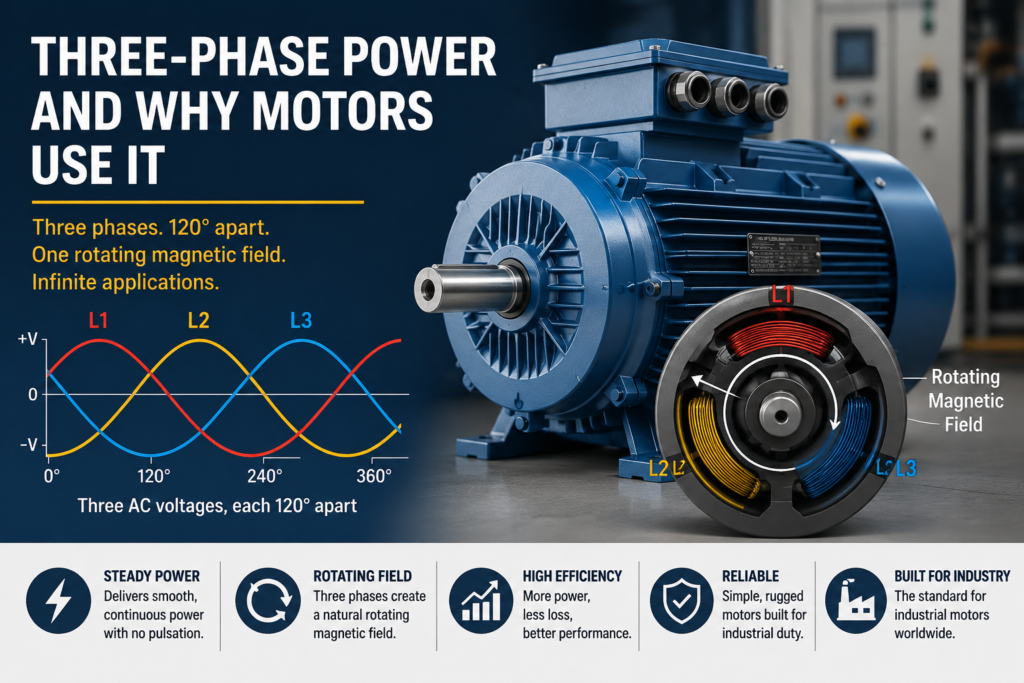
Three-phase power is the foundation on which the induction motor is built, and understanding it is the first step to understanding the motor. Where a simple electrical supply has a single alternating voltage, three-phase power provides three separate alternating voltages on three conductors, each shifted in time from the others by a third of a cycle — 120 degrees. This arrangement, which might seem an unnecessary complication, is in fact what makes the three-phase motor possible, because these three offset voltages can create a rotating magnetic field with no moving parts, and that rotating field is what turns the motor.
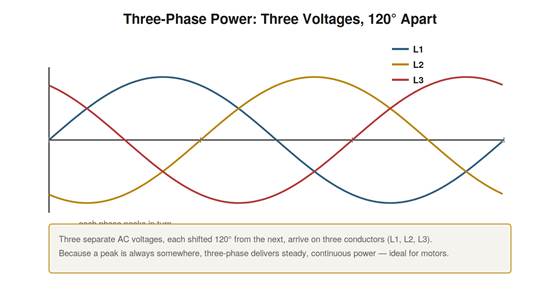
Figure 1.1 — Three-phase power: three AC voltages, each shifted 120° from the next, delivered on three conductors L1, L2, and L3. Because a peak is always present somewhere, three-phase delivers steady, continuous power.
Three voltages, 120 degrees apart
The defining feature of three-phase power is the timing of its three voltages. Each of the three phases is an alternating voltage rising and falling in the usual way, but they are staggered: as one reaches its peak, the next is a third of a cycle behind, and the third a further third behind. Over a full cycle, each phase peaks in turn, evenly spaced. This even staggering — 120 degrees between phases — means that at every instant the three voltages are at different points in their cycles, and crucially, there is always a phase near its peak somewhere. Understanding this timing is the key to understanding three-phase, because the offset between the phases is exactly what the motor exploits: three windings fed by these three offset voltages produce magnetic fields that peak in turn, combining into a field that sweeps around the motor. The 120-degree offset is not arbitrary but the precise arrangement that makes a smoothly rotating field, and thus a self-starting, smoothly running motor, possible.
Why three-phase suits motors
Three-phase power suits motors for two connected reasons. First, it delivers steady power: because the three phases peak in turn, the total power delivered is smooth and continuous rather than pulsing, unlike a single-phase supply whose power rises and falls twice per cycle. A motor fed by smooth three-phase power runs smoothly, without the pulsation a single-phase motor must contend with. Second, and more fundamentally, three-phase power creates a rotating magnetic field directly, simply by feeding three windings spaced around the motor. This rotating field is what makes the induction motor turn, and it arises naturally from three-phase power with no need for the extra components a single-phase motor requires to start and run. So three-phase power is not just a convenient way to deliver more power; it is the natural partner of the induction motor, providing both the smooth power and the rotating field the motor needs. This deep suitability is why industrial motors are overwhelmingly three-phase: the power and the motor are matched, the three-phase supply providing exactly what the induction motor requires to start and run smoothly and efficiently.
Line and phase quantities
Working with three-phase power, you will meet the terms line and phase, and understanding them prevents confusion. The line voltage is the voltage measured between any two of the three conductors, and the line current is the current in each conductor — these are what you measure at the motor’s supply. The phase voltage and phase current refer to the individual windings inside the motor. Depending on how the windings are connected (star or delta, covered later), the line and phase quantities relate differently: in one connection the line voltage is higher than the winding voltage by a factor of the square root of three, in the other they are equal. For now, the essential point is that line quantities are what you measure at the terminals between conductors, and they are the reference for most motor work — the nameplate voltage is a line voltage, and your supply measurements are line measurements. Keeping line and phase distinct, and knowing that motor ratings and supply measurements are normally line quantities, avoids the confusion that the two sets of terms can otherwise cause when working with three-phase motors and their supplies.
Single-phase versus three-phase, in practice
The practical difference between single-phase and three-phase power shows up clearly in motors, and appreciating it explains why industry runs on three-phase. A single-phase motor, fed by one alternating voltage, has a fundamental problem: a single alternating field does not rotate, it merely pulsates, so a single-phase motor cannot start on its own and needs extra components — a start winding, capacitors, or other tricks — to get it turning, and even then it runs less smoothly. A three-phase motor has no such problem: the three phases inherently create a rotating field, so the motor starts and runs by itself, smoothly, with no starting aids. This is a decisive advantage for the larger motors that drive industry, which is why single-phase motors are confined mostly to small domestic and light-commercial uses while three-phase motors dominate industrial applications. Understanding this difference — single-phase pulsates and needs starting help, three-phase rotates inherently — explains the division: three-phase power and its self-starting, smooth-running motors are the natural choice wherever real mechanical power is needed, which is throughout industry.
The economy of three-phase
Three-phase power is also more economical than single-phase for transmitting and using significant power, which reinforces its industrial dominance. For a given amount of power, three-phase distributes it across three conductors more efficiently than single-phase does across two, using conductor material more effectively and delivering smoother power. Three-phase motors are also more compact and efficient than single-phase motors of the same power, because they use the three-phase supply so effectively. So three-phase is not only technically better suited to motors (the rotating field) but also more economical for delivering and using power at industrial scale. This combination — better motor operation and better economy — is why industrial power distribution and industrial motors are three-phase throughout. Understanding that three-phase is both the natural partner of the induction motor and the economical way to distribute industrial power explains its complete dominance in industry: it is the right choice on every count — self-starting smooth motors, efficient power distribution, and compact efficient machines — which is why an industrial electrician or technician works with three-phase power and motors constantly, and why understanding them is so broadly essential.
Scenario: why the big machines are three-phase
A scenario illustrates why serious machinery is three-phase. Consider a plant with a large pump that must run continuously and reliably. If it were driven by a single-phase motor, that motor would need starting components (capacitors, a start winding, a centrifugal switch) that add complexity and failure points, would run less smoothly with a pulsating torque, and would be larger and less efficient for the power required. Driven instead by a three-phase motor, the pump gets a motor that starts by itself with no extra components, runs smoothly with steady torque, and is compact and efficient — simply by connecting it to the three-phase supply. The three-phase motor is the obvious choice for such a duty, and indeed for essentially all substantial industrial drives. This scenario captures why the big machines are three-phase: the three-phase motor’s inherent self-starting, smooth running, efficiency, and simplicity make it far better suited to real industrial power than a single-phase motor, so wherever significant, reliable mechanical power is needed — pumps, fans, compressors, conveyors — the three-phase motor is used. Understanding this through the concrete example reinforces why three-phase dominates industry: for the demanding, continuous, powerful duties of a plant, the three-phase motor is simply the right machine, and the three-phase supply is what makes it possible.
Three-phase as the industrial standard
Three-phase power is the industrial standard worldwide, and understanding its role positions your motor knowledge in the broader electrical system. Industrial facilities are supplied with three-phase power, distributed throughout the plant as three-phase, and used to drive the three-phase motors that do the plant’s mechanical work. This makes three-phase the backbone of industrial electrical systems, and the three-phase motor the primary load on those systems. Working with motors therefore means working within the three-phase system — understanding the supply, the distribution, and the motors as parts of one three-phase electrical system. This broader view helps in troubleshooting, because a motor problem can originate in the wider three-phase system (a supply imbalance, a distribution fault, a problem shared across multiple motors) rather than in the individual motor. Understanding three-phase as the industrial standard — the backbone of the plant’s electrical system, with motors as its primary loads — places your motor work in context and reminds you that motors and their supply are part of one system, so that some motor problems trace to the wider three-phase system and are diagnosed by considering the motor in the context of its supply and the other loads on the same system, not in isolation.
The foundation for everything else
Understanding three-phase power is the foundation for everything else about the motor, and it is worth recognizing this as the fundamentals conclude. The rotating field arises from three-phase power; the induction principle acts on that rotating field; slip is the rotor lagging the field; the winding connections relate to the three-phase supply; the balance measurements check the three phases; single-phasing is the loss of a phase. Every later topic builds on the three-phase foundation, so understanding three-phase — the three voltages 120 degrees apart, delivering smooth power and creating a rotating field — is the key that unlocks the rest. A reader who understands three-phase power grasps the basis from which the motor’s operation, its behavior, and its faults all follow. This is why the book begins here: three-phase power is not merely background but the foundation on which the entire understanding of the motor rests. Understanding it well makes everything that follows comprehensible, because the motor’s operation and its faults are consequences of how it uses three-phase power. Recognizing three-phase power as this foundation — the basis for the rotating field, induction, the connections, and the phase-related faults — underscores the importance of understanding it thoroughly, as the key that makes the rest of the subject follow naturally from a clear grasp of how the motor uses its three-phase supply.
A field note on respecting three-phase
A practical note worth carrying from the fundamentals: three-phase power, for all its elegance, is dangerous and unforgiving, and respecting it is part of understanding it. The same three offset voltages that drive motors so effectively carry lethal energy, and three-phase circuits often carry substantial current at industrial voltages. Understanding three-phase includes understanding that it demands respect: the isolation, the verification, the safe procedures are all the more important because three-phase circuits are powerful and dangerous. This respect is not separate from the technical understanding but part of it — knowing what three-phase power is includes knowing its danger and treating it accordingly. Carrying this into all the motor work that follows, the respect for three-phase power’s danger underlies the safety-first approach the book emphasizes throughout. Understanding three-phase power fully means understanding both its technical nature — three offset voltages creating smooth power and a rotating field — and its practical demand for respect and safe handling, so that the competence you build with motors rests on a foundation that includes healthy respect for the powerful, dangerous three-phase power that drives them, which is as much a part of understanding three-phase as the technical principles are.