Chapter 4 · The Motor and Its Nameplate
Before wiring or testing a motor, you must know what it is, and the nameplate tells you. The nameplate is the motor’s specification, stamped on a plate on its frame, giving the ratings and data that define how the motor should be supplied, protected, and operated. Reading it correctly is the foundation of every subsequent task, because the nameplate values are the reference against which you judge everything: the supply voltage, the running current, the speed, and the protection settings all derive from or compare to the nameplate.
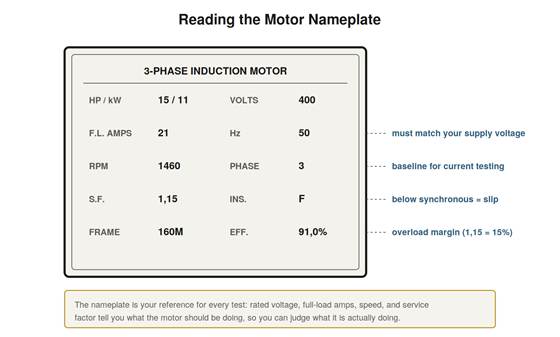
Figure 4.1 — Reading the motor nameplate. Rated voltage, full-load amps, speed, and service factor are your reference for every test — they tell you what the motor should be doing so you can judge what it is actually doing.
The key nameplate values
Several nameplate values are essential for motor work. The rated voltage is the supply voltage the motor is designed for, and your supply must match it. The full-load current (full-load amps) is the current the motor draws at its rated load, and it is the baseline for current measurements and for setting the overload protection — perhaps the single most useful value for troubleshooting. The rated power (in horsepower or kilowatts) is the mechanical power the motor delivers at full load. The rated speed (rpm) is the full-load speed, which is below synchronous speed by the slip. The frequency is the supply frequency the motor expects. And the service factor indicates how much the motor can be overloaded continuously beyond its rated power — a service factor of 1,15 means the motor can deliver 15 percent above its rating. Reading these values gives you the motor’s specification: what voltage to supply, what current to expect, what speed it should run at, and how much margin it has. They are the reference for supplying, protecting, and judging the motor, and reading them correctly is the necessary first step in any motor task.
Using the nameplate in troubleshooting
The nameplate is a troubleshooting tool because it tells you what the motor should be doing, letting you judge what it is actually doing. The full-load current tells you what current is normal, so a measured current well above it indicates overload and well below it indicates underload or a problem. The rated voltage tells you what the supply should be, so a measured voltage far from it indicates a supply problem. The rated speed tells you the normal running speed, so a motor running much slower indicates excessive slip from overload or a fault. In each case, the nameplate provides the expected value, and comparing the actual measurement to it reveals whether something is wrong and in which direction. This comparison — actual against nameplate — is fundamental to motor troubleshooting, turning a bare measurement into a judgment: a current of 25 amps means little alone, but against a nameplate full-load current of 21 amps it means the motor is overloaded. Always having the nameplate values to compare against is what makes measurements meaningful, which is why reading the nameplate is the essential starting point that gives every subsequent measurement its reference.
Frame, enclosure, and mounting
Beyond the electrical ratings, the nameplate and motor give physical information that matters for replacement and application. The frame size is a standardized designation that fixes the motor’s mounting dimensions and shaft, so a replacement of the same frame size will fit the same mounting and coupling. The enclosure type indicates how the motor is protected against its environment — whether it is open for maximum cooling, totally enclosed against dust and moisture, or otherwise rated — which must suit the installation. The mounting arrangement (foot-mounted, flange-mounted, and so on) must match the driven equipment. These physical details matter when replacing a motor: a replacement must match the frame size for mounting, have a suitable enclosure for the environment, and match the mounting arrangement, as well as matching the electrical ratings. Understanding that the nameplate and motor specify both electrical ratings and physical form ensures that a replacement is correct in every respect — electrically compatible and physically fitting — which is essential when a failed motor must be replaced with one that will both work correctly and fit the installation.
The nameplate as a contract
It helps to think of the nameplate as a contract stating the conditions under which the motor will perform as designed. The manufacturer guarantees the rated power, at the rated speed, drawing about the rated current, when supplied with the rated voltage at the rated frequency — provided the motor is operated within these conditions and its service factor. If you honor the contract — supply the rated voltage and frequency, load it within its rating and service factor, keep it cool — the motor should deliver as specified. If you violate the contract — wrong voltage, overloading, poor cooling — the motor will not perform as designed and may overheat or fail. This contract framing clarifies why the nameplate matters so much: it defines the conditions for proper operation, and most motor problems involve a violation of these conditions (wrong supply, overload, poor cooling). Understanding the nameplate as the contract — the conditions for guaranteed performance — orients both operation (honor the conditions) and troubleshooting (check whether the conditions are being met). When a motor misbehaves, asking whether its nameplate conditions are being honored — correct voltage, load within rating, adequate cooling — is often the path to the cause, because the motor is designed to work when its contract is honored and to struggle when it is not.
Scenario: the mystery current reading
A scenario shows the nameplate giving a measurement its meaning. A technician measures a motor drawing 24 amps and wonders whether that is a problem. The number alone means nothing without a reference — 24 amps could be normal or excessive depending on the motor. Reading the nameplate resolves it: the full-load current is 21 amps, so 24 amps is above full load, indicating the motor is overloaded, drawing about 15 percent more current than its rating. Now the measurement has meaning: the motor is running over its rated load, which explains any overheating or tripping and directs attention to the load. Had the nameplate shown a full-load current of 26 amps, the same 24-amp reading would have meant the motor was running comfortably within its rating, a completely different conclusion. This scenario shows why the nameplate is essential to interpreting measurements: the same current reading means overload or normal operation depending on the nameplate full-load current, and only by comparing the measurement to the nameplate can you judge it. Understanding this — that the nameplate turns a bare measurement into a meaningful judgment — reinforces reading the nameplate as the essential reference, without which measurements cannot be interpreted, and with which a simple current reading becomes a clear indication of the motor’s loading.
Matching a replacement motor
When a motor must be replaced, matching the replacement to the original using the nameplate is essential, and understanding what must match ensures a correct replacement. Electrically, the replacement must have the same voltage rating (to suit the supply), a suitable power rating (to drive the load), the same frequency, and a compatible speed (pole count) for the application. Physically, it must have the same frame size (to fit the mounting and coupling), a suitable enclosure for the environment, and the correct mounting arrangement. The nameplate provides these values for the original, and the replacement’s nameplate must match them appropriately. Getting this right ensures the replacement both works correctly (right electrical ratings) and fits (right physical form). A mismatch — wrong voltage, insufficient power, wrong speed, wrong frame — causes problems from the motor not working correctly to not fitting the installation. Understanding how to match a replacement using the nameplate — electrical ratings and physical form — ensures that a replacement motor is correct in every respect. It reinforces the nameplate’s role as the complete specification: when replacing a motor, the nameplate of the original tells you what the replacement must match, and comparing the two nameplates confirms the replacement is suitable electrically and physically, which is essential to a successful replacement that works and fits.
The nameplate as the starting point
Making the nameplate the starting point of every motor task is a habit worth adopting, and understanding its role as the reference reinforces this. Before wiring, testing, protecting, or troubleshooting a motor, reading its nameplate provides the reference values — voltage, current, speed, service factor — that every subsequent action needs. Starting here means you approach the motor knowing what it should be doing, so you can judge what it is doing, set its protection correctly, supply it properly, and interpret its measurements. This upfront reference makes everything after more effective: measurements have meaning, protection is set right, and the supply is matched. Skipping the nameplate leaves you without the reference, unable to judge measurements or set protection correctly. Understanding the nameplate as the starting point — the reference for every motor task — reinforces the habit of reading it first. It reinforces that the nameplate is the foundation of motor work: the specification against which everything is judged and by which everything is set, so that beginning every task by reading it ensures you have the reference the task requires. Adopting the habit of starting with the nameplate — always reading it before proceeding — grounds every motor task in the motor’s own specification, which is what makes measurements meaningful, protection correct, and the supply appropriate, and is therefore the essential first step in competent motor work.
Photograph the nameplate
A simple practical tip that saves trouble: photograph or record the nameplate before it becomes unreadable or inaccessible. Nameplates can become dirty, corroded, painted over, or hidden once a motor is installed, making the vital data hard to read when you need it. Recording the nameplate data — by photograph or in a record — when the motor is accessible and legible ensures you have the reference (voltage, current, speed, service factor, frame) when you need it for troubleshooting, protection setting, or replacement, even if the physical nameplate later becomes unreadable. This is especially valuable for motors in awkward locations or harsh environments where the nameplate degrades or is hard to access. Understanding the nameplate’s importance as the reference for all motor work motivates preserving its data: recording it while you can means you always have the reference, regardless of the physical plate’s later condition. It reinforces the practical value of the nameplate data by ensuring it remains available: a photograph or record of the nameplate, taken when accessible, is a small effort that preserves the essential motor reference for future troubleshooting, protection, and replacement needs, which is prudent given how nameplates can become unreadable or inaccessible over a motor’s service life in a plant environment.