A three-phase motor’s three windings can be connected in two configurations — star (also called wye) and delta — and understanding these connections is important for wiring the motor correctly and for understanding star-delta starting. The connection determines the relationship between the supply voltage and the voltage across each winding, which affects how the motor is wired for a given supply voltage and enables a common method of reducing starting current.
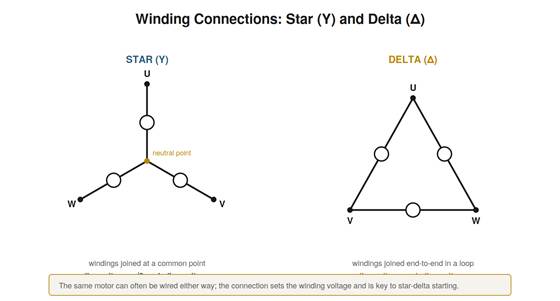
Figure 5.1 — Star (Y) and delta (Δ) winding connections. In star, the windings join at a common point and the line voltage is √3 times the winding voltage; in delta, the windings form a loop and the line voltage equals the winding voltage.
The star connection
In the star connection, one end of each of the three windings is joined together at a common point (the star or neutral point), and the other end of each winding connects to one of the three supply lines. The key consequence is the voltage relationship: because of how the windings are arranged, the voltage across each individual winding is the line voltage divided by the square root of three — about 58 percent of the line voltage. So in a star connection, each winding sees less than the full line voltage. This matters for matching the motor to a supply: a motor whose windings are rated for a particular voltage should be star-connected on a supply whose line voltage is the square root of three times that winding voltage. Understanding the star connection — windings joined at a common point, each seeing the line voltage divided by root three — lets you wire the motor correctly for the supply and understand why the star connection reduces the voltage on each winding, which is the basis of its use in reduced-voltage starting.
The delta connection
In the delta connection, the three windings are joined end to end in a closed loop, with the three supply lines connected to the three junction points. Here the voltage relationship is different: each winding is connected directly across two of the supply lines, so the voltage across each winding equals the full line voltage. A motor in delta thus has the full line voltage on each winding, unlike star where each winding sees less. This means that for a given supply voltage, a delta-connected motor’s windings experience more voltage than if star-connected, so the connection chosen must match the motor’s winding voltage rating to the supply. Understanding the delta connection — windings in a loop, each seeing the full line voltage — completes the picture of the two connections and their voltage relationships. Together, star and delta give two ways to connect the windings to a supply, with the winding voltage being either the line voltage divided by root three (star) or the full line voltage (delta), and choosing the right connection matches the motor’s winding rating to the available supply voltage.
Star-delta starting
The two connections enable a widely used method of reducing a motor’s starting current: star-delta starting. A motor started directly draws a large inrush current, several times its running current, which can be a problem for the supply. Star-delta starting reduces this by starting the motor in star — where each winding sees only the line voltage divided by root three, so the starting current is reduced — and then switching to delta for normal running once the motor is up to speed. The motor accelerates on the reduced star voltage, drawing less starting current, then runs on full delta voltage. This requires a motor whose windings are suitable for delta operation at the supply’s line voltage (so it runs correctly in delta) and a star-delta starter that connects the windings in star for starting and switches them to delta for running. Understanding star-delta starting explains a common starter type and why a motor might be wired through a more complex starter with a star-delta arrangement: it is reducing the starting current by starting at reduced voltage in star before switching to full-voltage delta running, using the two winding connections to achieve reduced-voltage starting.
Why the same motor can be dual-voltage
The star and delta connections explain how a single motor can often be used on two different supply voltages, which is a common and useful feature. Because star puts less voltage on each winding than delta (by the factor root three), the same windings can be correctly supplied at two voltages: at the higher voltage in star, and at the lower voltage (the higher divided by root three) in delta, with the windings seeing the same voltage in both cases. So a dual-voltage motor is one whose windings can be connected in star for the higher supply voltage or delta for the lower, matching the winding voltage in either case. This is why many motors have a terminal arrangement allowing either connection and are marked for two voltages: the connection is chosen to match the supply, star for the higher and delta for the lower. Understanding this — that star and delta put different voltages on the windings, so the same motor suits two supply voltages via the two connections — explains dual-voltage motors and the importance of connecting them correctly for the actual supply voltage. Connecting a dual-voltage motor in the wrong configuration for the supply — delta on the higher voltage, or star on the lower — mis-supplies the windings, causing over- or under-voltage operation, which is a real wiring fault that understanding the connections prevents.
Scenario: the weak motor wired in star
A scenario shows the consequence of a wrong winding connection. A motor that should run in delta on its supply was mistakenly connected in star, and it ran but was weak — unable to develop full power, struggling under load, and running slowly when loaded. Understanding star and delta explains why: in star, each winding sees only the line voltage divided by root three, so a motor connected in star when it should be in delta has too little voltage on its windings, developing reduced torque and thus running weak. The motor was under-fluxed by the star connection on a supply meant for its delta connection, leaving it unable to develop its rated torque. Correcting the connection to delta gave the windings their proper voltage, and the motor then developed full power. This scenario shows a real wiring fault — star instead of delta — diagnosed through understanding the connections: the star connection under-voltaged the windings, weakening the motor, and the fix was to connect it correctly in delta. It reinforces that the winding connection must match the supply and the motor’s design, and that a wrong connection (star for delta) is a real cause of a weak motor, diagnosed by understanding that star puts less voltage on the windings than delta, so a motor wrongly in star runs weak for lack of winding voltage.
Reading the terminal box
The motor’s terminal box is where the star or delta connection is made, and understanding how to read and make the connection there is a practical skill. A three-phase motor typically brings out its winding ends to terminals in the terminal box, arranged so that links or jumpers between the terminals configure the windings in star or delta. Reading the terminal box means identifying the winding terminals and understanding how the links configure the connection: one arrangement of links joins the windings in star (at a common point), another joins them in delta (in a loop). The terminal box usually has markings and often a diagram showing the star and delta link arrangements. Making the correct connection means placing the links for the desired configuration — star or delta — to match the supply and motor requirements. Understanding how to read the terminal box and configure the links is the practical means of connecting the motor correctly in star or delta. It reinforces the star-delta concepts with their physical implementation: the connection is made by links in the terminal box, and reading the box — its terminals, markings, and link arrangements — lets you verify or set the connection correctly. When troubleshooting a wrong-connection problem or wiring a motor, reading the terminal box to check or make the star or delta connection is the hands-on skill that applies the understanding of the two connections.
The connections in the bigger picture
The star and delta connections fit into the bigger picture of matching the motor to its supply and starting it, and understanding this context shows why they matter beyond being just two wiring options. The connection determines the winding voltage relative to the supply, which is fundamentally about matching the motor’s winding rating to the available supply voltage — the right connection puts the right voltage on the windings. This matters for dual-voltage motors (star or delta for two supply voltages) and for correct operation (a wrong connection mis-voltages the windings). The connections also enable star-delta starting, reducing the starting current by starting in star before running in delta. So the two connections are not just wiring details but tools for matching the motor to the supply and for reduced-voltage starting — practical purposes in the bigger picture of applying the motor. Understanding the connections in this context — matching winding voltage to supply, enabling dual-voltage use and star-delta starting — shows their practical importance. It reinforces that star and delta are functional choices with real consequences (correct winding voltage, dual-voltage capability, reduced-voltage starting), not arbitrary wiring options, so that understanding them lets you connect motors correctly for their supply, use dual-voltage motors properly, and understand star-delta starting — the practical applications that make the two connections matter in the bigger picture of applying and starting three-phase motors.
Label the connection
A practical habit around winding connections: when you determine or set a motor’s connection (star or delta) and its supply voltage, record and ideally label it, so the correct configuration is known for future work. Because a wrong connection causes real problems (a weak or over-stressed motor), and because the correct connection depends on the motor and supply, having the correct configuration recorded prevents future errors — someone rewiring or replacing the motor knows the right connection. This is part of good documentation: the connection, along with the supply voltage and nameplate data, defines how the motor should be wired. Understanding that the connection matters and that a wrong one causes problems motivates recording it, so the correct configuration is not lost or guessed at later. It reinforces good practice around the connections: determining the correct one (from the motor and supply) and recording it ensures future work maintains the correct configuration, avoiding the wrong-connection problems that come from uncertainty about how a motor should be wired. Recording and labeling the connection is a small documentation effort that, given the real consequences of a wrong connection, is worthwhile to ensure the motor is always wired correctly for its supply, both now and in any future rewiring or replacement, preserving the correct star or delta configuration that proper operation depends on.