A motor circuit needs two distinct kinds of protection: overload protection against sustained moderate overcurrent that would overheat the motor, and short-circuit protection against the huge currents of a fault. Understanding both — what each protects against and how they work — is essential, because protection that trips is one of the most common motor complaints, and diagnosing it requires knowing what the protection is responding to.
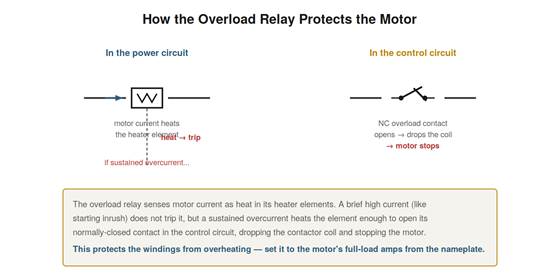
Figure 7.1 — How the overload relay protects the motor. Motor current heats the relay’s heater elements; a sustained overcurrent trips a normally-closed contact in the control circuit, dropping the contactor coil and stopping the motor before the windings overheat.
Overload protection
Overload protection guards the motor against sustained overcurrent — currents above the motor’s rating but not so high as a short circuit — which would overheat and damage the windings if allowed to continue. The overload relay senses the motor current, traditionally by passing it through heater elements that warm in proportion to the current, and trips if the current stays too high for too long. Crucially, it is time-dependent: a brief high current, like the normal inrush when starting, does not trip it, but a sustained overcurrent heats the element enough to trip. When it trips, it opens a contact in the control circuit, dropping the contactor coil and stopping the motor, protecting the windings from overheating. The overload relay must be set to the motor’s full-load current from the nameplate, so it trips on currents above what the motor should draw. Understanding overload protection — sensing sustained overcurrent as heat, tripping after a time to stop the motor, set to the nameplate full-load current — is essential because overload trips are a common complaint, and diagnosing them requires understanding that the overload is responding to a sustained overcurrent, whether from a genuine overload, a fault, or a setting that is too low.
Short-circuit protection
Short-circuit protection guards against the very large currents of a fault — a short between phases or to ground — which are far higher than any overload and must be interrupted almost instantly to prevent damage and danger. This protection is provided by fuses or a circuit breaker in the motor circuit, sized to carry the motor’s normal and starting currents but to interrupt the much larger fault current quickly. Unlike the overload, which trips on sustained moderate overcurrent after a time, the short-circuit protection acts fast on the extreme current of a fault. The two work together: the short-circuit protection handles the rare, extreme fault currents quickly, while the overload handles the more common sustained overcurrents with a time delay. Understanding this division — fuses or breaker for fast short-circuit protection, overload relay for time-delayed overload protection — clarifies what each protective device responds to and why both are needed. When a motor’s protection operates, knowing which device tripped tells you what kind of problem occurred: a blown fuse or tripped breaker indicates a short-circuit-level fault, while a tripped overload indicates a sustained overcurrent, and these point to different causes and different diagnoses.
Why protection trips
Protection tripping is a common motor complaint, and understanding why protection trips guides the diagnosis. An overload trip means the motor has drawn a sustained overcurrent, which could be a genuine mechanical overload (the load too heavy), a fault causing high current (like single-phasing or a winding fault), a supply problem (low voltage causing high current), an environmental issue (high ambient temperature or blocked cooling), or simply an overload setting that is too low for the motor. A short-circuit trip — a blown fuse or tripped breaker — means a fault current, such as a short in the motor, cable, or starter. In each case, the protection is responding to a real electrical condition, and the diagnosis is to find what caused that condition. Importantly, protection that trips is usually doing its job — responding to a real problem — so the response is not to simply defeat the protection but to find and fix what is causing the excessive current. Understanding the causes of tripping — overload from load, fault, supply, environment, or setting; short-circuit from a fault — directs the diagnosis toward the actual cause, which is the proper response to tripping protection, rather than merely resetting it repeatedly, which ignores the real problem the protection is signaling.
Why two kinds of protection
The need for two distinct kinds of protection — overload and short-circuit — reflects two distinct kinds of danger, and understanding why both are needed clarifies their roles. An overload is a moderate overcurrent, above the motor’s rating but not enormous, sustained over time — like a mechanically overloaded motor drawing 130 percent of its rating. This overheats the windings gradually and must be stopped, but not instantly, because brief overcurrents (like normal starting inrush) are acceptable; so overload protection responds after a time delay, tolerating brief overcurrents but tripping on sustained ones. A short circuit is an enormous overcurrent from a fault — many times the normal current — that must be interrupted almost instantly to prevent damage and danger; so short-circuit protection responds very fast. The two dangers — gradual overheating from sustained moderate overcurrent, and instant damage from enormous fault current — require two responses — time-delayed for overload, instantaneous for short circuit — which is why two kinds of protection are needed. Understanding this — two dangers, two responses, two protective devices — explains why a motor circuit has both an overload relay (time-delayed, for sustained overcurrent) and fuses or a breaker (fast, for fault current), each guarding against its kind of danger, together providing complete protection against both the gradual and the sudden overcurrent threats.
Scenario: the overload set too low
A scenario shows a nuisance trip from a wrong protection setting. A motor tripped its overload repeatedly, yet investigation found the motor running normally, driving a normal load, drawing a normal current close to its nameplate full-load value. The motor was fine — so why was it tripping? Checking the overload setting revealed it was set below the motor’s full-load current, so the overload tripped on the motor’s normal running current, treating normal operation as an overload. This was a nuisance trip caused by the wrong setting, not a real overcurrent. Setting the overload correctly to the motor’s nameplate full-load current stopped the nuisance tripping, and the motor ran without tripping. This scenario shows the importance of the overload setting: set too low, it trips on normal current, causing nuisance trips of a healthy motor. Understanding that the overload must be set to the nameplate full-load current — and that a setting too low causes nuisance tripping — diagnoses this common problem: a motor that trips but is drawing normal current has its overload set too low. It reinforces checking the overload setting against the nameplate when a motor trips, distinguishing a nuisance trip from a wrong setting (motor fine, setting too low) from a genuine trip from real overcurrent (motor drawing excess current), which call for different responses — correcting the setting versus finding the overcurrent’s cause.
Respecting what protection tells you
Protection that operates is telling you something, and respecting its message rather than defeating it is the mark of good practice. When an overload trips or a fuse blows, the immediate temptation may be to simply reset or replace and restart — but the protection operated because of a real electrical condition (a sustained overcurrent or a fault), and simply restoring it without addressing the cause invites the same operation again, or worse, damage if the protection is defeated. Respecting the protection means treating its operation as a signal to investigate: what caused the overcurrent or fault that made it operate? Finding and fixing that cause is the proper response, after which the protection will not operate because the condition is resolved. Defeating the protection — by oversizing it, bypassing it, or repeatedly resetting without investigation — removes the guard against a real danger and can lead to motor damage or worse. Understanding that protection operation is a meaningful signal to be respected and investigated, not an annoyance to be defeated, is essential to safe and effective motor work. It reinforces that tripped protection is usually doing its job — responding to a real problem — and that the correct response is to find and fix what caused it, not to defeat the protection, which would leave the underlying problem unaddressed and the motor unprotected against the danger the protection guards against.
Protection as the motor’s guardian
Protection is the motor’s guardian against electrical dangers, and appreciating this role frames how to think about it in operation and troubleshooting. The overload relay guards against the sustained overcurrents that would overheat and destroy the windings; the short-circuit protection guards against the fault currents that would cause immediate damage and danger. Together they protect the motor (and the circuit and people) from the electrical dangers of overcurrent, standing guard and acting when a dangerous condition arises. This guardian role means that when protection operates, it is protecting against a real danger, and the proper response is to find and fix what caused the danger, not to defeat the guardian. It also means that correct protection — properly sized and set — is essential to the motor’s safety, and that missing or defeated protection leaves the motor unguarded against overcurrent dangers. Understanding protection as the motor’s guardian — guarding against overload and fault overcurrents — frames its importance and the correct response to its operation. It reinforces that protection is there to protect, that its operation signals a real danger to be addressed, and that maintaining correct protection is essential to safe motor operation, so that the protection should be respected and maintained as the motor’s guardian, with its operation treated as a meaningful warning of a danger to be investigated and resolved rather than an inconvenience to be circumvented, keeping the guardian in place to protect the motor as intended.
Recording the overload setting
A practical habit around protection: record the correct overload setting for each motor, so it can be verified and restored. Because the overload must be set to the motor’s full-load current, and a wrong setting causes either nuisance trips (too low) or inadequate protection (too high), knowing the correct setting — recorded from the nameplate full-load current — lets you verify the setting is right and restore it if changed. This is useful when a motor trips (check the setting against the record), after any work on the starter (restore the correct setting), or when replacing an overload (set it correctly). Understanding that the overload setting must match the nameplate full-load current, and that a wrong setting causes problems, motivates recording the correct setting for reference. It reinforces good practice around protection: the correct overload setting, derived from the nameplate and recorded, provides a reference to verify and maintain the protection’s setting, preventing the nuisance trips or inadequate protection that a wrong setting causes. Recording the correct overload setting is a small documentation effort that helps keep the protection correctly set, so that the overload reliably protects the motor without nuisance-tripping, which depends on it being set to the motor’s full-load current — a value worth recording so it can be verified and maintained over the motor’s service life.