The most basic and revealing motor measurements are voltage and current on the three phases, and especially their balance. Because a three-phase motor depends on three balanced phases, measuring all three and checking how well they match is a powerful diagnostic, revealing supply problems, winding faults, and the imbalances that cause overheating. Understanding how to measure and interpret voltage, current, and balance is fundamental to motor testing.
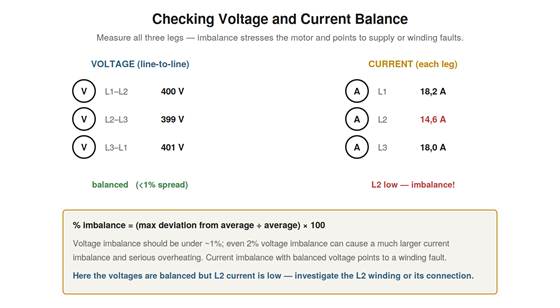
Figure 8.1 — Checking voltage and current balance. Measure all three legs; voltage imbalance should be under about 1%, and current imbalance with balanced voltage points to a winding fault. Even small voltage imbalance can cause large current imbalance and overheating.
Measuring the three phases
Motor voltage and current should always be measured on all three phases, not just one, because a three-phase motor’s health depends on all three being balanced. Voltage is measured between the lines — line one to line two, line two to line three, line three to line one — giving the three line voltages. Current is measured in each of the three lines, typically with a clamp meter around each conductor, giving the three line currents. Measuring all three, rather than assuming they are equal, is essential because imbalance between them is a key diagnostic that a single-phase measurement would miss. The three voltages should be close to each other and to the nameplate rated voltage; the three currents should be close to each other and, at full load, near the nameplate full-load current. Measuring all three phases of both voltage and current gives the complete electrical picture of the motor’s supply and draw, and comparing the three against each other and against the nameplate is the basis of the balance checks and the judgment of whether the motor is being supplied and is drawing current correctly.
Voltage balance
Voltage balance — how closely the three line voltages match — is an important check because voltage imbalance stresses the motor severely. The three line voltages should be nearly equal; the imbalance is calculated as the maximum deviation from their average, divided by the average, as a percentage. A small imbalance, under about one percent, is acceptable, but larger imbalances are a problem, because voltage imbalance causes a disproportionately larger current imbalance — a small voltage imbalance can produce a current imbalance several times larger — leading to uneven heating and overheating of the windings. So even a seemingly modest voltage imbalance of a couple of percent can cause serious overheating and should be investigated. Voltage imbalance points to a supply problem: unequal loading of the phases, a poor connection, or a supply fault. Checking voltage balance, and investigating imbalance beyond about one percent, catches a supply condition that stresses and overheats the motor, and understanding that voltage imbalance amplifies into larger current imbalance explains why even small voltage imbalances matter and must be addressed to protect the motor from the overheating they cause.
Current balance
Current balance — how closely the three line currents match — is equally revealing, and its interpretation depends on the voltage balance. If the voltages are balanced but the currents are not, the imbalance originates in the motor: a winding fault, an unequal winding, or a poor connection in one phase, causing that phase to draw a different current. If the currents are imbalanced because the voltages are imbalanced, the cause is the supply, and correcting the voltage balance should correct the current balance. So current imbalance with balanced voltage points to the motor, while current imbalance from voltage imbalance points to the supply — an important distinction for localizing the fault. Current balance is also a sensitive indicator of developing problems, as a winding beginning to fault may first show as a current imbalance. Checking current balance, and interpreting it in light of the voltage balance, distinguishes motor faults from supply problems and catches developing winding issues. Understanding that current imbalance with good voltage balance indicates a motor problem, while current imbalance following voltage imbalance indicates a supply problem, directs the diagnosis correctly and makes the balance checks a powerful tool for localizing the cause of imbalance to either the motor or its supply.
The clamp meter and safe current measurement
The clamp meter is the key tool for motor current measurement, and understanding why makes clear how to measure current safely and easily. A clamp meter measures the current in a conductor by clamping around it, sensing the magnetic field the current produces, without any electrical connection to the conductor — so you can measure the running current without breaking the circuit or making contact with live conductors. This is a major safety and convenience advantage: measuring motor current in series would require breaking into the circuit, disruptive and requiring the circuit to be opened, whereas the clamp meter simply clamps around each conductor to read its current with the motor running and the circuit intact. This makes measuring the three-phase currents — clamping each of the three conductors in turn — straightforward and safe. Understanding the clamp meter — non-contact current measurement by clamping around a conductor — explains how motor currents are measured in practice: safely, without breaking the circuit, by clamping each conductor. It is the standard tool for the current and balance measurements that are so central to motor diagnosis, enabling the routine measurement of running currents that would otherwise be impractical, and its non-contact operation is what makes checking the three-phase currents a safe, quick, routine part of motor testing.
Scenario: small voltage imbalance, big consequences
A scenario shows why even small voltage imbalance matters. A motor was overheating, and its currents were noticeably imbalanced — one phase drawing significantly more than the others. Suspecting a motor fault, the technician also checked the voltages and found them imbalanced by only about two percent — a seemingly small amount. But understanding that voltage imbalance produces a magnified current imbalance explained the overheating: the modest two percent voltage imbalance had caused a much larger current imbalance, several times greater, and the resulting uneven, excessive current in one phase was overheating the motor. The cause was not a motor fault but the supply voltage imbalance, magnified into a damaging current imbalance. Correcting the supply voltage imbalance (tracing it to unbalanced loading of the phases) balanced the currents and stopped the overheating. This scenario shows the important principle that small voltage imbalances cause disproportionately large current imbalances and serious overheating: a mere two percent voltage imbalance produced a damaging current imbalance. Understanding this magnification — and checking voltage balance when currents are imbalanced — diagnosed the overheating as a supply imbalance rather than a motor fault. It reinforces that voltage balance must be checked and kept tight (under about one percent), because even small voltage imbalances have big consequences through the magnified current imbalance and overheating they cause.
Balance as a sensitive early indicator
Balance measurements are a sensitive early indicator of developing problems, and understanding this makes them valuable for both diagnosis and monitoring. Because a healthy motor on a healthy supply has well-balanced voltages and currents, any developing imbalance — a winding beginning to fault, a connection starting to degrade, a supply becoming unbalanced — shows up as a growing imbalance before it becomes a hard failure. So checking balance, and especially tracking it over time, can catch a developing problem early: a current imbalance appearing where there was none, or growing, signals a developing fault in the motor or supply. This sensitivity makes balance a good thing to monitor in preventive maintenance, catching developing problems before they cause failures, as well as a good diagnostic when a problem is present. Understanding that balance is a sensitive early indicator — developing faults show as growing imbalance before hard failure — adds value to the balance measurements beyond immediate diagnosis: tracked over time, they provide early warning of developing motor and supply problems. It reinforces measuring and recording balance regularly, not just when troubleshooting, because the balance is sensitive to developing problems and its trend over time can catch a fault developing, providing the early warning that allows planned repair before the problem becomes a failure, which is the essence of predictive maintenance applied to motor balance.
Measurement as the basis of diagnosis
Voltage, current, and balance measurements are the basis of electrical motor diagnosis, and recognizing this centrality shows why measuring competently matters so much. These measurements reveal the motor’s electrical operation — whether it is supplied correctly (voltage), drawing normal current (current versus nameplate), and operating in balance (balance) — which is the fundamental electrical information a diagnosis needs. From them follow the judgments: overload (high current), supply problems (wrong or imbalanced voltage), motor faults (current imbalance with good voltage), and more. So the ability to measure voltage, current, and balance competently and safely is the foundation of electrical motor diagnosis, providing the observations the diagnosis reasons from. A technician who measures these well has the basis for diagnosis; one who cannot measure them reliably lacks the fundamental information. Understanding measurement as the basis of diagnosis — the observations from which electrical judgments follow — underscores the importance of measuring competently. It reinforces that the measurement skills are foundational, not peripheral: the voltage, current, and balance measurements provide the essential electrical information, and diagnosing motor problems electrically depends on obtaining these measurements accurately and safely, then interpreting them against the nameplate and each other. Measurement competence is therefore prerequisite to diagnostic competence, making the measurement techniques — and especially the safe, complete measurement of all three phases — a foundation worth mastering as the basis of all electrical motor diagnosis.
Safe measurement discipline
A practical emphasis on the measurements that require the motor energized: the discipline of safe live measurement. Measuring running voltage and current requires the circuit energized, which means working near live conductors — a real hazard demanding proper procedure: the correct meter and leads rated for the voltage, correct technique (especially the non-contact clamp meter for current), appropriate personal protective equipment, and full attention. The measurements are valuable, but only worth taking safely; an unsafe measurement risks injury. Understanding that some measurements require the circuit live, and that live work is hazardous, emphasizes the discipline of safe measurement: using the right tools and technique, with proper protection, and only when necessary. It reinforces that the valuable running measurements must be taken safely, with the discipline that live work demands, so that the diagnostic value of measuring running voltage and current is obtained without accepting undue risk. The clamp meter helps by allowing non-contact current measurement, reducing the hazard, but voltage measurement and any contact work require careful safe technique. Emphasizing safe measurement discipline — right tools, right technique, right protection, only when necessary — ensures the running measurements are taken safely, which is essential given that they require the circuit energized and thus involve working near the lethal voltages that three-phase motor circuits carry, making safe discipline inseparable from competent live measurement.