Affiliate disclosure: This post contains an affiliate link. If you buy through my link, I may earn a small commission at no extra cost to you.
Book link:
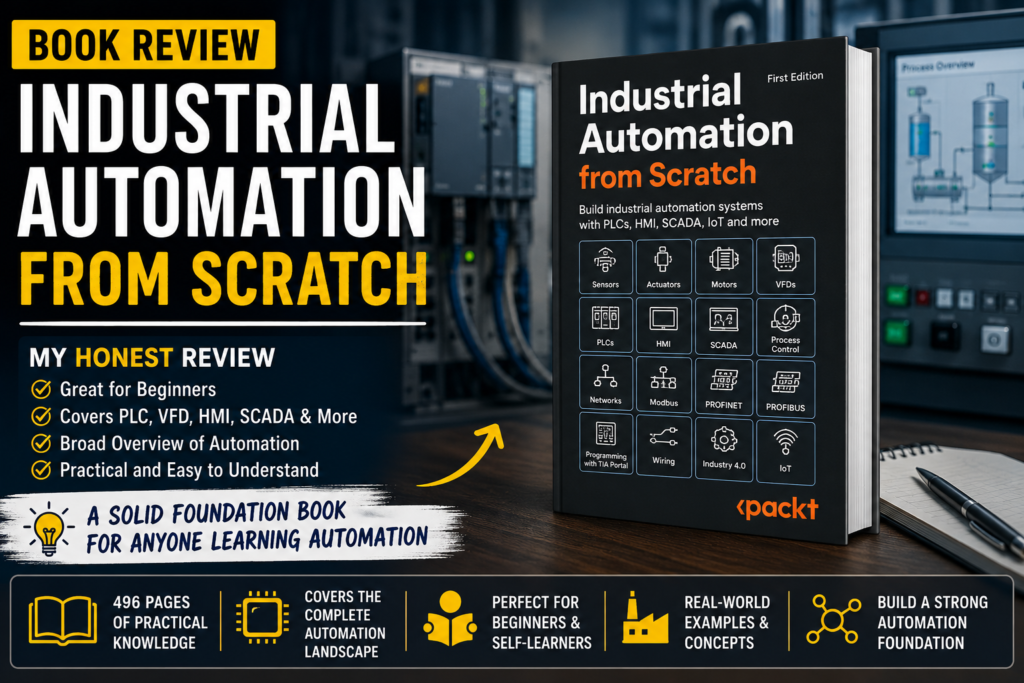
Industrial Automation from Scratch
I recently read Industrial Automation from Scratch, and honestly, I liked the information it gave.
It is not the type of book that only focuses on one tiny part of automation. Instead, it gives a wider look at how industrial automation systems actually work. For me, that was the most useful part.
When you are learning PLCs or trying to understand factory automation, it is easy to get stuck only on programming. But real industrial machines are not just PLC code. You also have sensors, actuators, motors, VFDs, electrical panels, HMIs, SCADA systems, communication networks, and many other things working together.
This book helped connect those pieces better.
What I Liked About the Book
The biggest thing I liked is that the book explains many important automation topics in one place.
It covers things like:
Sensors
Actuators
Motors
Variable Frequency Drives
PLC hardware
PLC wiring
TIA Portal
HMI systems
SCADA
Process control
Industrial networks
Modbus
PROFINET
PROFIBUS
Industry 4.0 basics
For me, this made the book feel more like an industrial automation foundation guide, not just a PLC programming book.
That is useful because if you want to understand real automation systems, you need more than just ladder logic. You need to understand how the PLC connects to the real machine.
A sensor gives a signal.
A PLC reads it.
The program makes a decision.
The output controls something.
A motor starts.
A VFD controls speed.
An HMI shows status.
A network connects the devices.
That full picture matters.
Good for Building Automation Knowledge
I think this book is especially useful if you are still building your base knowledge in industrial automation.
It does not feel like a super advanced engineering textbook. That is actually a good thing. The information is easier to follow, and it gives a practical overview of the topics that appear in real industrial work.
I liked it because it gave me many ideas for what to study next.
For example, if you are learning TIA Portal, the book can help you understand where PLC programming fits inside a bigger automation system. If you are learning about VFDs, it gives context about how drives are used with motors and control systems. If you are interested in industrial networks, it introduces common communication systems like Modbus, PROFINET, and PROFIBUS.
It is broad, but that is also the reason I found it useful.
Is It Good for PLC Learning?
Yes, but with one important note.
I would not use this book as my only resource for learning Siemens PLC programming.
It includes PLC topics and TIA Portal information, which is useful. But if your goal is to become really good with Siemens PLCs, you will still need more practice.
You should also use:
Siemens manuals
TIA Portal practice projects
Real PLC examples
HMI practice
Wiring diagrams
A more Siemens-focused book or course
So, I see this book more as a strong automation overview. It helps you understand the full system. Then, after that, you can go deeper into PLC programming, HMI development, VFD setup, or industrial networks.
Who I Think This Book Is For
I would recommend this book to people who are:
Learning industrial automation
Starting with PLCs
Interested in TIA Portal
Working around electrical panels
Trying to understand factory machines
Moving from electrical work into automation
Looking for a broad automation reference
Creating automation or PLC learning content
If you are already very advanced in PLC programming, maybe this book will feel too general in some places. But for beginners and early intermediate learners, I think it gives a lot of useful information.
What I Did Not Like
The main weakness is that the book is broad.
It covers many topics, but because of that, it cannot go extremely deep into every single one.
So if you are looking only for deep Siemens TIA Portal programming, this may not be enough by itself. You will need more focused learning materials.
But as a book for understanding industrial automation overall, I liked it.
Final Verdict
After reading Industrial Automation from Scratch, I think it is a good book for anyone who wants to understand industrial automation better.
It gives a useful overview of PLCs, VFDs, sensors, actuators, HMIs, SCADA, industrial networks, and other important automation topics.
For me, the best part was that it helped connect the different parts of automation into one bigger picture.
Would I recommend it?
Yes.
I would buy it as a broad automation foundation book.
I would not buy it as my only Siemens PLC programming resource.
So my final opinion is:
If you are learning industrial automation and want a practical overview, this book is worth checking out.
Check the book here:
[Industrial Automation from Scratch]