Before troubleshooting a variable frequency drive, it helps to be
clear about what it does and why, because its purpose shapes both its
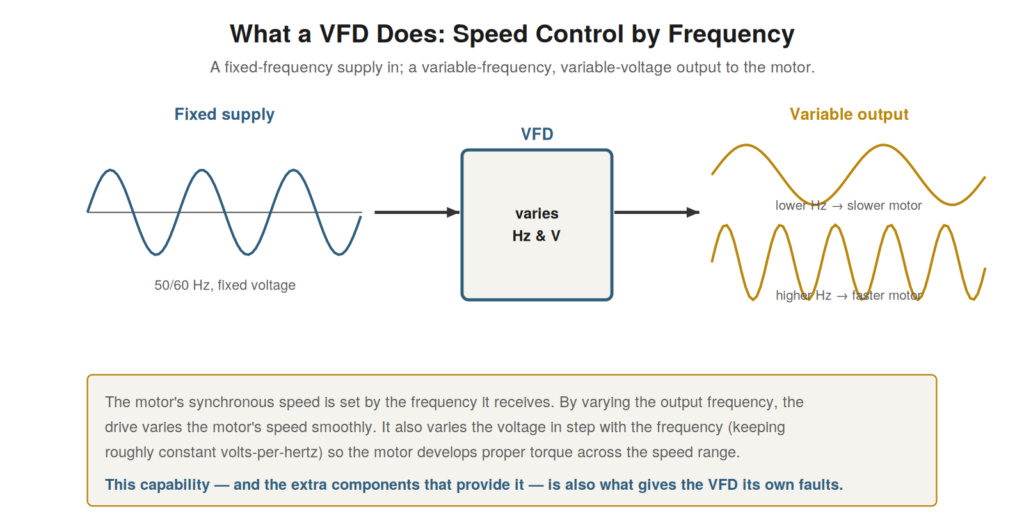
design and its faults. A VFD takes the fixed-frequency alternating power
of the supply and converts it into an output whose frequency — and
voltage — the drive can vary. Because an induction motor’s speed follows
the frequency it receives, varying the output frequency varies the
motor’s speed, smoothly and over a wide range. This ability to control
motor speed electronically, rather than running the motor at one fixed
speed, is the VFD’s central purpose, and everything about the drive
follows from it.
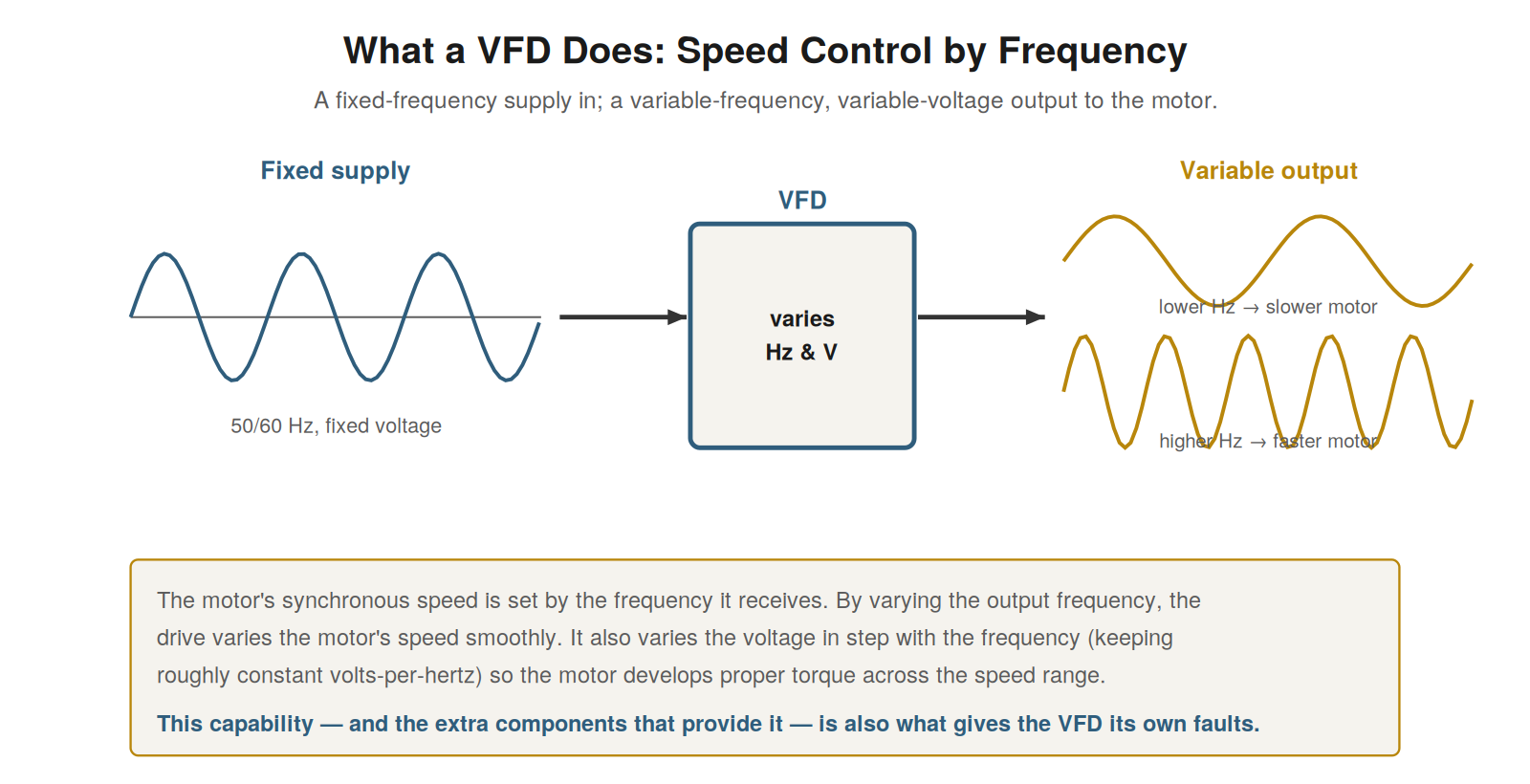
and a variable-frequency, variable-voltage output goes to the motor.
Varying the output frequency varies the motor’s speed; the voltage is
scaled with it to keep proper torque.
Why vary a motor’s speed
The reasons to vary a motor’s speed are compelling, which is why
drives have become so widespread. Many loads do not need full speed all
the time: a pump feeding a varying demand, a fan whose airflow should
modulate, a conveyor that should match a changing production rate.
Running such a load at full speed and throttling it wastes energy,
whereas slowing the motor to match the demand saves a great deal of
energy — often the primary justification for a drive. Beyond energy,
variable speed gives better process control, letting the motor run at
exactly the speed the process needs. And the drive starts the motor
gently, ramping it up rather than the harsh across-the-line start,
reducing mechanical and electrical stress. Understanding these reasons —
energy saving, process control, and gentle starting — explains why VFDs
are used so extensively and what they are expected to deliver. It also
frames the troubleshooting: a drive exists to control speed efficiently
and gently, and its faults often relate to this function, so
understanding the purpose helps understand the problems, which arise
from the electronics that provide the variable-speed capability the load
requires.
Frequency, voltage, and speed
The heart of what a VFD does is the relationship between frequency,
voltage, and motor speed. An induction motor’s speed is set by the
frequency of the power it receives — higher frequency, higher speed — so
the drive controls speed by controlling frequency. But it cannot simply
vary the frequency alone: the motor also needs its voltage scaled in
proportion to the frequency, to maintain the right magnetic flux in the
motor. So the drive varies voltage and frequency together, keeping
roughly constant volts-per-hertz, so the motor develops proper torque
across its speed range. At low frequency, the drive supplies low
voltage; at higher frequency, higher voltage, up to the motor’s rated
voltage at its rated frequency. Understanding this — the drive varies
frequency to set speed, and scales voltage with frequency to maintain
flux and torque — is fundamental to how the drive operates and to many
of its faults. The volts-per-hertz relationship is central: getting it
wrong (through motor data or settings) causes torque and current
problems, and understanding that the drive controls both frequency and
voltage together, in proportion, is the basis for understanding the
drive’s output and the faults related to it.
Capability comes with complexity
The VFD’s capability comes at the cost of complexity, and this
complexity is the source of its faults — a key point for
troubleshooting. A simple across-the-line starter connects the motor
directly to the supply with a contactor; it is robust and has few
failure modes. A VFD, by contrast, contains power electronics (the
rectifier, DC bus, and inverter), a control system with a microprocessor
and extensive parameters, cooling systems, and communication interfaces
— far more that can go wrong. This added complexity is the price of the
variable-speed capability, and it means a VFD has its own distinct set
of faults that a simple starter does not: overvoltage and undervoltage
on the DC bus, overtemperature of the electronics, faults in the
inverter, parameter errors, communication problems, and more.
Understanding that the drive’s capability brings complexity, and that
this complexity is where its faults live, frames the whole subject of
VFD troubleshooting: the drive does more than a starter, and
correspondingly there is more to understand and diagnose. The good news,
developed throughout this book, is that this complexity is organized and
comprehensible — the drive’s structure, control, and faults follow clear
principles — and that the drive helps by reporting its own faults, so
that the added complexity, while real, is manageable with understanding
and method.
The drive versus the simple starter
A useful way to appreciate what a VFD does is to compare it with the
simple starter it often replaces. A direct-on-line starter connects the
motor to the full fixed-frequency supply through a contactor: the motor
runs at one speed, full speed, whenever it is on, and starts with a
harsh inrush of current. A VFD, in place of that starter, controls the
motor continuously: it starts the motor gently by ramping the frequency
up from zero, runs it at whatever speed the process needs by setting the
frequency, and stops it by ramping down. So where the starter offers
on-off control at a single speed, the drive offers continuous speed
control with gentle starting and stopping. This difference —
single-speed on-off versus continuous variable-speed control — captures
what the drive adds. Understanding the drive by contrast with the
starter clarifies its function: it is not merely a fancier way to switch
the motor on, but a fundamentally different mode of control, governing
the motor’s speed continuously rather than just connecting it to the
supply. This is why the drive is so much more capable — and so much more
complex — than the starter, and understanding the contrast frames both
the drive’s value (continuous speed control, gentle operation) and its
greater complexity (the electronics that provide that control), which
together define what the drive does and why it has the faults it
does.
Scenario: the pump that saved energy
A scenario shows why drives are so widely adopted. A plant had a
large pump feeding a process whose demand varied through the day, and
the pump ran at full speed always, with a valve throttling the flow to
match demand — wasting energy, as the pump did full work while the valve
dissipated the excess. Replacing the throttling arrangement with a VFD
driving the pump let the pump run only as fast as the demand required:
at low demand, the drive slowed the pump, using far less energy; at high
demand, it ran faster. The energy saving was substantial, because pump
power falls steeply with speed, so slowing the pump to match demand
saved much more energy than throttling a full-speed pump. This scenario
illustrates the drive’s primary justification in many applications:
energy saving by matching motor speed to the actual demand, rather than
running at full speed and throttling. Understanding what the drive does
— varying the motor speed to match the need — explains this energy
saving, which is often the main reason drives are installed. The
scenario reinforces the drive’s value: by controlling the pump’s speed
to match demand, the drive saves the energy that a
full-speed-and-throttle arrangement wastes, which is why drives are so
widely adopted on variable-demand loads like pumps and fans, where the
energy savings from variable-speed operation are large and directly
justify the drive.
Where drives are used
Understanding where drives are typically used helps place your
troubleshooting in context and anticipate the applications you will
encounter. Drives are used wherever variable motor speed brings benefit:
on pumps and fans (the largest category, for energy saving by matching
output to demand), on conveyors and material handling (for controlled,
gentle starting and speed matching), on machine tools and processing
equipment (for precise speed control), on mixers, extruders, and many
process machines (for process control), and on hoists and cranes (for
controlled lifting and lowering, involving regeneration). Each
application has characteristic considerations: pumps and fans emphasize
energy saving and may have specific control modes; conveyors emphasize
smooth starting; cranes involve overhauling loads and regeneration;
precise applications use vector control. Understanding the range of
applications and their characteristics helps anticipate the drives and
problems you will meet. It reinforces that drives are widespread across
many applications, each with its own emphases, so that understanding an
application’s nature (pump, conveyor, crane, machine) informs the
troubleshooting — a crane’s overvoltage likely being regeneration from
lowering, a pump drive emphasizing energy-saving speed control, a
precise machine using vector control. Understanding where drives are
used, and the characteristics of different applications, provides
context that aids troubleshooting by anticipating the typical concerns
of each application, connecting the general understanding of drives to
the specific applications where they are found and the characteristic
problems each presents.
The foundation for understanding faults
Understanding what a VFD does is the foundation for understanding its
faults, and recognizing this connects the drive’s purpose to its
troubleshooting. Because the drive’s faults arise from the electronics
that provide its function — varying frequency and voltage to control
motor speed — understanding that function is the basis for understanding
the faults. The DC bus faults relate to the drive’s conversion to and
from DC; the overcurrent to the inverter’s output; the overtemperature
to the electronics’ heat; the parameter faults to the configuration
governing the drive’s operation. Every fault category connects to some
aspect of what the drive does, so understanding the drive’s function
illuminates its faults. Recognizing that understanding the drive’s
purpose and operation is the foundation for understanding its faults
reinforces the value of the fundamentals: they are not separate from
troubleshooting but its basis. Understanding what the drive does — and
how it does it — explains why it has the faults it has and how to reason
about them, making the functional understanding the foundation on which
the fault diagnosis rests. Recognizing this connection — that the
drive’s function explains its faults — underscores learning the
fundamentals well, because they are the key to understanding the faults
that arise from the drive’s operation, so that a technician who
understands what the drive does and how is equipped to understand and
diagnose its faults, which are consequences of that operation,
connecting the drive’s purpose directly to the practical work of
troubleshooting it.