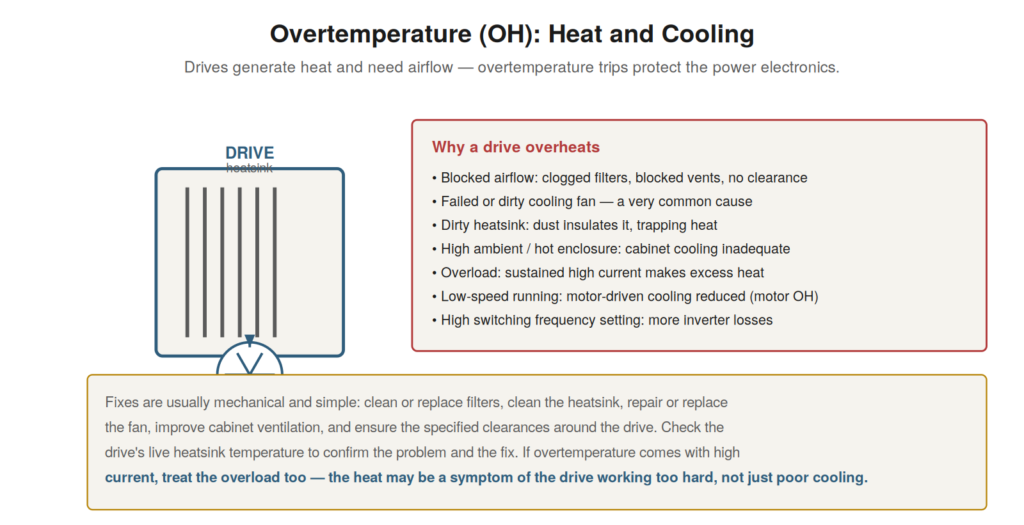
Overtemperature faults protect the drive’s power electronics from
excessive heat, and they are among the more straightforward faults to
diagnose and fix, being usually cooling-related. A drive generates heat
in its power electronics and must dissipate it through cooling; when it
cannot, the temperature rises and the drive trips to protect itself.
Because the causes are usually mechanical cooling problems, the
diagnosis and fixes are often simple, and this chapter covers them.
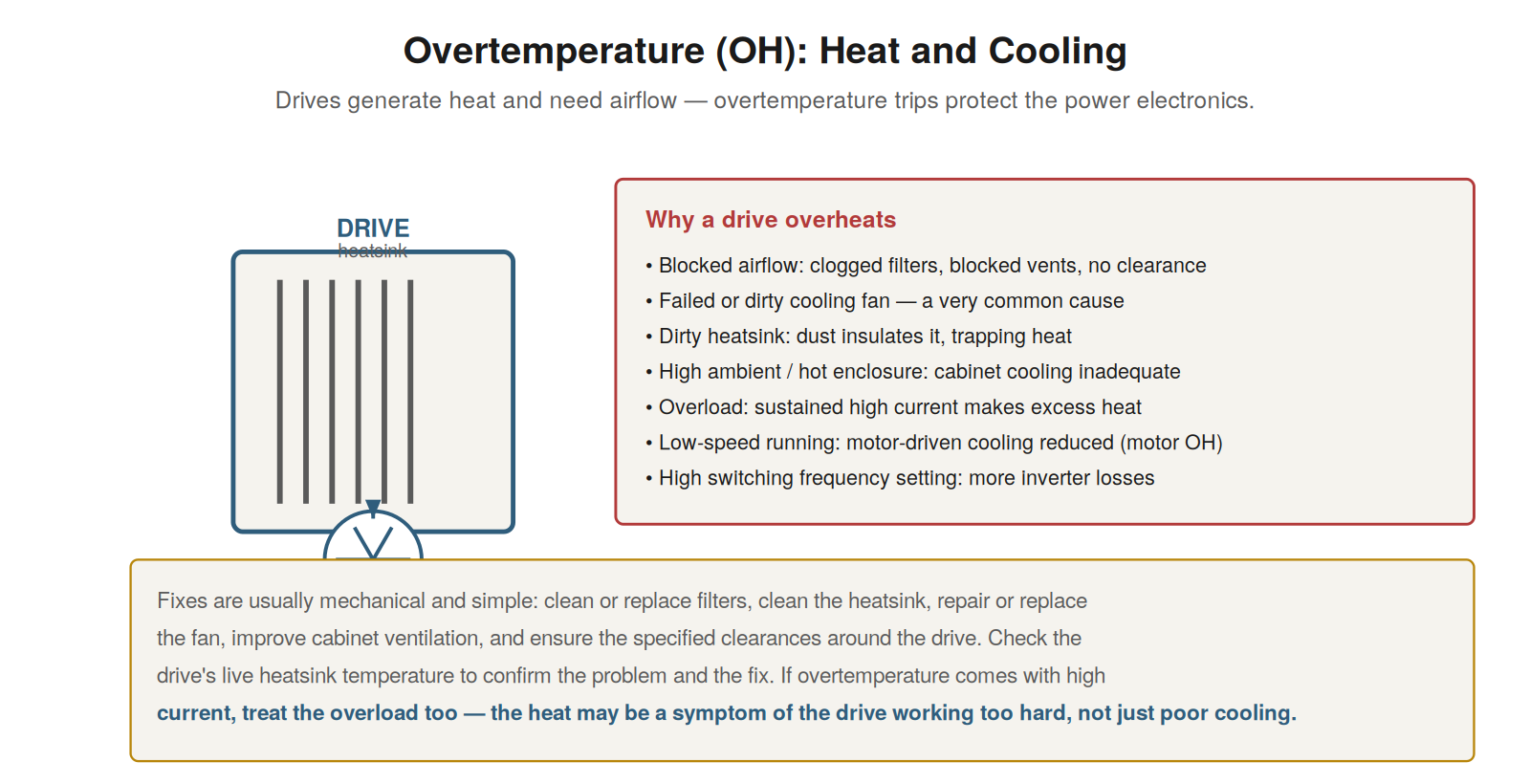
airflow through the heatsink and cooling fan. Causes are usually
cooling-related — blocked airflow, failed or dirty fan, dirty heatsink,
high ambient, or overload. Fixes are usually mechanical and
simple.
Why drives overheat
A drive overheats when it generates more heat than its cooling can
remove, and the causes are mostly cooling-related. The drive’s power
electronics — the rectifier and especially the inverter — generate heat
in operation, which is normally removed by a heatsink and cooling fan.
Overheating results when this cooling is impaired: blocked airflow
(clogged filters, blocked vents, insufficient clearance around the
drive), a failed or dirty cooling fan (a very common cause), a dirty
heatsink (dust insulating it and trapping heat), or a high ambient
temperature or hot enclosure that the cooling cannot overcome.
Overheating can also come from the drive working too hard — a sustained
overload generating excess heat — or from a high switching frequency
setting increasing the inverter’s losses. Understanding why drives
overheat — mostly impaired cooling, sometimes overload or settings —
directs the diagnosis. It reinforces that overtemperature faults usually
stem from cooling problems (blocked airflow, failed fan, dirty heatsink,
high ambient), which are the first things to check, with overload and
switching frequency as further possibilities. Because the causes are
mostly cooling-related and mechanical, the diagnosis of overtemperature
typically involves checking the drive’s cooling — the airflow, fan,
heatsink, and ambient — to find the impairment causing the overheating,
making overtemperature a fault that usually leads to a cooling problem
identified by examining the drive’s cooling system and environment.
Diagnosing and fixing overheating
Diagnosing and fixing an overtemperature fault is usually
straightforward, following from the cooling-related causes. The
diagnosis checks the drive’s cooling: are the air filters clean, the
vents clear, the clearances adequate? Is the cooling fan running and
clean? Is the heatsink clean or coated with dust? Is the ambient
temperature or enclosure too hot? The drive’s live heatsink temperature
reading confirms the overheating and, after a fix, confirms the cure.
The fixes are usually simple and mechanical: clean or replace clogged
filters, clean the heatsink of dust, repair or replace a failed fan,
improve the enclosure ventilation, ensure proper clearances. If
overheating accompanies high current, the overload should also be
addressed, as the heat may be from the drive working too hard rather
than just poor cooling. Understanding how to diagnose and fix
overheating — check the cooling, confirm with the heatsink temperature,
apply the usually simple mechanical fixes — makes overtemperature a
manageable fault. It reinforces that overtemperature is often among the
easier faults to resolve, its cooling-related causes being identifiable
by inspection and its fixes usually simple maintenance (cleaning, fan
replacement, ventilation). Understanding the diagnosis — examine the
cooling, use the heatsink temperature reading — and the fixes — clean,
repair, ventilate — equips the technician to resolve overtemperature
faults efficiently, addressing the cooling impairment that usually
causes them, while remembering to check for an accompanying overload
that would indicate the heat comes from excessive work rather than only
from impaired cooling.
Motor overtemperature versus drive
overtemperature
It is important to distinguish drive overtemperature from motor
overtemperature, because they are different faults with different
causes, though a drive may report both. Drive overtemperature, discussed
above, concerns the drive’s own electronics overheating, usually from
cooling problems in the drive. Motor overtemperature concerns the motor
overheating, which the drive may detect (through a motor thermal model
or a motor temperature sensor) and report. Motor overheating has its own
causes: overload, low-speed running (reducing the motor’s self-cooling,
a particular concern with drives that run motors slowly for extended
periods), poor motor cooling, or excess current from wrong settings. So
a temperature fault from a drive could concern the drive’s electronics
or the motor, and distinguishing which is essential to diagnosing
correctly. Understanding this distinction — drive overtemperature (the
electronics, usually drive cooling) versus motor overtemperature (the
motor, from overload, low-speed cooling, or other motor causes) —
ensures the right diagnosis. It reinforces reading the fault carefully
to determine whether the drive or the motor is overheating, because they
call for different investigations: the drive’s cooling for drive
overtemperature, the motor’s loading and cooling for motor
overtemperature. A particular drive-related cause of motor overheating —
reduced self-cooling at low speed — is worth noting, as drives commonly
run motors slowly, which can overheat a motor relying on its
shaft-driven fan for cooling. Understanding the distinction directs the
temperature-fault diagnosis to the correct subject, the drive or the
motor, each with its own causes and fixes.
The heatsink and airflow path
Understanding the drive’s cooling path — how heat gets from the
electronics to the air — helps diagnose overtemperature faults
precisely. The drive’s power electronics, especially the inverter’s
switching devices, generate heat, which is conducted to a heatsink — a
metal structure with fins that spread the heat to a large surface area.
A cooling fan blows air across the heatsink fins, carrying the heat away
into the surrounding air, which must then be removed from the enclosure.
So the cooling path runs: electronics to heatsink to fin surface to air
(moved by the fan) to enclosure to ambient. A problem anywhere in this
path impairs cooling: a dirty heatsink (dust insulating the fins), a
failed fan (no airflow across the fins), blocked airflow (the air cannot
reach or leave the fins), a hot enclosure (the air is already hot), or
high ambient (nowhere for the heat to go). Understanding this cooling
path — electronics to heatsink to air to ambient — lets you diagnose
overtemperature by checking each stage: is the heatsink clean, the fan
working, the airflow clear, the enclosure and ambient cool? It
reinforces systematic overtemperature diagnosis: trace the cooling path
and find the impaired stage. Understanding how the drive’s cooling works
— the path from the heat-generating electronics through the heatsink and
fan to the ambient air — makes the overtemperature diagnosis precise,
checking each stage of the cooling path to find where the heat removal
is impaired, which is the cause of the overheating.
Scenario: the failed fan
A scenario shows a simple, common overtemperature cause. A drive
began tripping on overtemperature, having run fine for years. Checking
the cooling — following the overtemperature diagnosis — the technician
found the drive’s cooling fan had failed, no longer moving air across
the heatsink. Without the fan’s airflow, the heatsink could not shed the
heat from the electronics, so the drive overheated and tripped. The
drive’s live heatsink temperature reading confirmed it was running hot.
The cause was simply the failed fan — a common, finite-life component.
Replacing the fan restored the airflow and cooling, the heatsink
temperature returned to normal, and the overtemperature trips stopped.
This scenario shows a failed cooling fan — a very common overtemperature
cause — diagnosed by checking the cooling and confirmed by the heatsink
temperature, and fixed simply by replacing the fan. Understanding that
overtemperature is usually cooling-related, and that the fan is a common
failure point, explains this straightforward diagnosis and fix. It
reinforces that overtemperature faults usually have simple, mechanical,
cooling-related causes — here a failed fan — found by checking the
cooling and fixed by simple maintenance (fan replacement). The scenario
reinforces the usually-simple nature of overtemperature faults: the
failed fan, a common finite-life component, caused the overheating,
diagnosed by checking the cooling and confirmed by the drive’s heatsink
temperature reading, and resolved by the simple fix of replacing the
fan, illustrating why overtemperature is often among the more
straightforward drive faults to resolve.
Ambient temperature and derating
An important factor in drive overheating is the ambient temperature
and the related concept of derating, and understanding them explains
overheating that is not due to a cooling fault. A drive is rated to
operate up to a certain ambient temperature, and its cooling is designed
for that. If the ambient temperature is higher — a hot plant, a hot
enclosure, poor room ventilation — the drive’s cooling has less margin,
and the drive may overheat even with its cooling working properly,
because the cooling air is already hot. To handle high ambients, drives
are derated: operated at reduced output (less current, less heat) to
stay within temperature limits, or provided with extra cooling. So
overheating can result from a high ambient temperature exceeding the
drive’s rating, not a cooling fault, addressed by reducing the ambient
(better ventilation, cooling the enclosure) or derating the drive.
Understanding ambient temperature and derating — that a high ambient can
cause overheating despite good cooling, addressed by reducing the
ambient or derating — explains this cause and its remedy. It reinforces
checking the ambient temperature and enclosure conditions in
overtemperature diagnosis, because a high ambient can cause overheating
that is not a cooling fault, remedied by improving the ambient or
derating rather than by fixing a (working) cooling system. Understanding
ambient temperature and derating adds an important consideration to
overtemperature diagnosis: the drive’s thermal environment, which if too
hot causes overheating despite good cooling, addressed by improving the
ambient conditions or operating the drive within a derated capacity
suited to the high ambient temperature.
Overtemperature among the manageable faults
A consolidating recognition is that overtemperature is among the more
manageable drive faults, and appreciating this frames the approach to
it. Overtemperature’s causes are mostly cooling-related and mechanical —
blocked airflow, failed fan, dirty heatsink, high ambient — which are
identifiable by inspection and fixable by usually-simple maintenance
(cleaning, fan replacement, ventilation). Unlike some faults that
require careful electrical diagnosis, overtemperature usually leads to a
straightforward cooling problem with a simple fix. This makes it one of
the more manageable faults, resolved by checking the cooling and
applying simple remedies. Recognizing overtemperature as manageable
frames the approach: check the cooling systematically (the cooling path
from electronics to ambient), find the impairment, and apply the
usually-simple fix, while remembering to check for an accompanying
overload if the heat comes from excessive work. It reinforces that
overtemperature, with its mostly cooling-related causes and simple
fixes, is among the more approachable drive faults, diagnosed by
examining the cooling and resolved by maintenance. Understanding
overtemperature as a manageable fault — usually a cooling problem with a
simple fix — consolidates a confident approach to it: check the cooling
path, find and fix the impairment, consider ambient and overload, and
resolve the fault through the usually-simple cooling maintenance it
requires, making overtemperature, for all that it stops the drive, one
of the more straightforward faults to diagnose and fix once its
cooling-related nature is understood and the cooling is checked
systematically.