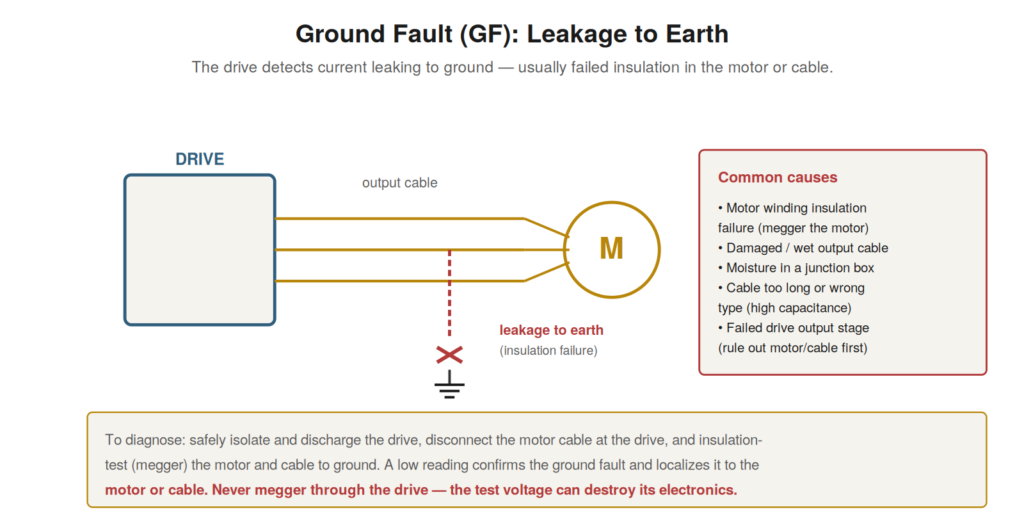
Ground faults and other output-side problems concern the connection
from the drive to the motor — the output cable and the motor itself —
and diagnosing them requires care, particularly the crucial rule never
to insulation-test through the drive. A ground fault means the drive
detected current leaking to earth, usually from failed insulation in the
motor or cable. Understanding these output-side faults and how to
diagnose them safely is important, both for resolving them and for
protecting the drive during testing.
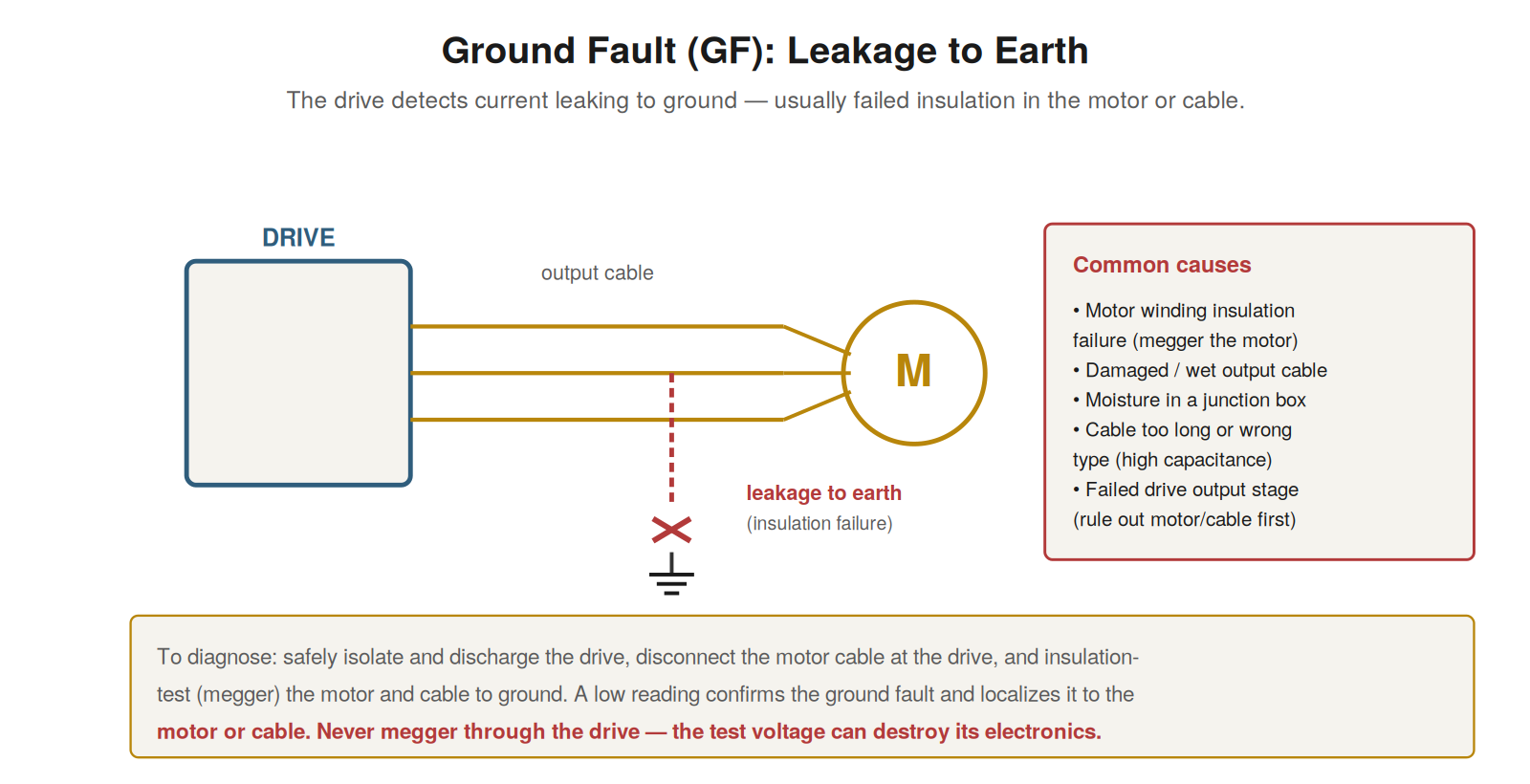
earth, usually from failed insulation in the motor or cable. To
diagnose, isolate and discharge the drive, disconnect the motor cable at
the drive, and megger the motor and cable — never through the drive, as
the test voltage destroys its electronics.
What a ground fault means
A ground fault means the drive detected current flowing to earth from
its output — current that should be flowing to the motor is instead
leaking to ground, indicating a fault in the insulation somewhere in the
output circuit. The usual cause is failed insulation: the motor’s
winding insulation breaking down and leaking to the motor frame (earth),
or the output cable’s insulation failing and leaking to ground.
Moisture, contamination, damage, and aging cause such insulation
failures. Because the leaking current is a fault condition (and a safety
concern), the drive trips on detecting it. So a ground fault points to
an insulation failure in the motor or the output cable, letting current
leak to earth. Understanding what a ground fault means — current leaking
to earth from failed insulation in the motor or cable — directs the
diagnosis to the motor and cable insulation. It reinforces that ground
faults are usually insulation failures in the output circuit (motor or
cable), which the diagnosis localizes by insulation testing. The ground
fault is the drive detecting the leakage that failed insulation allows,
and understanding this points the diagnosis to finding the insulation
failure in the motor or cable, which is the usual cause of the leakage
current that triggers the ground fault, making insulation testing of the
motor and cable the natural diagnostic step — with the crucial caveat
about how to do it safely for the drive.
Never megger through the drive
A crucial rule in diagnosing ground faults and testing motor
insulation on a drive system is never to insulation-test (megger)
through the drive, because the megger’s high test voltage will destroy
the drive’s electronics. Insulation testing applies a high voltage to
measure the insulation resistance, and while the motor and cable can
withstand this, the drive’s sensitive electronics cannot — applying the
megger’s high voltage to the drive’s output terminals, with the drive
connected, would damage or destroy the drive. So insulation testing must
be done with the motor and cable disconnected from the drive: safely
isolate and discharge the drive, disconnect the motor cable at the drive
output, and then megger the motor and cable (now separated from the
drive) to test their insulation. This tests the motor and cable
insulation without exposing the drive to the damaging test voltage.
Understanding this rule — never megger through the drive, always
disconnect the motor and cable from the drive first — is critically
important, because violating it destroys the drive. It reinforces the
correct procedure for insulation testing on a drive system: disconnect
the motor and cable from the drive, then test them separately,
protecting the drive from the megger’s high voltage. This is one of the
most important practical rules in drive work, because the natural
diagnostic step for a ground fault — insulation testing — will destroy
the drive if done through it, so understanding to always disconnect the
motor and cable first, and never megger through the drive, is essential
to diagnosing ground faults without damaging the drive.
Localizing output faults
Once a ground fault or output problem is indicated, localizing it to
the motor or the cable follows from testing them separately. With the
motor cable disconnected from the drive, the motor and cable can be
insulation-tested to find where the fault lies: testing the cable alone
(disconnected from the motor) and the motor alone localizes the fault to
one or the other. A low insulation reading on the motor points to the
motor’s winding insulation; a low reading on the cable points to the
cable. Other output problems — such as an output phase loss or imbalance
— are similarly localized by testing the output wiring and connections.
Once localized, the fault is repaired: a failed motor may need rewinding
or replacement, a failed cable needs replacement, a bad connection needs
remaking. Understanding how to localize output faults — by testing the
motor and cable separately to find which has failed — completes the
diagnosis of ground faults and output problems. It reinforces the
systematic approach: with the motor and cable safely disconnected from
the drive, test each to localize the fault, then repair the failed
component. This localization — motor versus cable, and the specific
fault within — directs the repair, whether to the motor, the cable, or a
connection. Understanding how to localize output faults by separate
testing, following the crucial rule of disconnecting from the drive
first, equips the technician to diagnose and resolve ground faults and
output problems safely and effectively, protecting the drive while
finding and fixing the insulation or connection failure in the output
circuit.
Why the megger rule is absolute
The rule never to megger through the drive deserves emphasis as an
absolute rule, because violating it causes expensive, immediate damage.
The megger applies a high voltage — hundreds or a thousand volts — to
test insulation, and while motors and cables are built to withstand
this, the drive’s electronics are not: they operate at the DC bus
voltage and are designed for that, and the megger’s high test voltage,
applied to the drive’s output terminals with the drive connected, will
break down and destroy the drive’s output devices. This is not a risk
but a near-certainty: meggering through the drive damages it. And it is
easily done by mistake — testing motor insulation the usual way,
forgetting the drive is connected. So the rule is absolute: always
disconnect the motor and cable from the drive before insulation testing,
never megger with the drive connected. Understanding why the rule is
absolute — the megger voltage destroys the drive’s electronics, reliably
— impresses its importance. It reinforces the discipline of always
disconnecting the motor and cable from the drive before any insulation
test, treating this as an inviolable rule, because the consequence of
violating it — a destroyed drive — is severe and certain. Understanding
that meggering through the drive reliably destroys it makes clear why
this is one of the most important rules in drive work, an absolute
prohibition to be observed every time insulation testing is done on a
drive system, protecting the drive from the megger voltage that would
otherwise destroy it.
Scenario: the megger that saved the drive
A scenario shows the crucial megger rule preventing a costly mistake.
A drive reported a ground fault, and a technician prepared to
insulation-test the motor to check its insulation — the natural
diagnostic step. But remembering the crucial rule never to megger
through the drive, the technician first safely isolated the drive,
verified the DC bus discharge, and disconnected the motor cable from the
drive output before applying the megger to the motor and cable. This
protected the drive: had the megger been applied with the drive
connected, its high test voltage would have destroyed the drive’s output
electronics. With the motor and cable properly disconnected, the megger
safely tested them, revealing a low insulation reading on the motor —
confirming a motor insulation failure as the ground fault’s cause. The
motor was repaired, and the drive, protected by the correct procedure,
was undamaged. This scenario shows the megger rule preventing a costly
mistake: disconnecting the motor and cable from the drive before
meggering protected the drive from destruction. Understanding the
absolute rule — never megger through the drive, always disconnect first
— saved the drive here. It reinforces the critical importance of the
rule: the natural diagnostic step (meggering the motor) would have
destroyed the drive if done through it, and only disconnecting the motor
and cable first protected the drive. The scenario reinforces this
inviolable rule, showing how following it — disconnecting before
meggering — protected the drive while still allowing the insulation test
that diagnosed the ground fault, whereas violating it would have
destroyed the drive.
Distinguishing motor faults from cable faults
When a ground fault is traced to the output circuit, distinguishing
whether the motor or the cable is at fault is the next step, and
understanding how to separate them localizes the repair. With the motor
cable disconnected from the drive (following the crucial rule), the
motor and cable can be tested separately to determine which has the
insulation fault. Disconnecting the cable from the motor as well allows
testing each in isolation: insulation-testing the cable alone (both ends
disconnected) checks the cable, and insulation-testing the motor alone
checks the motor. A low reading on the cable indicates a cable fault; a
low reading on the motor indicates a motor fault. This separation
localizes the ground fault to the cable or the motor, directing the
repair to the correct component (replace the cable, or repair/replace
the motor). Understanding how to distinguish motor from cable faults —
by testing each in isolation — localizes the repair. It reinforces the
systematic approach to a ground fault traced to the output: separate the
motor and cable and test each to determine which is faulted, directing
the repair. Understanding how to distinguish the motor from the cable —
testing each in isolation once both are disconnected — completes the
ground-fault localization, identifying whether the motor or the cable
has the insulation failure, which directs the repair to the correct
component rather than replacing or repairing the wrong one, making the
separate testing of motor and cable the key to localizing the ground
fault within the output circuit.
The megger rule as the key lesson
The key lesson from ground faults and output problems is the megger
rule — never insulation-test through the drive — and consolidating it
impresses its critical importance. Diagnosing a ground fault naturally
leads to insulation testing the motor and cable, but doing so through
the drive (with the drive connected) destroys the drive’s electronics
with the megger’s high voltage. So the crucial rule, which must be
observed every time, is to disconnect the motor and cable from the drive
before insulation testing, never meggering through the drive. This
single rule protects the drive during the natural diagnostic step for
ground faults. Consolidating the megger rule as the key lesson impresses
its importance: it is an absolute rule, its violation destroying the
drive, so it must be observed without exception in insulation testing on
a drive system. It reinforces the discipline of always disconnecting the
motor and cable from the drive before meggering, as the inviolable rule
that protects the drive. Understanding the megger rule as the key lesson
of ground faults and output problems — never megger through the drive,
always disconnect first — consolidates one of the most important
practical rules in all of drive work, an absolute prohibition whose
observance protects the drive during the insulation testing that
ground-fault diagnosis requires, and whose violation reliably destroys
the drive, making it a rule to internalize completely and observe every
single time insulation testing is done on a drive system.