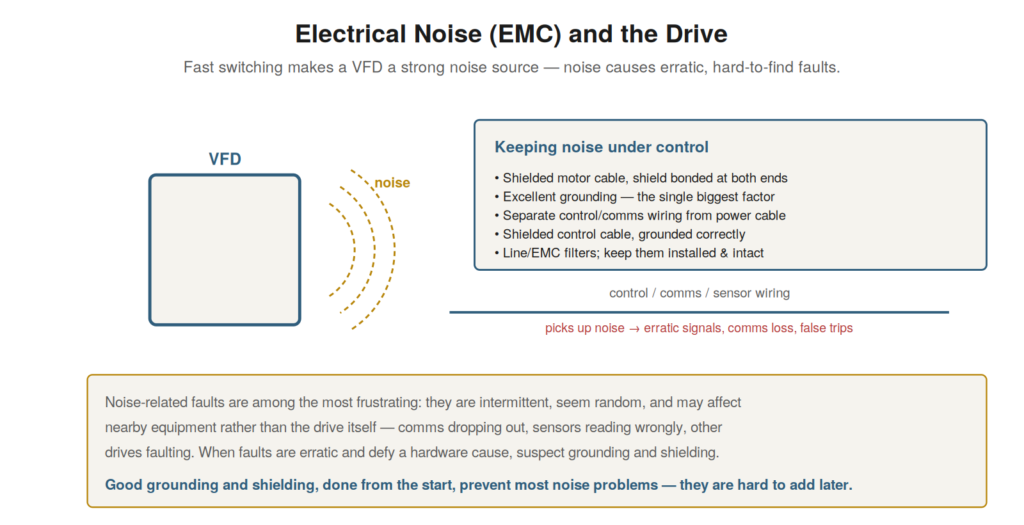
Electrical noise — electromagnetic interference — is one of the most
troublesome aspects of drives, causing erratic, intermittent faults that
can be very hard to diagnose. Because the drive’s fast switching makes
it a strong source of noise, and because that noise can disrupt the
drive’s own signals, its communications, and nearby equipment,
understanding noise and how to control it is essential to drive
troubleshooting. Noise-related faults are often the most frustrating,
and understanding their nature is the key to resolving them.
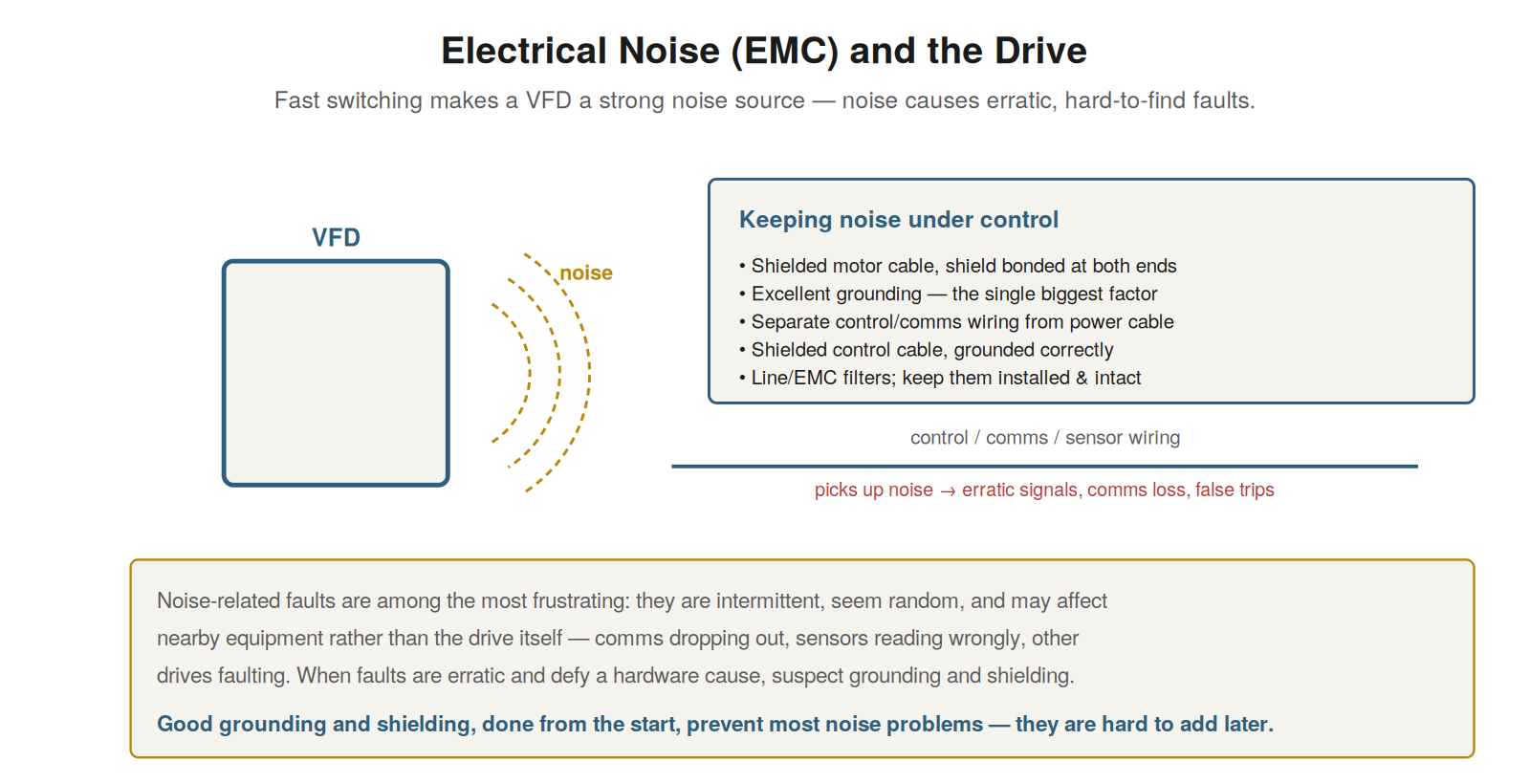
a strong noise source. Noise couples into control, communications, and
sensor wiring, causing erratic, hard-to-find faults — and may affect
nearby equipment. Good grounding and shielding, done from the start,
prevent most noise problems.
Why drives generate noise
Drives generate significant electrical noise because of their fast
switching, and understanding this explains why noise is such an issue
with drives specifically. The inverter switches the DC bus voltage very
rapidly, with extremely fast-rising edges, and this fast switching
generates electromagnetic interference — noise — that radiates from the
drive and its output cable and couples into nearby wiring. The faster
the switching (higher switching frequencies, faster edges), the more
noise, and modern drives switch fast for good performance, so they are
strong noise sources. This noise is not a defect but an inherent
consequence of the fast switching that drives use, making every drive a
source of electrical noise that must be managed. Understanding why
drives generate noise — the inherent consequence of their fast switching
— explains why noise is a characteristic drive issue, unlike simple
starters that switch slowly and infrequently. It reinforces that noise
is inherent to drives, generated by the fast switching essential to
their operation, and must therefore be managed in every drive
installation. Understanding the origin of the noise — the fast switching
— clarifies that it is not a fault to be eliminated but a characteristic
to be controlled, through the grounding, shielding, and filtering that
contain it, making noise management an inherent part of drive
installation and troubleshooting rather than an occasional issue,
because the fast switching that makes drives work also makes them
generate the noise that must be controlled.
How noise causes faults
Understanding how noise causes faults explains the erratic, puzzling
problems that noise produces. The drive’s noise couples into sensitive
wiring — the control signals, the speed reference, the communications,
sensor signals — and disrupts them: a noisy reference signal makes the
speed erratic, noise on communications causes communication faults,
noise on sensor signals causes false readings. The noise can also affect
nearby equipment, not just the drive itself, causing faults in other
devices — other drives, controllers, instruments — that share the
environment. Because noise is intermittent and depends on conditions
(what the drive is doing, how wiring is routed, grounding quality), the
faults it causes are often intermittent and seemingly random, appearing
and disappearing without an obvious pattern, which makes them very hard
to diagnose. Understanding how noise causes faults — coupling into
sensitive wiring to disrupt signals and communications, affecting the
drive and nearby equipment, intermittently and erratically — explains
the frustrating nature of noise-related faults. It reinforces that when
faults are erratic, intermittent, and defy a hardware cause — especially
communication problems, erratic operation, false signals, or faults in
nearby equipment — noise should be suspected. Understanding that noise
causes exactly these hard-to-diagnose, intermittent, seemingly random
faults directs the troubleshooter to consider noise when conventional
hardware diagnosis finds no cause, pointing toward the grounding,
shielding, and wiring practices that control noise, which is often the
underlying cause of otherwise inexplicable erratic drive and equipment
faults.
Controlling noise
Controlling noise is done through grounding, shielding, wiring
practices, and filtering, and understanding these measures is key both
to preventing noise problems and to fixing them. Good grounding — a
solid, low-impedance ground for the drive, motor, and shields — is the
single most important factor, providing the path that contains the
noise. Shielding — shielded motor cable and shielded control cable,
bonded correctly — contains the noise from the cables. Wiring practices
— separating power from control wiring, keeping runs short and properly
routed — prevent noise coupling. Filtering — line filters and EMC
filters — reduces the noise the drive puts onto the supply and
environment. Together these measures control the noise, preventing the
faults it causes. Crucially, these measures are best done from the
start, as they are hard to add or improve after the fact. Understanding
how to control noise — grounding, shielding, wiring, and filtering — is
essential to both prevention and cure. It reinforces that noise is
controlled by good grounding (the biggest factor), proper shielding,
careful wiring separation, and filtering, and that these are best
implemented from the start. When diagnosing noise-related faults, these
are the areas to check and improve: the grounding, the shielding, the
wiring practices, and the filters. Understanding the measures that
control noise — and that good grounding and shielding done from the
start prevent most noise problems — equips the technician both to
install drives that avoid noise faults and to remedy noise problems when
they occur, by improving the grounding, shielding, wiring, and filtering
that control the noise inherent to drive operation.
Grounding is the foundation
Among all the noise-control measures, grounding stands out as the
foundation, and understanding why directs the primary effort in
preventing and fixing noise problems. Good grounding — a solid,
low-impedance connection to ground for the drive, the motor, and the
cable shields — provides the path for the noise currents to return in a
controlled way, rather than finding uncontrolled paths through sensitive
wiring and equipment. Without good grounding, the other measures
(shielding, filtering) are undermined, because the noise has no proper
return path; with good grounding, the noise is contained and the other
measures work as intended. So grounding is the foundation on which noise
control rests, the single most important factor. Understanding that
grounding is the foundation — providing the controlled return path that
noise control depends on — directs the primary effort in noise matters
to the grounding. It reinforces that when preventing noise problems,
excellent grounding comes first, and when fixing noise problems, the
grounding is the first thing to check and improve, because it is
foundational: poor grounding undermines everything else, and good
grounding is the basis on which shielding and filtering work.
Understanding grounding as the foundation of noise control — the most
important single factor — focuses the noise-control effort where it
matters most, on establishing the solid, low-impedance grounding that
contains the drive’s noise and makes the other measures effective, which
is the key to both preventing and remedying the noise problems that
plague drive installations.
Scenario: the drive that disturbed the neighbors
A scenario shows noise affecting nearby equipment. A newly installed
drive worked fine itself, but after its installation, nearby equipment —
sensors, a controller, and another drive — began having intermittent
problems that had not occurred before. The timing (problems starting
with the new drive) and the pattern (affecting multiple nearby devices)
pointed to the new drive as a noise source disturbing its neighbors.
Investigating, the new drive’s grounding and shielding were inadequate,
so its switching noise radiated and coupled into the nearby equipment,
disturbing them. The drive itself was unaffected (its own signals
happened to be robust), but it was noisy, and its neighbors suffered.
The fix addressed the noise at its source: improving the new drive’s
grounding and shielding to contain its noise. This resolved the nearby
equipment’s problems. This scenario shows a drive as a noise source
disturbing nearby equipment rather than itself — a noise problem
manifesting in the neighbors. Understanding that a drive generates noise
that can affect nearby equipment, not just itself, explains this: the
noisy new drive disturbed its neighbors, fixed by containing its noise
through grounding and shielding. It reinforces that noise problems may
appear in equipment near a drive rather than in the drive itself, so a
drive causing problems in nearby equipment — especially a newly
installed one — should be suspected as a noise source, its grounding and
shielding checked. The scenario reinforces that a drive’s noise can
affect its surroundings, and that containing the noise at the drive
(grounding, shielding) resolves problems it causes in nearby equipment,
a manifestation of noise beyond the drive’s own faults.
Line filters and the supply side
Beyond the output and control side, the drive’s noise affects the
supply side too, and understanding line filters completes the
noise-control picture. The drive draws its power from the supply through
the rectifier, and its operation puts noise and harmonics back onto the
supply, which can affect other equipment on the same supply and may need
to meet standards limiting supply disturbance. Line filters (input
filters, EMC filters) on the drive’s supply side reduce this: they
filter the noise the drive puts onto the supply, containing it and
helping meet EMC standards. So line filters address the supply-side
noise, complementing the output and control-side measures (shielded
motor cable, control wiring practices). Understanding line filters —
reducing the noise the drive puts onto the supply — completes the
noise-control picture, covering the supply side as well as the output
and control sides. It reinforces that noise control has a supply-side
aspect: line filters contain the noise the drive feeds back onto the
supply, protecting other equipment and meeting standards. Understanding
line filters — the supply-side noise control — alongside the output
shielding and control-wiring measures gives a complete picture of
managing the drive’s noise, which affects the supply (line filters), the
output cable (shielding), and the control wiring (separation and
shielding), all grounded in good grounding. Understanding the full range
of noise-control measures, including the supply-side line filters,
equips the technician to manage the drive’s noise comprehensively,
across the supply, output, and control sides, which together contain the
noise inherent to drive operation.
Noise as the hidden cause
A consolidating recognition is that noise is the hidden cause behind
many puzzling drive problems, and appreciating this frames the approach
to erratic, inexplicable faults. Noise causes faults that are
intermittent, erratic, and seemingly random, that defy hardware
diagnosis (the hardware being fine), and that may affect nearby
equipment rather than the drive itself. These characteristics make noise
a hidden cause — not obvious, not found by hardware testing, behind
problems that otherwise seem inexplicable. So when drive problems are
erratic and defy diagnosis, noise is the hidden cause to suspect,
pointing to the grounding, shielding, and wiring rather than to
hardware. Recognizing noise as this hidden cause frames the approach to
puzzling faults: when hardware diagnosis finds nothing and the faults
are erratic, suspect noise and investigate the grounding and shielding.
It reinforces that noise, being hidden (intermittent, not
hardware-testable, sometimes affecting neighbors), is the cause behind
many otherwise inexplicable drive problems, and should be suspected when
conventional diagnosis fails. Understanding noise as the hidden cause —
behind erratic, inexplicable, hardware-defying faults — consolidates the
approach to such problems: suspect noise, and investigate the grounding,
shielding, and wiring that control it, because noise is frequently the
hidden cause of the puzzling, erratic faults that defy hardware
diagnosis, and recognizing its signature (intermittent, erratic, no
hardware cause, possibly affecting nearby equipment) directs the
troubleshooter to the noise-control measures that resolve these
otherwise inexplicable problems, making noise-awareness essential to
diagnosing the drive faults that have no apparent hardware cause.