This closing chapter draws the book’s guidance together into a
coherent method, shows how the skills combine in a worked fault, and
reflects on the confident PROFINET troubleshooter this book has aimed to
develop. The specific skills — reading LEDs and diagnostics,
understanding connections, reading loss patterns, suspecting the
physical, naming devices — come together into an approach, held by the
compass of look first, let the network talk, suspect the physical, and
name it right.
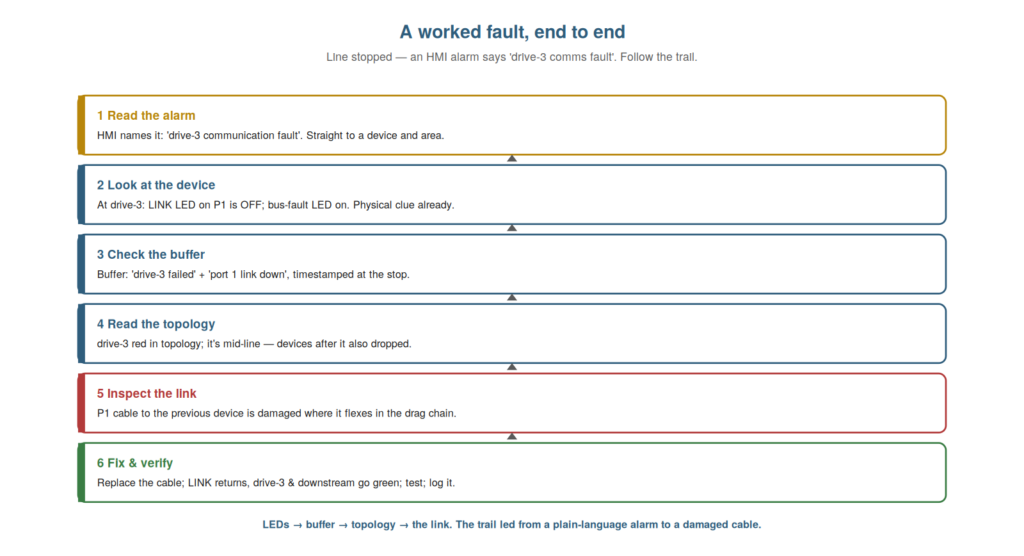
‘drive-3 comms fault’; the device LEDs show a dark LINK and bus-fault;
the buffer confirms the failure and port; the topology places it
mid-line with downstream devices also lost; the link inspection finds a
cable damaged in the drag chain; replace, verify, and log.
The method in one piece
Consolidating the book, the PROFINET troubleshooting method in one
piece is a coherent sequence built on the compass, and understanding it
as a whole equips you to approach any fault. The method: ensure safety
and know the machine state. Look first — read the LEDs at the device for
immediate physical clues (link, activity, fault). Let the network talk —
read the diagnostics buffer (what and when) and the topology (where),
and note any HMI alarm that names the fault. Read the loss pattern
against the topology to localize. Suspect the physical layer — check
cables, connectors, and port statistics, since most faults live there.
Consider what changed and whether load or timing is involved. Then fix
the cause and verify, and update your records. This sequence — safe,
look first, let the network talk, read the pattern, suspect physical,
consider changes and load, fix and verify — is the method in one piece,
applying to any fault. Understanding it as a whole equips you to
approach any PROFINET fault methodically. It reinforces that the method
is a coherent sequence (look first, let the network talk, read the
pattern, suspect physical, consider changes and load, fix and verify)
built on the compass, applying to any fault. Understanding the method in
one piece — the coherent sequence from safety through looking first,
letting the network talk, reading the pattern, suspecting the physical,
considering changes and load, to fixing and verifying — equips you to
approach any PROFINET fault methodically, so that the book’s guidance
comes together into a single reliable approach you can apply to whatever
fault you meet, built on the compass of look first, let the network
talk, suspect the physical, and name it right, which is the practical
method this book has developed and the core of confident PROFINET
troubleshooting.
A worked fault from alarm to fix
Seeing the method in action on a worked fault shows how the skills
combine from symptom to resolution. Suppose a line stops and the HMI
shows ‘drive-3 communication fault’. You read the alarm — it names a
device and area, a head start. At drive-3, you look at the LEDs: the
LINK LED on port 1 is off, and the bus-fault LED is on — a physical clue
already. You check the diagnostics buffer, which confirms ‘drive-3
failed’ and ‘port 1 link down’, timestamped at the stop. You read the
topology: drive-3 is red, mid-line, and the devices after it also
dropped — consistent with a break at drive-3’s incoming link. You
inspect that link, and find the cable damaged where it flexes in the
drag chain. You replace the cable; the LINK LED returns, drive-3 and the
downstream devices go green, and you test operation and log the fix. The
trail ran from a plain-language alarm through the LEDs, buffer, and
topology to the damaged cable — the method in action. Understanding this
worked fault shows how the skills combine from alarm to fix. It
reinforces that the skills combine in practice: alarm, LEDs, buffer,
topology, link inspection, fix, and verify lead from symptom to
resolution. Understanding a worked fault from alarm to fix — the HMI
alarm naming the device, the LEDs showing a physical clue, the buffer
confirming the fault, the topology placing it and revealing the
downstream loss, the link inspection finding the damaged cable, and the
fix and verification — shows how the book’s skills combine in practice,
so that you see the method flow from a plain-language symptom through
the diagnostic tools to the physical cause and its repair, which is how
a real PROFINET fault is resolved and how the individual skills this
book has taught come together into an effective, coherent diagnosis.
The confident PROFINET troubleshooter
The confident PROFINET troubleshooter this book has aimed to develop
combines understanding, method, and good habits into effective network
maintenance, and reflecting on this equips you to continue growing. Such
a technician understands enough of how PROFINET works to reason about
faults; reads the LEDs and the network’s diagnostics fluently;
interprets loss patterns against the topology; suspects and investigates
the physical layer where most faults live; handles device names and
replacements correctly; recognizes load and intermittent faults; and
works safely, reading and diagnosing freely while changing the network
deliberately. Held by the compass — look first, let the network talk,
suspect the physical, name it right — these combine into confident,
effective troubleshooting. The seemingly intangible network becomes,
with this understanding and method, a diagnosable system, and the
technician who has developed this competence can keep
PROFINET-controlled machinery running — a genuinely valuable skill,
given how much of modern industry runs on PROFINET. That competence
grows with practice, working on real networks until the method becomes
second nature. The journey from finding the network mysterious to
diagnosing it confidently is entirely achievable, and this book has
aimed to provide the map. The maintenance technician who completes it
holds a valuable, broadly applicable skill: the ability to keep the
industrial networks that run so much of modern machinery healthy and
running, turning PROFINET from an intangible mystery into an open,
understandable, diagnosable system that they can maintain with
confidence.
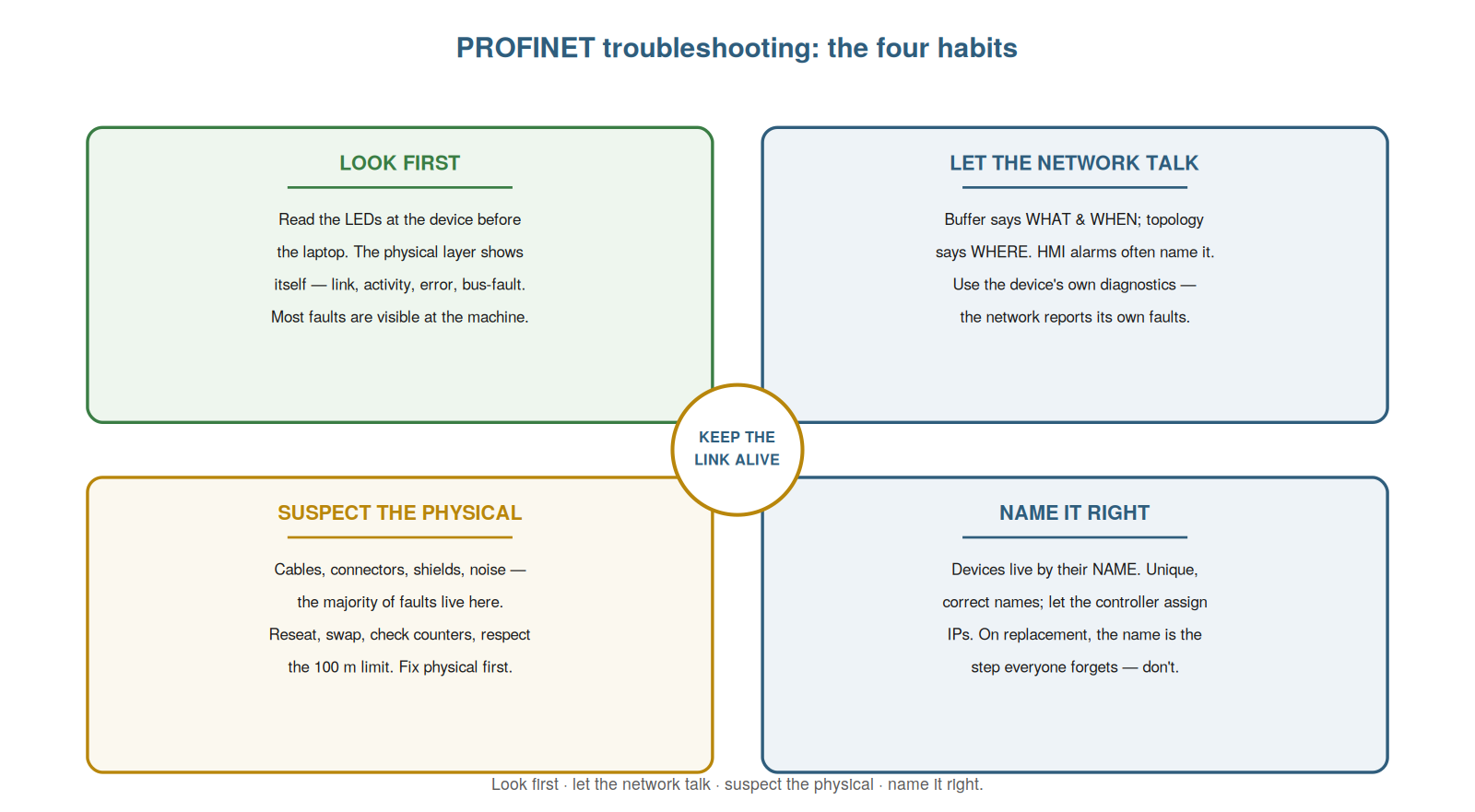
first (read the LEDs at the device), let the network talk (buffer says
what and when, topology says where), suspect the physical (most faults
live in cables, connectors, and noise), and name it right (devices live
by their names). Keep the link alive.
Keeping a fault log
A practice that ties the book’s method to long-term improvement is
keeping a fault log, and understanding its value shows how recording
faults builds knowledge that speeds future work. A fault log records the
faults that occur and how they were resolved: what the symptom was, what
the cause turned out to be, and what fixed it. Over time, this log
becomes valuable knowledge: a recurring fault is quickly recognized from
past entries (you have seen it before and know the cause), patterns
across faults emerge (a particular type of problem on a particular
machine), and the accumulated experience speeds future diagnosis. A
fault log also helps others: a colleague facing a similar fault can
learn from your recorded resolution. So keeping a fault log turns each
resolved fault into lasting knowledge that speeds future work, for you
and others. Understanding the value of a fault log — building knowledge
that speeds future diagnosis — shows how recording faults improves your
troubleshooting over time. Understanding the value of keeping a fault
log — recording each fault’s symptom, cause, and fix so that recurring
faults are quickly recognized, patterns emerge, and the accumulated
experience speeds future diagnosis — shows how recording faults builds
lasting knowledge that improves your troubleshooting over time, so that
each resolved fault becomes a reference that makes the next similar
fault faster to diagnose, for you and your colleagues, which turns the
individual method the book has taught into a growing body of practical
knowledge, making the fault log a simple practice that compounds your
troubleshooting skill through the accumulated record of real faults and
their resolutions.
Scenario: the whole method on one fault
A scenario shows the whole method flowing on a single fault. A line
stopped, and the technician applied the complete method. He ensured
safety and noted the state. He looked first at the HMI, which showed an
alarm naming a device. At the device, he read the LEDs — a dark link and
bus-fault, a physical clue. He let the network talk: the buffer
confirmed the device failed with a port link down, and the topology
placed it and showed downstream devices also lost — a line break at that
device’s incoming link. He suspected the physical layer and inspected
that link, finding a damaged cable. He fixed it, verified the devices
returned green and the machine ran, and logged the fault. The whole
method — look first, let the network talk, read the pattern, suspect the
physical, fix and verify — had flowed smoothly from symptom to
resolution. This scenario shows the complete method flowing smoothly on
one fault. Understanding the method as a coherent whole let the
technician flow from the alarm through the diagnostics and pattern to
the physical cause and fix. It reinforces that the whole method flows on
a real fault: look first, let the network talk, read the pattern,
suspect physical, fix and verify. The scenario reinforces the book’s
method as a coherent whole: the technician resolved a line stop by
flowing through the complete method — the HMI alarm, the LEDs, the
buffer and topology, the loss pattern, the physical inspection, and the
fix and verification — illustrating how the individual skills combine
into a single smooth approach that carries you from symptom to
resolution, which is the confident, methodical PROFINET troubleshooting
the book has aimed to develop.
Staying calm and systematic under pressure
A final, human aspect of the method is staying calm and systematic
under the pressure of a line-down, and understanding its importance
helps you apply the method well when it matters most. A stopped line
brings pressure — people waiting, production lost, urgency — and under
pressure there is a temptation to rush, guess, or change things hastily,
which often makes matters worse. The value of a systematic method is
greatest exactly here: staying calm and working the method (look first,
let the network talk, read the pattern, suspect the physical, fix and
verify) is faster and safer than panicked guessing, because it leads
reliably to the cause. So understanding to stay calm and systematic
under pressure — trusting the method rather than rushing — helps you
resolve faults well when it matters most. The method is your anchor in
the pressure: follow it, and it carries you to the resolution.
Understanding the importance of staying calm and systematic under
pressure — trusting the method over panicked guessing — helps you apply
it well in a line-down. Understanding the importance of staying calm and
systematic under pressure — that a line-down’s urgency tempts you to
rush and guess, which makes things worse, while calmly working the
method leads reliably to the cause — helps you apply the method well
when it matters most, so that you treat the systematic approach as your
anchor in the pressure of a stopped line, trusting that looking first,
letting the network talk, reading the pattern, suspecting the physical,
and fixing and verifying will carry you to the resolution faster and
more safely than panicked guessing, which is the human discipline that
lets the method deliver its value exactly when the pressure is
greatest.
Your PROFINET troubleshooting journey
To close the book, it is fitting to reflect on the journey from here,
because troubleshooting skill continues to grow with experience beyond
what any book provides. This book has given you the map: the
understanding of what PROFINET is and how it works, the diagnostic
methods, the fault patterns, the good practices, and the compass of look
first, let the network talk, suspect the physical, and name it right.
But the map is the beginning; the journey continues as you apply it to
real faults, building the experience that turns method into intuition.
Each fault you resolve deepens your competence; each pattern you
recognize sharpens your instinct; the fault log you keep and the
knowledge you share compound your and your team’s capability. So the
journey from here is one of growing mastery through practice, with this
book as the foundation and real experience as the teacher. The confident
PROFINET troubleshooter is not made by a book alone but by a book’s
foundation built upon through experience — and that journey, from here,
is yours to walk. Understanding the journey from here — growing mastery
through applying the book’s foundation to real faults — frames the book
as a beginning built upon by experience. Understanding your PROFINET
troubleshooting journey from here — the growing mastery that comes from
applying this book’s foundation of understanding, method, patterns,
practices, and the compass to real faults, building the experience that
turns method into intuition — frames the book as a beginning rather than
an end, so that you carry its map into the real work where each resolved
fault deepens your competence, each recognized pattern sharpens your
instinct, and the knowledge you log and share compounds your capability,
the confident troubleshooter being made not by the book alone but by its
foundation built upon through the experience that is yours, from here,
to gain.