Fuses and circuit breakers exist to protect conductors and equipment from currents high enough to damage them. When one operates, it is doing its job, and the troubleshooter’s task is to determine whether it operated correctly on a real fault or whether something has changed — never simply to defeat it.
Overload versus short circuit
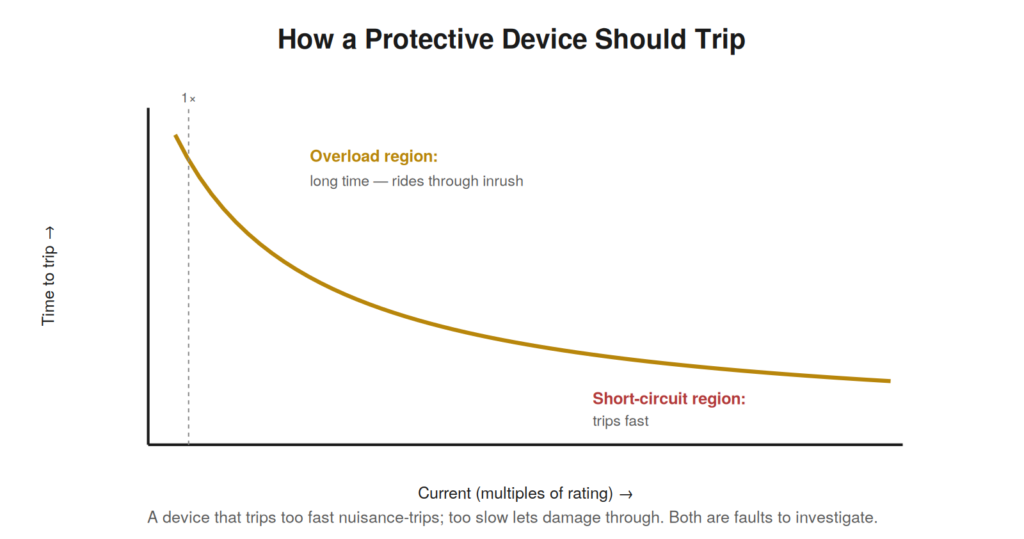
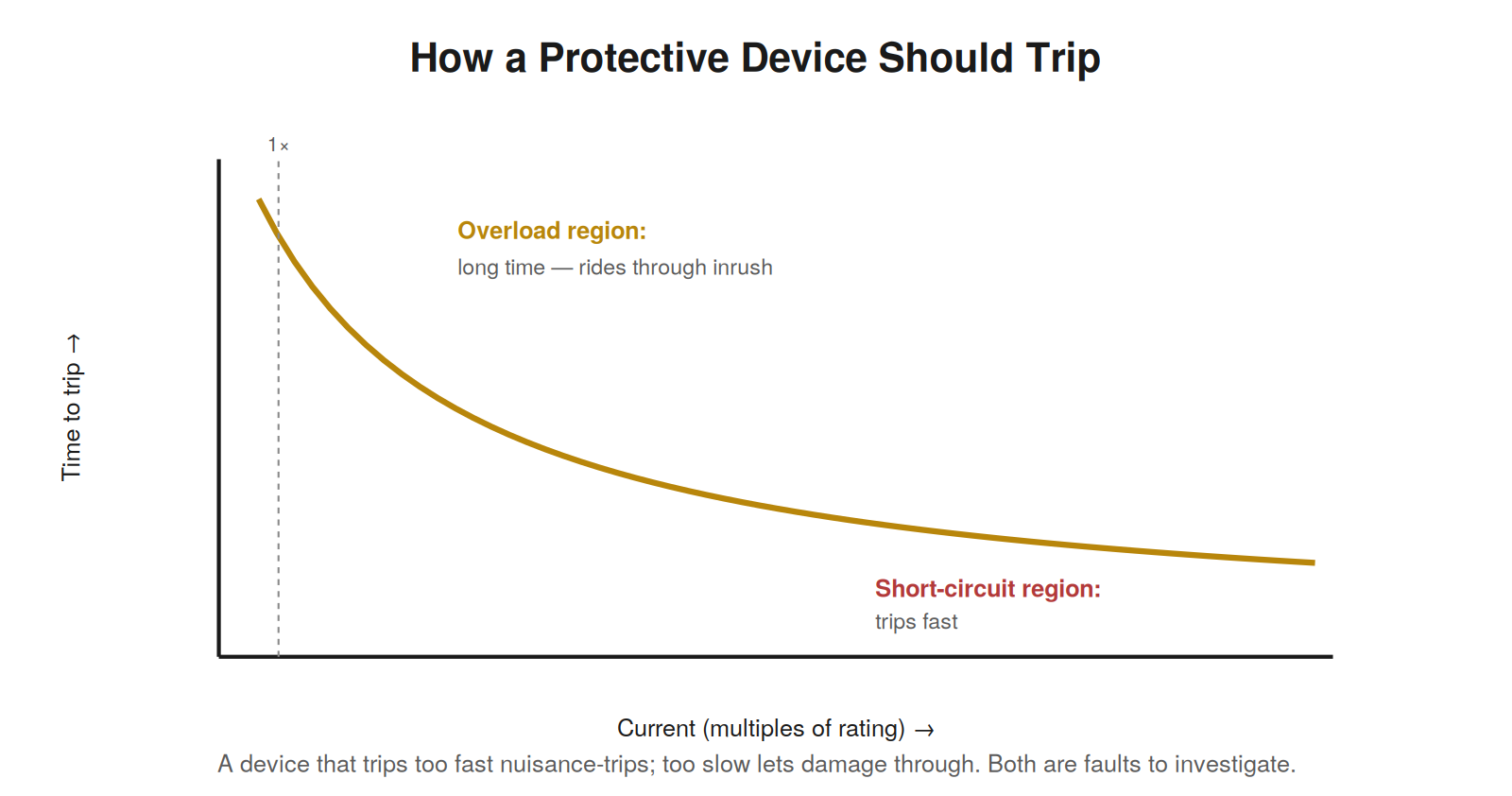
Protective devices respond to two distinct kinds of overcurrent, and distinguishing them guides the investigation. An overload is a moderate overcurrent sustained over time — a motor working too hard, too many loads on a circuit — and protective devices respond to it with an intentional time delay, tripping only after the excess persists long enough to threaten damage, while riding through the harmless brief inrush of a motor starting. A short circuit is a massive overcurrent from a direct fault — a live conductor contacting neutral, ground, or another phase — and protective devices respond to it almost instantly. Which behavior you see tells you what kind of fault to look for: a breaker that trips instantly points at a short circuit or dead short, while one that trips after a delay points at an overload condition.
Reading a tripped device
A protective device that has operated is a source of information. A fuse that has opened, examined, sometimes shows whether it failed from a slow overload or a violent short by the state of its element. A circuit breaker’s trip mechanism, and any indicator it provides, can distinguish an overload trip from a short-circuit trip. Most importantly, a device that trips again immediately upon reset is reporting a persistent fault — very often a short circuit — and should not be repeatedly reset, because each reset feeds the fault again. A device that holds after reset but trips again later under load points instead at an overload or an intermittent condition that appears only when the equipment works.
The cardinal rule: find the cause
The single most important discipline with protective devices is never to defeat them. Replacing a fuse with a larger one, or a breaker with a higher rating, to ‘stop it blowing’ removes the protection that stands between a fault and a fire or an injury. A device that operates repeatedly is protecting against a genuine overcurrent, and the professional response is to find and fix the cause of that overcurrent — the short, the overload, the failing equipment — then restore the correctly rated protection. Upsizing protection to match a fault instead of fixing the fault is among the most dangerous shortcuts in the trade.
COORDINATIONProtective devices are sized and timed so that the device nearest a fault trips first, isolating only the affected circuit rather than shutting down a whole area. When a fault trips a device further upstream than expected — taking down more than it should — suspect a coordination problem or a device not operating as intended, in addition to the fault itself. |
A case file: the breaker that would not stay on
A circuit breaker trips the instant it is reset — it will not stay on at all, tripping again immediately each time. This behavior is diagnostic: a breaker that trips immediately on reset, before any load is even operated, is reporting a persistent short circuit or dead fault in the circuit, not an overload. Rather than repeatedly resetting it — which merely feeds the fault again and stresses the breaker — the technician treats the immediate trip as the signature of a short and, with the circuit de-energized, sets out to find it. Inspecting the circuit reveals a cable crushed where equipment had been moved against it, shorting a conductor to ground. Repairing the damaged cable clears the fault and the breaker holds. The principle is important: a protective device that trips immediately on reset is reporting a hard fault that must be found and fixed, and repeatedly resetting it is both futile and hazardous, because each reset re-energizes the fault the device is trying to protect against.
The device that trips only under load
A different pattern tells a different story: a breaker that resets and holds fine, but trips again later once the equipment is running under load. Because it holds with no load but trips under load, this points not at a dead short but at an overload condition or a fault that only manifests when current flows — a motor drawing too much, a load that is too large, a fault that appears under operating conditions. The investigation shifts to measuring the actual current under load and comparing it against the circuit’s rating, which reveals whether the equipment is genuinely drawing more than it should and, if so, why. This distinction between a device that trips immediately on reset and one that trips only under load is one of the most useful early observations in protective-device troubleshooting, because it separates hard faults from overload conditions and directs the investigation accordingly.
A structured summary of protective-device faults
The behavior of a protective device is itself the primary diagnostic, and it sorts the possibilities cleanly. A device that trips immediately on reset, before any load operates, is reporting a persistent short circuit or hard fault that must be found and fixed, never repeatedly reset. A device that resets and holds but trips again under load is reporting an overload or a fault that appears only when current flows, sending the investigation to measuring the actual current under load against the rating. A device that trips further upstream than expected, taking down more than it should, points at a coordination problem or a device not operating as intended alongside the fault. And the cardinal rule across all of these is that a protective device is never to be defeated — upsizing it to stop it operating removes the protection between a fault and a fire or injury, so the response to repeated operation is always to find and fix the cause of the overcurrent and restore correctly rated protection. Reading which way a device behaves on reset and under load, and treating its operation as a real report of a real overcurrent, organizes the whole approach to fuses and breakers and keeps the troubleshooter from the dangerous shortcut of defeating the protection.
Coordination and the scope of a trip
Protective devices in a well-designed system are coordinated so that the device nearest a fault operates first, isolating only the affected circuit while leaving the rest of the system running — a branch fault should trip that branch’s protection, not the main feeding a whole area. When this coordination works, the scope of what goes dark during a fault is itself diagnostic, pointing at the faulted circuit. When it fails to work — when a fault trips a device further upstream than it should, taking down more of the system than the fault warranted — there are two possibilities worth distinguishing: a coordination problem, where the devices are not selectively coordinated so an upstream device trips before the intended downstream one, or a downstream device failing to operate when it should, forcing the fault to be cleared by the next device upstream. Either way, an upstream device tripping for a fault that a downstream device should have cleared is a signal worth investigating beyond the fault itself, because it means the protection is not isolating faults to their smallest affected area, and a future fault will again take down more than it should. Reading the scope of a trip against what the coordination scheme intends reveals when the protection system itself, not just the circuit, needs attention.
A case file: the nuisance trip that was not
A breaker trips occasionally under normal operation, and after several trips with no obvious cause found, there is pressure to replace it with a higher-rated device to stop the nuisance. The disciplined technician resists this, treating the trips as real reports and measuring the actual current under load rather than assuming the breaker is oversensitive. The measurement reveals the current climbing close to the breaker’s rating during a particular part of the operating cycle — the load is genuinely drawing near the limit at that moment, and the breaker is correctly tripping when it occasionally crosses over. The breaker was never faulty or oversensitive; it was accurately protecting against a load that was running too close to the circuit’s capacity, and upsizing the breaker would have removed the protection while leaving the real problem — a load drawing more than the circuit was meant to carry — in place, risking the conductors the breaker was there to protect. Addressing the actual cause, the load drawing too much at that point in its cycle, resolved the trips properly. The case reinforces the cardinal rule: a protective device that trips is reporting a real overcurrent, and the response is to measure and address the cause, never to upsize the device to silence it, because the device that looks like a nuisance is usually protecting against a hazard that upsizing would merely uncover to the conductors it guards.
What a fuse or breaker actually protects
Understanding what a protective device is actually protecting clarifies why defeating it is so dangerous and why its correct rating matters. A fuse or circuit breaker protects primarily the conductors of its circuit — the wiring — from carrying more current than it can safely handle, because conductors overloaded with excessive current overheat, degrade their insulation, and can start fires. The device is sized to the conductors it protects, rated to interrupt the circuit before the current can damage the wiring. This is why upsizing a device that trips is so hazardous: a larger device allows more current to flow before it operates, and that greater current may exceed what the conductors can safely carry, so the wiring can overheat and fail — potentially catching fire — while the oversized protection, sized for larger conductors than are actually present, never operates. The device that keeps tripping is protecting the wiring from a current the wiring cannot safely carry, and replacing it with a larger one removes that protection while leaving the undersized wiring exposed to the excessive current. Beyond the conductors, protective devices also protect equipment and limit the extent of faults, but the conductor protection is the most fundamental and the most direct reason the rating must match the wiring and must never be increased to stop nuisance tripping. When a device trips repeatedly, the correct response is always to find and fix the cause of the excess current and restore correctly rated protection sized to the conductors, because the alternative — a larger device — protects nothing and exposes the wiring to exactly the overcurrent the protection existed to prevent.