Electric motors are the workhorses of industry, and motor problems are among the most common calls a troubleshooter answers. A motor sits at the boundary of electrical and mechanical worlds, and its faults can originate on either side, which makes disciplined diagnosis especially valuable.
The three-phase induction motor
The three-phase induction motor dominates industrial applications because it is rugged, efficient, and simple. Three-phase power creates a rotating magnetic field in the stator, which induces current in the rotor and drags it around. Because it depends on all three phases, this motor is vulnerable to phase problems, and because it converts electrical energy to mechanical, its faults may be electrical, mechanical, or a mix. A methodical approach separates these: confirm the motor is receiving correct, balanced three-phase power; confirm the motor itself is electrically sound; and confirm it can turn mechanically.
Single-phasing and unbalance
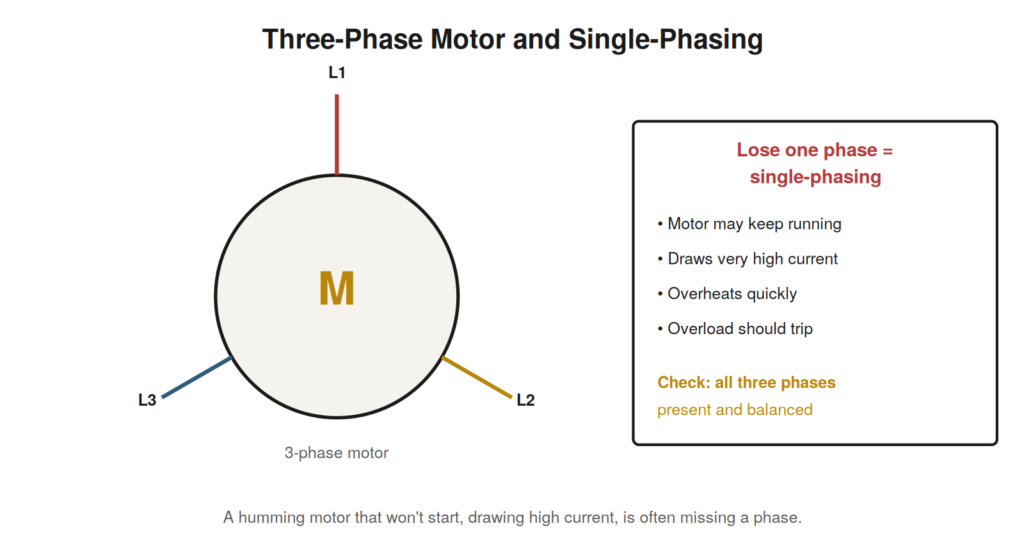
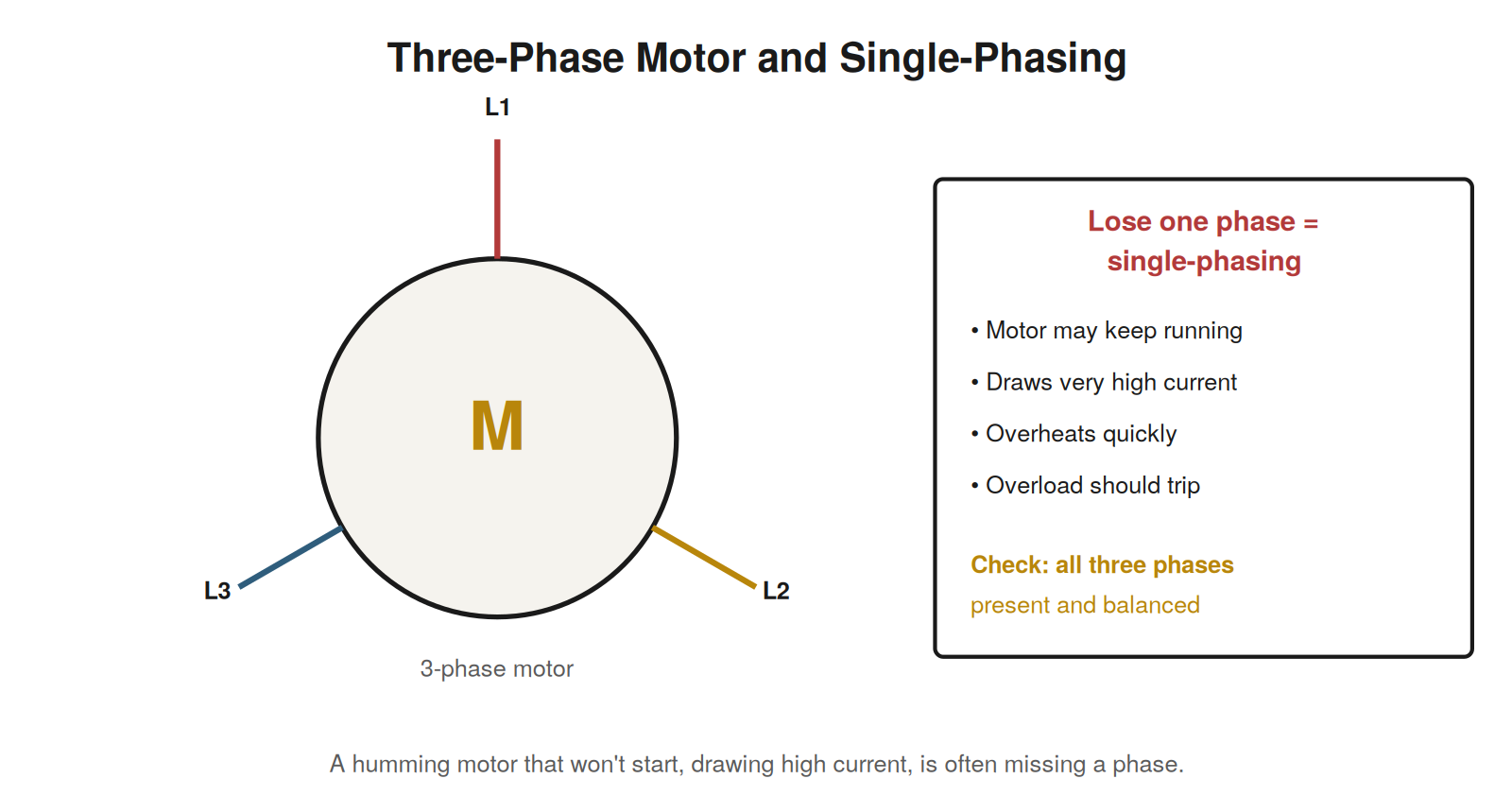
Losing one of the three phases — single-phasing — is a classic and destructive motor fault. A motor already running may continue to run on two phases, but it draws greatly increased current, overheats, and struggles under load; a stopped motor that has lost a phase typically only hums and cannot start, again drawing heavy current. The overload should trip, and when it does, single-phasing is a prime suspect. The cause of the lost phase may be a blown fuse in one phase, a failed contact, or a broken conductor. Measuring all three phases at the motor reveals the missing one immediately. Voltage or current unbalance short of a full loss is subtler but also harmful, heating the motor and shortening its life, and is found by comparing the three phase currents under load.
Insulation and winding faults
Inside the motor, the winding insulation degrades over time from heat, moisture, contamination, and age, and its failure is a leading cause of motor death. Insulation breakdown can appear as a ground fault (a winding shorting to the frame), a turn-to-turn short within a winding, or a phase-to-phase short. The insulation resistance tester, applied to an isolated motor, measures winding-to-ground insulation and reveals breakdown that has not yet failed completely; comparing the resistance of the three phases and trending readings over time catches developing faults. A winding that reads low to ground, or phases that read very differently from one another, points at insulation failure inside the motor rather than a supply problem.
Mechanical faults that look electrical
Not every motor fault is electrical. A seized or dragging bearing, a misaligned coupling, or a jammed driven load can prevent a motor from turning or make it draw excessive current, mimicking an electrical fault. A motor that trips its overload may be electrically perfect but mechanically overloaded by the machine it drives. This is why measuring the running current and comparing it against the nameplate is so revealing: elevated current on healthy, balanced phases points at a mechanical overload rather than an electrical fault, sending you to the bearings, the coupling, and the driven equipment. Trying to spin the motor by hand when safely de-energized, and listening and feeling for roughness, separates a mechanical bind from an electrical problem before power is ever applied.
A case file: the motor that tripped after a repair
A motor that had run reliably for years begins tripping its overload shortly after the driven gearbox was serviced. The timing is the clue: a motor that was fine until work was done on the equipment it drives, and trips afterward, points at the mechanical side rather than the motor itself. Measuring the running current confirms it is elevated across all three phases equally — balanced but high — which indicates the motor is working harder than before rather than suffering an electrical fault, since an electrical fault would typically show unbalance. The gearbox, reassembled after servicing, has been set up with too much preload or a misalignment that adds mechanical resistance, forcing the motor to draw more current until the overload protects it. The motor is electrically perfect; the fault is the mechanical load imposed by the servicing. Correcting the gearbox setup returns the current to normal. The lesson is that balanced high current points at mechanical overload, and a motor that starts tripping right after nearby mechanical work is very often reporting a problem introduced by that work, not a fault of its own.
Reading a motor with the insulation tester
When a motor is suspected of an internal fault, the insulation resistance tester provides evidence a normal meter cannot. With the motor isolated and its terminals accessible, testing each winding to the frame reveals the insulation’s health: a high reading indicates sound insulation, while a low reading indicates breakdown that may be causing a ground fault or nuisance trips. Testing all three phases and comparing them adds information, since one phase reading much lower than the others points at a localized insulation failure. Trending these readings over time, recorded at each maintenance interval, catches insulation degrading slowly toward failure, allowing a motor to be rewound or replaced on a planned basis rather than failing in service. A motor that reads low to ground, especially one that also trips ground-fault protection, has an insulation problem inside it, and the tester distinguishes this from a supply or control fault definitively, directing the repair to the motor itself rather than to the circuit feeding it.
Separating electrical from mechanical faults
Because a motor bridges the electrical and mechanical worlds, its faults can originate on either side, and the most valuable diagnostic move is often to determine which side a fault lives on before diving into either. Two techniques do this cleanly. The first is measuring the running current and comparing it against the nameplate: elevated current balanced across all three phases points at a mechanical overload, because the motor is electrically healthy but working too hard, while unbalanced current points at an electrical fault such as a lost phase or a failing winding. The second is turning the motor by hand when safely de-energized: a rotation that is stiff, rough, or dragging reveals a mechanical problem — a failing bearing, a binding load — before power is ever applied, while a free, smooth rotation points the suspicion back toward the electrical side. Between them, these two checks split the motor’s fault space into its electrical and mechanical halves early, directing the rest of the investigation to the right side and sparing the technician from testing windings when the fault is a bearing, or the reverse.
What running current reveals
The running current, read with a clamp meter and compared against the nameplate, is one of the richest single measurements available on a motor, because it reflects the actual work the motor is doing and the health of its supply at once. Current well above nameplate, balanced across phases, indicates a motor working too hard — a mechanical overload from the driven equipment, a bearing, a coupling. Current unbalanced across phases indicates an electrical problem in the supply or the motor. Current below expected may indicate a motor barely loaded, or in some cases a fault reducing its output. Tracking a motor’s normal running current over time, and noticing when it drifts, catches developing problems before they trip protection or cause failure. This makes the running current not merely a check performed when something is wrong but a vital sign worth knowing for critical motors, because a change in it is often the first measurable sign that something — electrical or mechanical — is beginning to go wrong, well before the motor trips or fails outright.
A case file: the motor that ran backward
After a motor was disconnected for other work and reconnected, the driven equipment runs in the wrong direction. The symptom is unambiguous and points directly at phase sequence: a three-phase motor’s direction is determined by the order in which the phases are connected, and swapping any two of the three phases reverses the direction. During the disconnection and reconnection, two of the phase conductors were reconnected in swapped positions, reversing the rotation. The motor is entirely healthy; only the phase connections are out of order. Confirming the phase sequence and swapping two phases back restores correct direction. The case is a clean illustration of a phase-rotation fault, and it carries a practical warning: whenever a three-phase motor is disconnected and reconnected, the possibility of swapping the direction exists, so checking rotation after such work — before the driven equipment is put back into service where running backward could cause damage — is a sensible precaution. A motor running backward after reconnection is almost always a swapped phase pair rather than a motor fault, resolved by correcting the phase sequence rather than by any repair to the motor itself.
The motor as a system spanning two worlds
The reason motors reward a disciplined diagnostic approach is that they sit at the boundary of the electrical and mechanical worlds, and their faults can originate on either side or in the coupling between them. A motor converts electrical energy into mechanical work, and a fault in that conversion may be electrical — a lost phase, an unbalanced supply, failed winding insulation, a control or starter problem — or mechanical — a failing bearing, a binding load, a misaligned coupling, an overloaded driven machine. Crucially, faults from either world can produce the same symptom: a motor that trips its overload may be electrically faulted or merely mechanically overloaded, and only investigation distinguishes them. This is why the two splitting techniques matter so much — measuring running current to see whether it is high-but-balanced (mechanical) or unbalanced (electrical), and turning the motor by hand when safely de-energized to feel for mechanical resistance. These checks determine which world the fault lives in before the detailed investigation begins, and getting that determination right early is the difference between efficiently finding a bad bearing and fruitlessly testing healthy windings. The motor’s position spanning two worlds is what makes it both a common source of faults and a satisfying one to diagnose well, because the disciplined approach of first establishing which world the fault occupies transforms a potentially confusing failure into a directed investigation on the correct side.
A structured summary of motor faults
The motor material assembles into a structured picture organized around the motor’s position spanning the electrical and mechanical worlds. On the electrical side there is single-phasing and unbalance — the loss or inequality of phases, found by measuring and comparing all three phases at the motor, producing a motor that hums and will not start or that runs hot and trips. There is insulation and winding failure — the degradation of the motor’s internal insulation, found with the insulation resistance tester reading low to ground or unbalanced across phases, producing ground faults and eventual motor death. On the mechanical side there are bearing failures, misalignment, and driven-load problems — mechanical resistance that overloads the motor, found by the running current being high but balanced and by feeling stiffness when turning the motor by hand de-energized. And there are supply and control faults upstream of the motor entirely — lost power, control problems, starter faults — that stop the motor without any fault in the motor itself. The two splitting techniques organize the whole diagnosis: running current, high-but-balanced pointing mechanical and unbalanced pointing electrical, and turning by hand to feel for mechanical resistance. Establishing which world the fault occupies before the detailed investigation is the master move in motor troubleshooting, turning a symptom that could arise from many sources into a directed search on the correct side, and the appendix table of motor symptoms and their likely causes serves as a quick field reference to this structure.