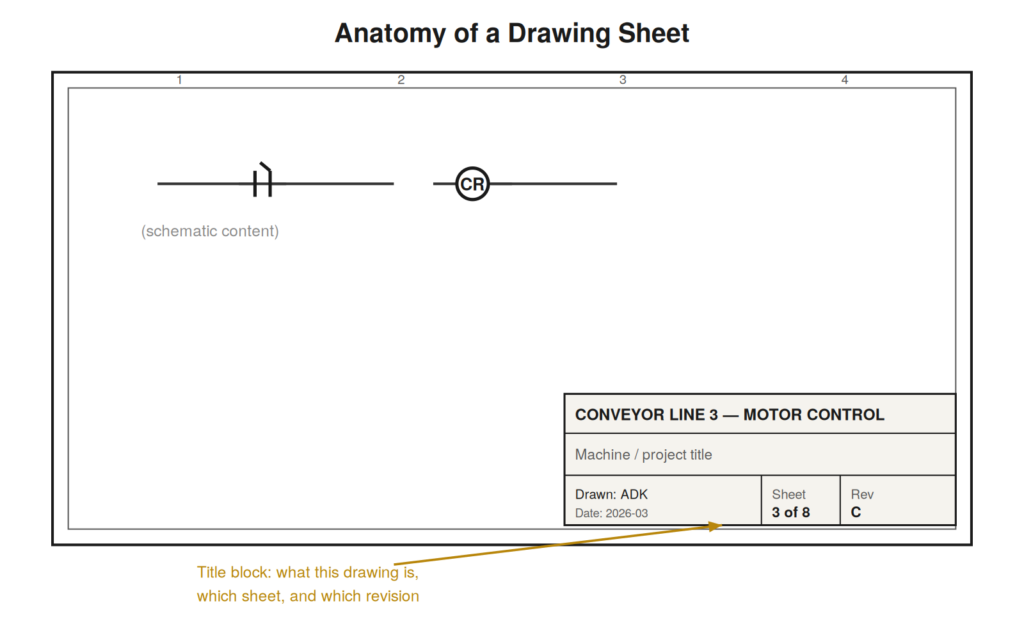
A real machine is rarely documented by a single schematic. Instead it comes with a drawing set — a collection of sheets that together describe the whole electrical system, organized in a standard way. Knowing how a drawing set is organized lets you find the sheet you need and navigate between related information, which is a skill in its own right, separate from reading any individual circuit.
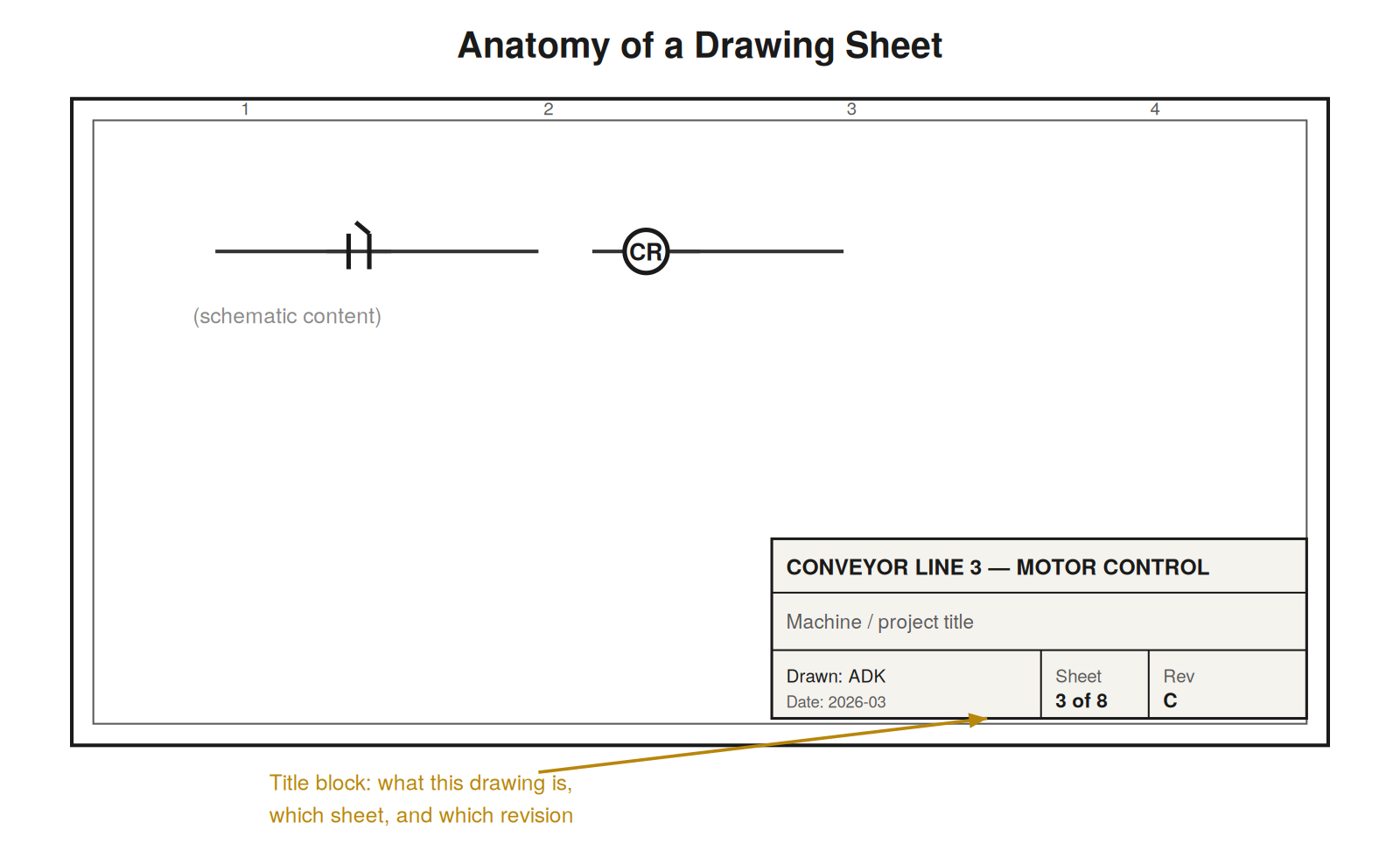
The title block
Every drawing sheet carries a title block, usually in the lower-right corner, that identifies the drawing. It tells you what machine or system the drawing describes, who drew it and when, which sheet this is within the larger set (such as ‘sheet 3 of 8’), and — critically — the revision level. The revision is important because drawings change as equipment is modified, and knowing you are looking at revision C rather than revision A can matter when the circuit has been altered. Before reading any drawing in earnest, glancing at the title block orients you: you know what you are looking at, where it sits in the set, and how current it is. The title block is the drawing’s identity, and reading it first is a habit of every fluent drawing-reader.
Sheets and how they connect
A drawing set divides the system across multiple sheets, and understanding how they connect is essential to following a circuit that spans several of them. Sheets are typically organized by function — power distribution on some, control circuits on others, specific machine sections on their own — and a single circuit’s story may continue from one sheet to the next. Connections that cross between sheets are marked with references that tell you where a wire or signal continues, so that following a circuit off the bottom of one sheet, you can find where it resumes on another. Learning to read these sheet-to-sheet references turns a stack of separate sheets into a single navigable document, and it is what lets you follow a circuit through a whole system rather than losing it at the edge of a page.
Cross-references
Within and across sheets, cross-references tie together the scattered parts of a single device. A relay’s coil appears in one place, but its contacts may be used in several others, spread across the drawing set — and cross-references are the notes that connect them, telling you where each contact of a given coil is located and, from any contact, where its controlling coil is. This matters enormously in troubleshooting, because when an output will not operate, you often need to find the coil controlling a suspect contact, or find all the places a given relay acts. Cross-references make this possible, turning a device scattered across many sheets into something you can follow from coil to contacts and back. The next part of the book covers cross-references in more depth, but the point here is that a drawing set is not just a pile of sheets — it is a connected document, and its title blocks, sheet references, and cross-references are the connective tissue that makes it navigable.
ORIENT BEFORE YOU READBefore diving into a circuit, orient yourself in the drawing set: check the title block to know what and which revision you are reading, understand how the sheets are organized, and note how connections cross between them. A few seconds of orientation saves you from reading the wrong sheet or an outdated revision. |
Finding your way in a large set
A drawing set for a substantial machine may run to dozens of sheets, and finding the one you need is a skill in itself. The set usually opens with an index or drawing list — a table of what is on each sheet — which is the fastest way to locate the circuit you want. Beyond the index, the organization is typically logical: power distribution near the front, then control circuits, often grouped by machine section or function, with related circuits kept together. Learning to navigate this organization — using the index, understanding the grouping, following sheet references — means you can go quickly to the relevant sheet rather than leafing through the whole set. In troubleshooting, this navigation speed matters, because time spent finding the right sheet is time the machine is down. A fluent reader treats the drawing set as a navigable document with an index and a logical structure, not an undifferentiated stack of paper, and that treatment gets them to the relevant circuit fast.
Revisions and why they matter
The revision level in the title block deserves particular attention, because reading an outdated revision can mislead you badly. When a machine is modified, the drawings should be updated and the revision advanced, with a revision history noting what changed. Reading the current revision means you are looking at the machine as it is now; reading an old revision means you may be looking at a circuit that has since been changed. Before trusting a drawing in a critical situation, confirming you have the current revision — and glancing at the revision history to see what recently changed — protects you from troubleshooting against an obsolete picture of the circuit. Recent revisions are especially worth noting, because a fault that appeared after a modification may be related to what that modification changed, and the revision history points right at it. The revision is not bureaucratic detail; it is the drawing’s currency, and reading it is part of reading the drawing wisely.
Reading exercise: tracing a sheet cross-reference
To build fluency with a multi-sheet drawing set, practice following a connection from one sheet to another using the cross-reference marks. Find a point where a wire or signal leaves a sheet — marked with a reference to where it continues — and follow that reference to the other sheet, locating where the connection resumes. Doing this a few times on a real set builds the habit of treating the sheets as one connected document rather than separate pages, which is essential for following circuits that span the set. Many real faults involve circuits that cross several sheets — a coil on one, its contacts on others, a signal originating on one and acting on another — and the ability to follow cross-sheet references fluidly is what lets you trace such circuits without losing the thread. The exercise is simple but valuable: pick a cross-reference, follow it, confirm you have found the continuation, and repeat until following references between sheets is second nature and the whole drawing set reads as one continuous circuit rather than a stack of disconnected sheets.
The legend and notes sheets
Beyond the individual circuit sheets, a drawing set usually includes reference sheets that repay reading before you dive into circuits: the legend (or symbol sheet) and the notes. The legend defines the symbols used throughout the set, and reading it first ensures you know the drawing’s specific conventions, which may differ in detail from the common vocabulary. The notes sheet carries general information applying across the drawings — wire and cable specifications, conventions used, assumptions, special instructions — that provides context for reading the circuits. Skipping these reference sheets and going straight to a circuit means reading without the context they provide, which can lead to misreading a symbol the legend would have clarified or missing a convention the notes explain. A thorough reader glances at the legend and notes when picking up a drawing set, absorbing the conventions and context before reading circuits in detail. These reference sheets are part of the drawing set for a reason, and reading them first is part of reading the set well, orienting you to its specific language before you rely on it.
How drawing sets differ across industries
While the principles of drawing sets are general, their specifics vary across industries and applications, and awareness of this helps you adapt to unfamiliar sets. A drawing set for a machine tool differs in organization and emphasis from one for a process plant, a building’s electrical system, or a packaging line, reflecting the different nature of each. The conventions, the level of detail, the way sheets are organized, the balance of power and control content — all vary with the application. Reading a new drawing set from an unfamiliar industry means expecting these differences and adapting: reading the legend and notes to learn this set’s conventions, understanding its particular organization, and recognizing that its emphasis reflects its application. The core skills transfer — symbols, connections, logic, navigation — but their specific application varies, and a good reader adapts to each set’s conventions rather than assuming all drawing sets are alike. This adaptability, grounded in the general principles but flexible to specific conventions, is what lets a technician read drawings across the varied equipment a career encounters, from any industry, by applying the general skills while adapting to each set’s particular way of using them.
Case: the fault that spanned three sheets
A fault that spanned several sheets shows why navigating the drawing set matters. A machine’s output was not operating, and reading the rung for that output (on one sheet) showed it depended on a contact of a relay whose coil was on another sheet, which in turn depended on conditions on a third. Following the fault meant navigating across three sheets: from the output, to the relay contact, via cross-reference to the relay’s coil on the second sheet, to the conditions controlling that coil on the third. A technician who could not navigate the drawing set would have been stuck at the first sheet, seeing the output depended on a relay contact but unable to follow it to find why that relay was not energized. Reading across the sheets, following the cross-references, led to the third sheet where a condition was unmet, which was the fault. This case shows that real faults often span the drawing set, and finding them requires the navigation skills — following cross-references between sheets — that turn a set of separate sheets into one traceable circuit. The ability to follow a circuit across sheets, not just read a single sheet, is what let the fault be traced from the output on one sheet to its cause on another, through the connective cross-references that link the set.
Developing drawing-set fluency
Fluency with drawing sets — moving easily through a set, finding what you need, following circuits across sheets — develops with exposure and deliberate navigation practice. Each drawing set you work with builds familiarity with how sets are organized, and deliberately practicing navigation (using the index, following cross-references, locating circuits) accelerates the fluency. For the equipment you maintain regularly, deep familiarity with its drawing set develops naturally, and you come to know where things are and how the set is organized. For unfamiliar sets, the general fluency lets you orient quickly — reading the index and legend, understanding the organization — and find your way. This drawing-set fluency is distinct from reading individual circuits; it is the skill of navigating the document that contains them, and it is worth developing deliberately because a circuit you cannot find is a circuit you cannot read. Practicing navigation — deliberately finding circuits, following references, understanding organization — builds the fluency that makes the whole drawing set accessible, so that reading a circuit is never blocked by inability to find it. The fluent reader navigates the set as easily as they read a circuit, and both skills together make the entire drawing set a readable, navigable resource.