Certain circuit patterns repeat across virtually every industrial installation, and learning to recognize them on sight is a huge accelerator to reading schematics. The most important of these is the start/stop/seal-in circuit that runs most motors, and once you can read it instantly, a large fraction of control drawings becomes familiar territory.

The pattern explained
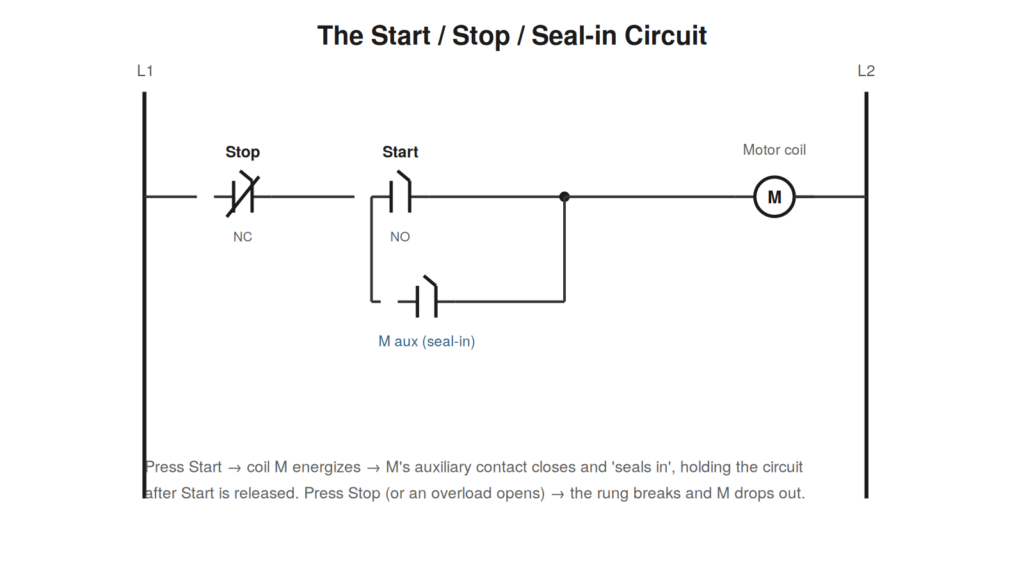
The start/stop/seal-in circuit solves a specific problem: a start button is momentary, so how does a motor keep running after the button is released? The pattern uses a normally-closed Stop button and a normally-open Start button in the rung controlling the motor’s contactor coil, plus a normally-open auxiliary contact of that same contactor wired in parallel with the Start button. Pressing Start completes the rung and energizes the coil; the coil closes its auxiliary contact, which is in parallel with Start, so when Start is released the circuit stays complete through that auxiliary contact — the circuit ‘seals in’. Pressing Stop, or an overload opening, breaks the rung and the coil drops out, opening the auxiliary contact so the seal is lost. Recognizing this pattern — Stop and Start in series, an auxiliary contact parallel to Start — lets you read it at a glance wherever it appears, which is nearly everywhere.
Reading the seal-in
The seal-in is the clever part, and reading it well means understanding the role of that parallel auxiliary contact. Because the auxiliary contact is operated by the same coil it helps to energize, it creates a self-holding circuit: once the coil is energized, its own contact keeps it energized. This is why the pattern is sometimes called a holding or latching circuit. Reading it, you recognize that the parallel contact bearing the coil’s label is what holds the circuit after the momentary Start is released, and you understand the whole circuit’s behavior: momentary Start to begin, seal-in to hold, Stop to end. This single pattern, read fluently, unlocks the control logic of most motor circuits, and its variations — additional conditions in series, multiple start or stop points — are all recognizable once the core pattern is familiar.
Other common patterns
Beyond start/stop/seal-in, a handful of other patterns recur often enough to learn on sight. A simple control rung — one input contact driving one output coil — is the most basic, an input directly controlling an output. An indicator circuit uses a contact of a running device to light a pilot lamp, showing the device’s state. A reversing circuit uses two contactors, one for each direction, with interlocks preventing both at once. A two-hand or permissive circuit requires multiple conditions in series before allowing an action. Each of these patterns, once recognized, reads instantly, and much of the fluency of an experienced drawing-reader comes from recognizing these recurring patterns rather than reading every rung from scratch. The patterns are the idioms of the language, and knowing them lets you read whole circuits at a glance.
Recognizing the pattern with variations
The start/stop/seal-in pattern rarely appears in its barest form; it usually comes with variations, and recognizing the pattern beneath the variations is the practical skill. Common variations include additional permissive contacts in series (conditions that must also be met to start or run), multiple stop buttons in series (any one stops the machine), multiple start buttons in parallel (any one starts it), and the seal-in contact combined with other holding conditions. Beneath all these, the core is unchanged: a normally-closed stop path, a normally-open start with a parallel seal-in, driving a coil that holds itself in. Recognizing this core beneath the added conditions lets you read a complex real-world motor circuit as ‘start/stop/seal-in, plus these extra permissives,’ which is far faster than reading it as an unfamiliar tangle. The pattern is the skeleton; the variations are additions to it; and reading the skeleton first, then noting the additions, is how an experienced reader handles the endless variety of real motor circuits built on this one foundational pattern.
Case scenario: the motor that stops on its own
Consider a scenario that reading the seal-in circuit explains. A motor starts fine when the operator presses Start, but sometimes stops on its own after running a while, with no one touching Stop. Reading the start/stop/seal-in circuit, the motor stays running through the seal-in contact after Start is released, so if the motor stops on its own, something is breaking the sealed circuit: the Stop contact, a permissive in series, an overload, or the seal-in contact itself becoming intermittent. Reading the circuit lists these possibilities, and the intermittent nature points toward a marginal connection or a permissive that occasionally opens — perhaps a vibration-sensitive Stop contact, or an overload near its trip point, or a loose connection in the seal-in path. The reading turns ‘stops on its own’ into a specific list of things in the holding path that could intermittently break it, which is far more tractable than a vague search. This is how reading the common patterns pays off: knowing the seal-in circuit, you know exactly what holds the motor running and therefore what could interrupt it.
Multiple stops, multiple starts
A frequent elaboration of the start/stop circuit is multiple stop and start points — several places an operator can stop or start the machine — and reading how they are wired reveals a small but important logic principle. Multiple stop buttons are wired in series: because each is normally-closed and must be closed for the circuit to run, putting them in series means any one of them, when pressed, breaks the circuit and stops the machine — which is the desired behavior, since a stop from any location should work. Multiple start buttons are wired in parallel: because each is normally-open and closing any one should start the machine, parallel wiring means pressing any start button completes the start path. Reading these arrangements confirms the logic: series stops (any one stops), parallel starts (any one starts), which follows directly from the contact types and the AND/OR meaning of series and parallel. Recognizing this pattern lets you read a circuit with stop and start buttons scattered across several locations as the same familiar start/stop/seal-in logic, simply with the stops in series and the starts in parallel, rather than as something new and complex.
Jog circuits and momentary control
A variation worth recognizing is the jog (or inch) circuit, which provides momentary operation — running a motor only while a button is held, without sealing in — and reading it shows how defeating the seal-in changes the behavior. Where the standard start/stop/seal-in holds the motor running after Start is released, a jog circuit deliberately prevents the seal-in, so the motor runs only while the jog button is pressed and stops the instant it is released. This is useful for positioning or testing, where you want momentary control rather than continuous running. On the drawing, a jog circuit is recognized by an arrangement that bypasses or defeats the seal-in when jogging — often a jog button that energizes the motor coil through a path that does not include the seal-in, or that opens the seal-in path. Reading a jog circuit means recognizing this defeat of the seal-in and understanding the resulting momentary behavior: run while held, stop when released. It contrasts instructively with the standard seal-in circuit, and reading both shows how the presence or absence of an effective seal-in determines whether operation is continuous or momentary, which is the key behavioral distinction the seal-in creates.
Case: the machine that starts but will not stay running
A specific and common start/stop fault is a machine that starts when the button is held but stops the moment the button is released, and reading the seal-in explains it precisely. The operator presses Start and the machine runs, but on releasing Start the machine immediately stops — it will not stay running on its own. Reading the start/stop/seal-in circuit, the machine stays running after Start is released only through the seal-in contact, so a machine that stops on release means the seal-in is not holding — the seal-in contact is not closing or not maintaining the circuit. Reading the circuit localizes the fault to the seal-in path: the seal-in contact (an auxiliary contact of the coil) not closing, or its wiring open. This is a precise diagnosis from reading: the symptom ‘runs while held, stops on release’ points specifically to the seal-in failing, because the seal-in is exactly what holds the circuit after release. Checking the seal-in contact and its wiring finds the fault. This case shows how reading the seal-in circuit turns a specific symptom into a specific diagnosis: the seal-in is what maintains running after release, so failure to stay running after release is a seal-in fault, and reading the circuit points right at it rather than leaving you to search the whole circuit for why the machine will not stay on.
Why pattern recognition accelerates everything
The emphasis on recognizing common patterns like start/stop/seal-in reflects a general truth about reading fluency: pattern recognition accelerates everything, because recognizing a familiar structure lets you read it instantly instead of analyzing it from scratch. A large fraction of what appears on control drawings consists of recurring patterns — the same structures appearing again and again across machines and industries — and the reader who recognizes these patterns reads most of a drawing quickly, focusing effort only on the novel parts. This is how experienced readers achieve their speed: not by analyzing every drawing element from first principles, but by recognizing the many familiar patterns and reading them at a glance, reserving analysis for the unfamiliar. Building a repertoire of recognized patterns — start/stop/seal-in, interlocks, jog circuits, indicator circuits, common sequences — is therefore a high-leverage investment, because each pattern recognized is a structure you can henceforth read instantly wherever it appears. The book emphasizes these patterns because recognizing them is so accelerating, and the reader who internalizes them will find drawings that once required careful analysis becoming largely familiar, read quickly through recognized patterns with careful analysis reserved for the genuinely new parts. Pattern recognition is the engine of reading fluency, and building the pattern repertoire is building reading speed.