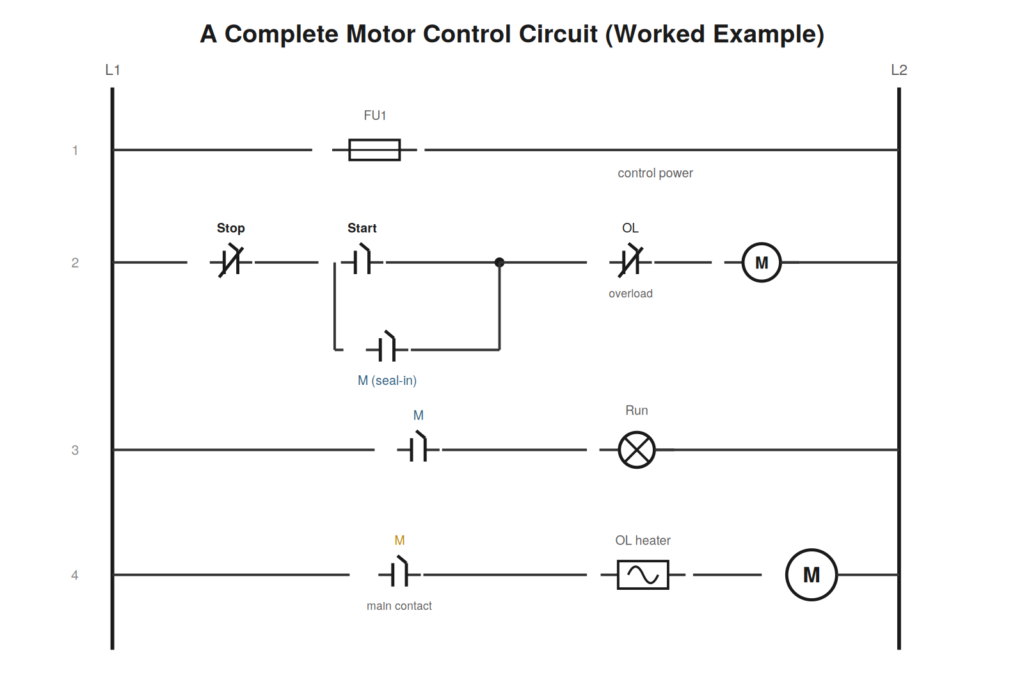
With all the pieces in hand, the real test is reading a complete circuit from end to end — taking a full control scheme and following its logic from inputs to outputs, understanding everything it does. This chapter works through a complete motor control circuit as a demonstration of reading in practice, bringing together everything the book has covered.
Reading the circuit rung by rung
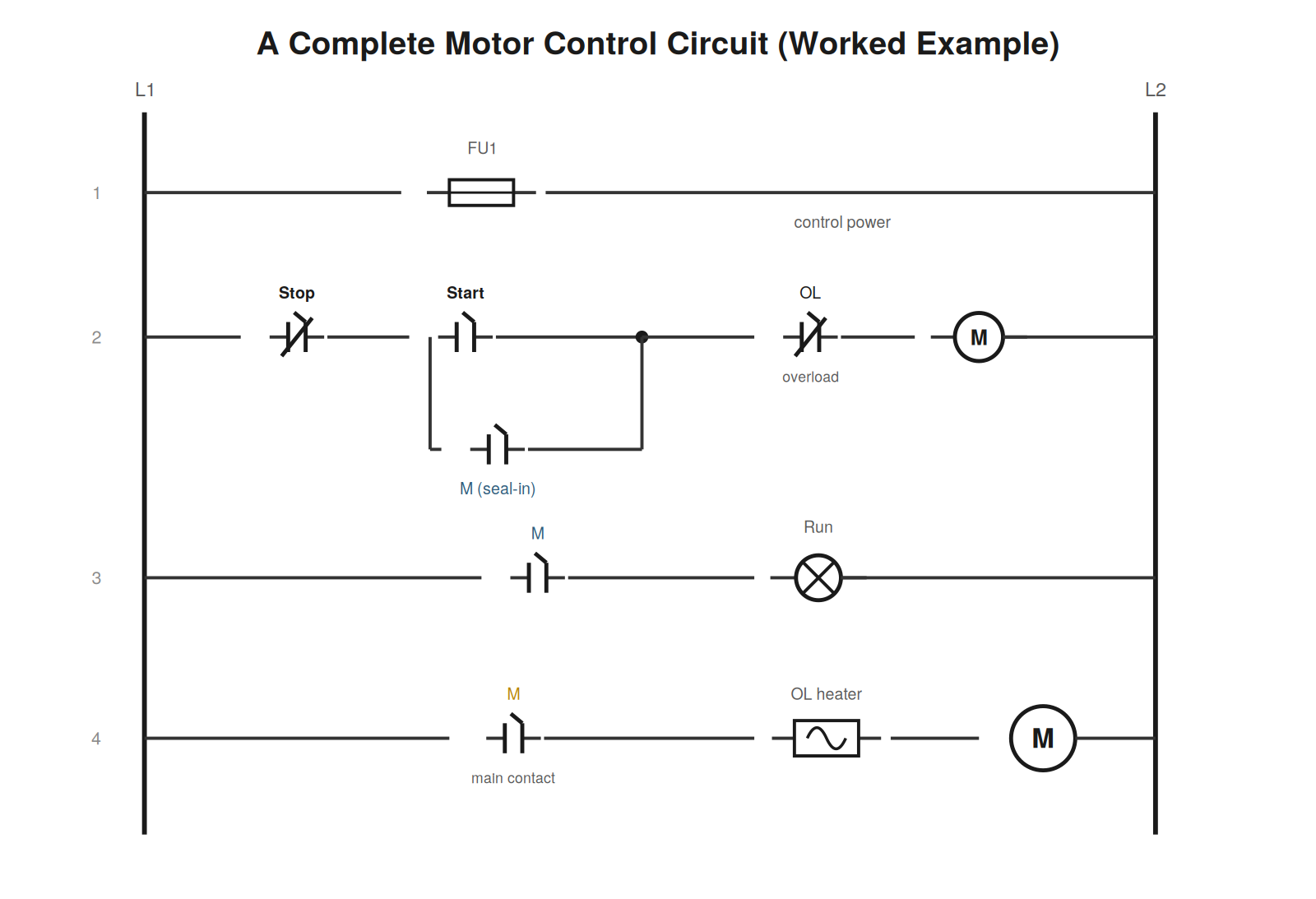
Take the complete circuit and read it one rung at a time, top to bottom. Rung 1 provides control power through a fuse — the source of the control logic’s energy, protected against a fault. Rung 2 is the heart: a normally-closed Stop, a normally-open Start with the seal-in auxiliary contact in parallel, and a normally-closed overload contact in series, all driving the motor contactor coil M. Reading it: pressing Start (with Stop not pressed and the overload not tripped) energizes M, which seals in through its auxiliary contact and stays running until Stop is pressed or the overload trips. Rung 3 uses a normally-open contact of M to light a run lamp — when M is energized, its contact closes and the lamp shows the motor is running. Rung 4, on the power side, shows M’s main contact delivering power through the overload heater to the motor. Read together, these rungs tell the complete story: how the motor is started, held, indicated, protected, and powered.
Seeing the whole behavior
Reading a circuit end to end means assembling the individual rungs into an understanding of the whole machine’s behavior. From the worked circuit, you can now state exactly what the machine does: it starts when Start is pressed provided Stop is released and no overload has tripped; it continues running via the seal-in after Start is released; it shows a run lamp while running; it delivers three-phase power to the motor through the contactor and overload; and it stops when Stop is pressed or the overload trips on excessive current. This complete behavioral understanding, assembled by reading each rung and connecting them, is the goal of reading a schematic — not just recognizing symbols but understanding what the whole circuit does. An experienced reader arrives at this whole-circuit understanding fluently, and it is what makes the drawing genuinely useful for operating, modifying, and troubleshooting the machine.
Predicting behavior from the drawing
The ultimate reading skill is predicting behavior from the drawing — using your understanding of the circuit to say what will happen under various conditions, which is exactly what troubleshooting requires. From the worked circuit, you can predict: what happens if the Stop button’s contact fails open (the motor cannot start or stay running, because the rung is broken); what happens if the seal-in contact fails to close (the motor runs only while Start is held); what happens if the overload trips (the motor stops and cannot restart until reset). Each prediction comes from reading the circuit and reasoning about how it behaves when a condition changes. This predictive reading — running the circuit in your head, asking what happens if this or that changes — is the highest form of schematic reading, and it is precisely the skill that turns a drawing into a troubleshooting tool, because troubleshooting is largely the art of predicting from the drawing what fault would produce the symptom you see.
Reading order for an unfamiliar circuit
When facing an unfamiliar circuit, a deliberate reading order makes the reading manageable rather than overwhelming. First, orient: read the title block and get the big picture of what the drawing controls. Second, find the outputs — the coils and loads — because they are what the circuit exists to control, and identifying them tells you what the circuit does. Third, for each output, read its rung to understand what conditions control it. Fourth, follow the conditions back: where a condition is a contact operated by another coil, find that coil and read what controls it, working backward through the logic. Fifth, assemble the whole picture from these readings. This outputs-first, work-backward order is efficient because it starts from the circuit’s purpose (its outputs) and traces back to the conditions, rather than reading forward from inputs without knowing where they lead. Following this order on an unfamiliar circuit turns an intimidating tangle into a systematic reading that builds understanding piece by piece from the outputs back to the inputs that drive them.
The satisfaction of a complete reading
There is a distinct satisfaction in reading a circuit completely — reaching the point where the whole thing makes sense, where you can state exactly what it does under any conditions and predict its behavior for any fault. This complete understanding is the payoff of all the foundational skills: symbol recognition, connection reading, logic reading, pattern recognition, all combining to let you read a whole circuit fluently. When you reach it, the drawing is no longer a puzzle but a clear description you can reason over freely, and the machine’s behavior holds no mystery. This is the goal the book has been building toward, and reaching it on a real circuit — reading it end to end until it is fully clear — confirms that the skill has taken hold. The satisfaction is real and motivating, and it marks the transition from someone who can pick out symbols to someone who reads schematics fluently, which is a genuine professional capability that repays every hour spent learning it, on every machine you will ever face.
Reading a circuit you will need to modify
Reading a circuit end to end is essential not only for troubleshooting but for modifying it safely, and modification is a common reason to read a circuit thoroughly. Before changing a circuit — adding a condition, a device, an interlock — you must understand it completely, because a modification made without understanding can break existing behavior or create unsafe conditions. Reading the circuit end to end gives you the complete understanding modification requires: what the circuit does, how each part contributes, what depends on what, so that you can see how a proposed change fits and what it might affect. A change to one rung may affect others through shared coils and contacts; a new condition may interact with existing permissives; a modification may have safety implications. Only a complete reading reveals these interactions, which is why reading a circuit fully is the prerequisite to modifying it responsibly. The end-to-end reading that lets you troubleshoot a circuit is the same reading that lets you modify it safely, and both rest on understanding the whole circuit rather than just the part you are focused on, because in a control circuit the parts are interconnected and a change to one can ripple to others.
Reading at different levels of detail
A skilled reader adjusts the level of detail to the purpose, reading a circuit at a high level for an overview or in fine detail for troubleshooting, and knowing when to do which is part of fluency. For a general understanding of what a machine does, a high-level reading suffices — identifying the main functions, the key circuits, the overall behavior, without tracing every contact. For troubleshooting a specific fault, a detailed reading of the relevant circuit is needed — every condition, every contact, every checkpoint. Reading at the appropriate level for the purpose is efficient: you do not need to trace every detail of a circuit to understand its general function, nor can you troubleshoot a specific fault without the details. The skill is to zoom in and out — reading broadly to grasp the whole, then narrowly to diagnose a part — matching the depth of reading to what you need. A fluent reader moves fluidly between these levels, using a high-level reading to orient and locate the relevant circuit, then a detailed reading to diagnose within it. This adjustable depth is efficient reading, applying just the detail the purpose requires, and it is how experienced technicians read quickly for overview and carefully for diagnosis as the situation demands.
Case: reading a whole machine before touching it
There is value in reading a whole machine’s circuit before ever touching it, as this case shows. A technician new to a machine faced a fault, and rather than diving in, first read the machine’s control circuit end to end, building a complete understanding of how it worked. This upfront reading took some time but paid off immediately: with the whole circuit understood, the technician could reason about the fault in full context, knowing how every part related, and went to the fault efficiently. A technician who dove in without this reading would have understood only fragments, reasoning about the fault without the full picture and likely taking longer. The end-to-end reading before touching the machine provided the complete context that made the subsequent troubleshooting fast and sure. This case illustrates the value of reading a circuit fully before working on it, especially an unfamiliar one: the investment in reading end to end builds the complete understanding that makes all subsequent work — troubleshooting, modifying — faster and more reliable. Reading the whole before addressing the part is often the fastest path overall, because the whole-circuit understanding gives every subsequent action its full context, and this case shows a technician benefiting from reading the entire machine before touching it, arriving at the fault with the complete picture that made the fix quick and certain.
The end-to-end reading as the integrating skill
Reading a circuit end to end is the integrating skill that brings together everything the book has taught, and reaching fluency in it marks real mastery, because it requires and combines all the component skills at once. To read a circuit end to end, you use symbol recognition, connection reading, node tracing, logic reading, pattern recognition, cross-referencing, and integration of power and control — all together, fluently, on a whole circuit. This is why it is the culminating skill: it is not a new technique but the integration of all the techniques into the ability to read a complete circuit. Reaching fluency in end-to-end reading means the component skills have become automatic enough to combine seamlessly, which is the mark of real mastery. The reader who can pick up an unfamiliar circuit and read it end to end fluently has integrated all the book’s skills into a capable whole, and that integration is the goal. Everything the book teaches builds toward this integrating skill, and developing it — through reading whole circuits until it is fluent — is developing the complete capability of reading schematics. The end-to-end reading is where all the skills come together, and mastering it is mastering the reading of schematics as an integrated whole, which is the real aim beneath all the component skills the book has developed one by one.