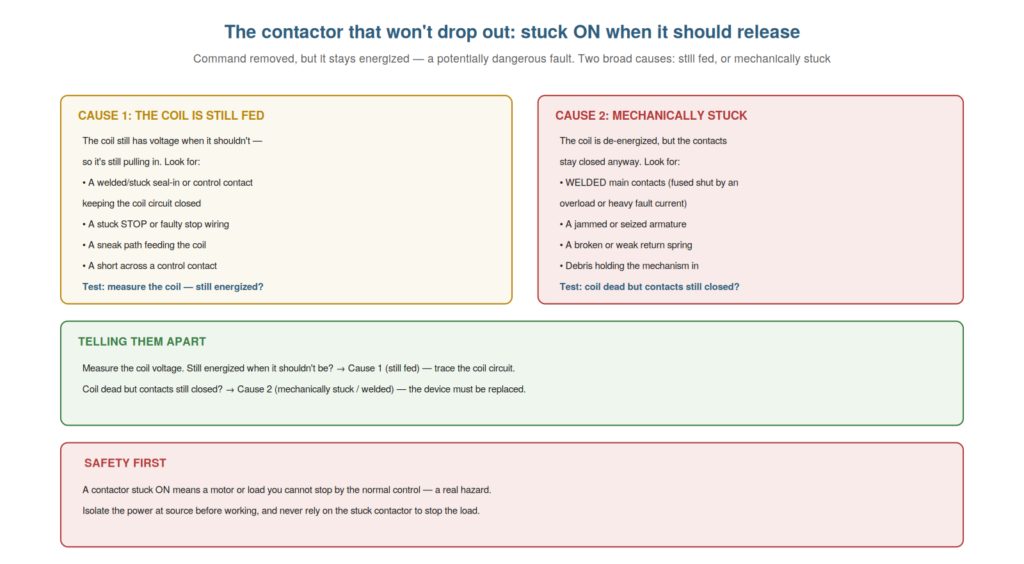
A contactor that will not drop out — staying energized when it should release — is a serious and potentially dangerous fault, because it means a motor or load you cannot stop by the normal control, and understanding its two broad causes lets you diagnose it safely. Either the coil is still being fed (so it stays pulled in), or the contactor is mechanically stuck (welded contacts or a jammed mechanism). Understanding how to tell these apart, and the safety implications, is essential. This chapter covers the won’t-drop-out fault.
The safety implication first
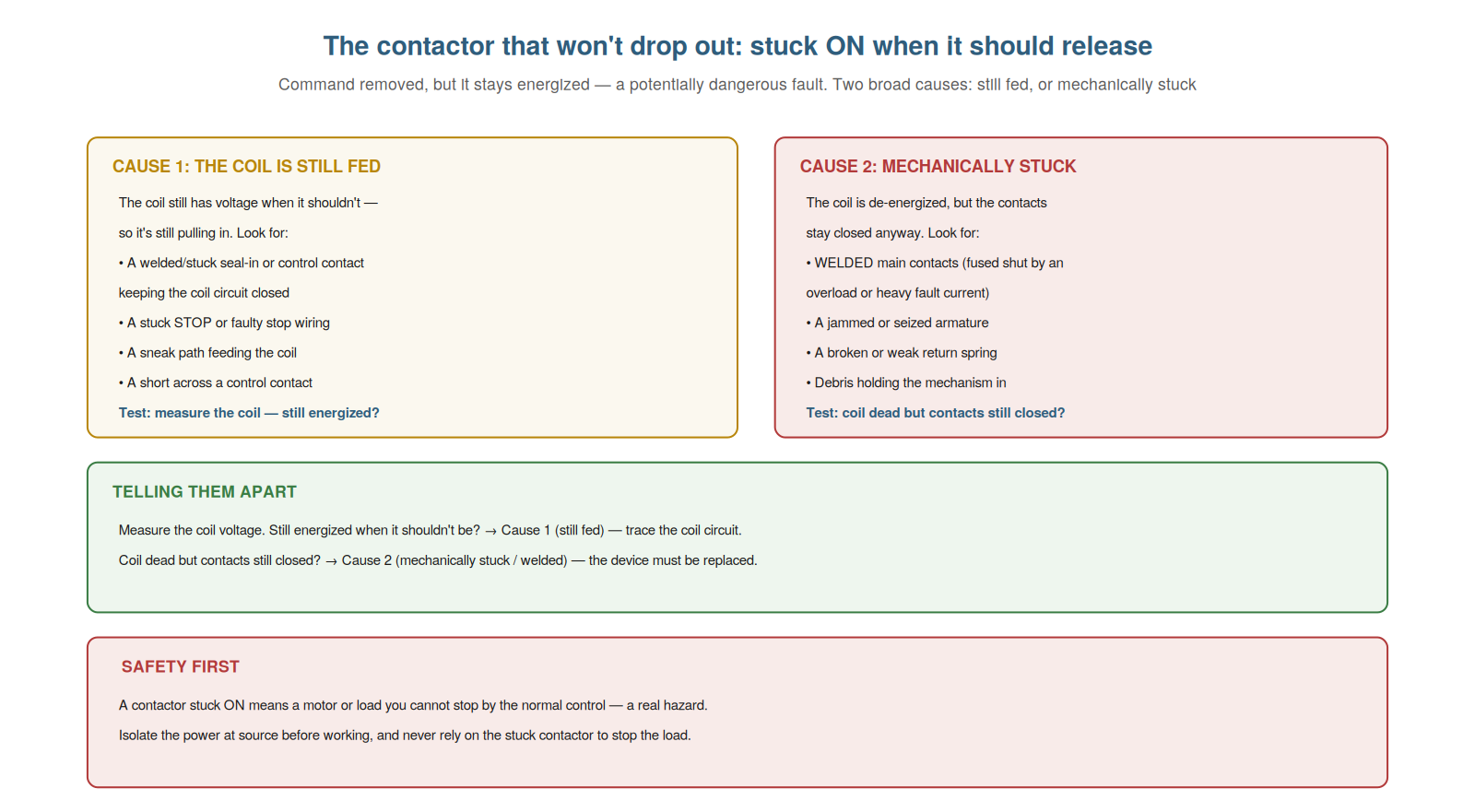
Before diagnosing a won’t-drop-out fault, understanding its safety implication is essential, because a stuck contactor means a load you cannot stop normally. A contactor that will not drop out keeps its load energized — a motor running, a heater on — despite the control commanding it off. This is a hazard: the normal means of stopping the load (the control circuit) has failed to stop it, so the load is running uncontrolled, and pressing stop or removing the command does not stop it. Understanding this means you treat the situation as dangerous: you must isolate the power at its source (upstream of the stuck contactor) to actually stop and safely work on the load, and you must never rely on the stuck contactor or the normal control to stop it. This safety-first understanding shapes how you approach the fault: secure the situation (isolate at source) before diagnosing or working. So understanding the safety implication first — a stuck contactor is an unstoppable load — means you isolate at source before anything else. Understanding the safety implication of a won’t-drop-out fault first — that a contactor stuck on means a load you cannot stop by the normal control, a real hazard — means you isolate the power at its source before diagnosing or working, so that you secure the dangerous situation of an uncontrolled running load by isolating upstream of the stuck contactor and never relying on it or the failed normal control to stop the load, which is the essential safety-first response that must precede any diagnosis of a contactor that will not drop out.
Still fed, or mechanically stuck?
The diagnostic key to a won’t-drop-out fault is distinguishing whether the coil is still fed or the contactor is mechanically stuck, and understanding how one measurement tells them apart directs the diagnosis. Measure the coil voltage when the contactor should have dropped out. If the coil is still energized (voltage present when it should be zero), the cause is that the coil is still being fed — something is keeping the coil circuit closed: a welded or stuck control contact (a seal-in or other contact fused shut), a stuck stop button, a sneak path feeding the coil, or a short across a control contact. If the coil is dead (no voltage, correctly de-energized) but the contactor’s contacts are still closed, the cause is mechanical — the contactor is physically stuck closed despite no coil power: welded main contacts (fused shut by heavy current), a jammed armature, a broken or weak return spring, or debris holding it in. So the coil measurement splits the fault: still fed (trace the coil circuit for what keeps it energized) or mechanically stuck (the device is physically stuck and must be replaced). Understanding this split directs the diagnosis to the right cause. So understanding still-fed versus mechanically-stuck — told apart by the coil voltage — directs the won’t-drop-out diagnosis. Understanding whether the coil is still fed or the contactor is mechanically stuck — distinguished by measuring the coil voltage (still energized means still fed by a welded control contact, stuck stop, or sneak path; dead but contacts still closed means mechanically stuck by welded contacts, a jammed armature, or a broken spring) — directs the won’t-drop-out diagnosis, so that one measurement sends you either to trace the coil circuit for what is keeping the coil energized or to conclude the device is physically stuck and must be replaced, which efficiently splits this serious fault into its two causes and directs you to the right one.
Welded contacts: the common mechanical cause
The most common mechanical cause of a won’t-drop-out fault is welded contacts, and understanding welding — why it happens and what it means — explains this failure and why the device must be replaced. Contacts weld when they are fused together by heat: switching a heavy current (especially a fault current or a severe overload) creates intense arcing and heat at the contacts, which can melt and fuse the contact surfaces together, so they stick closed. Once welded, the contacts are physically joined and the return spring cannot pull them apart, so the contactor stays closed even with the coil de-energized. Understanding this explains the symptom (coil dead but load still on) and the cause (contacts fused by heat from switching heavy current). It also means the device must be replaced — welded contacts cannot be reliably un-welded and reused. And it points to a cause to address: what caused the heavy current that welded them (a fault, a severe overload)? Fixing only the contactor without addressing that leaves the cause to weld the next one. So understanding welded contacts — fused by heat, requiring replacement, and signalling a heavy-current cause — explains the common mechanical won’t-drop-out fault. Understanding welded contacts as the common mechanical cause — the contacts fused together by the heat and arcing of switching a heavy current or fault, so they stick closed and the spring cannot open them — explains this won’t-drop-out failure, so that you recognize a coil-dead-but-load-still-on fault as welded contacts, understand the device must be replaced (welded contacts cannot be reliably reused), and know to address the cause of the heavy current that welded them (a fault or severe overload), which resolves the welded-contact fault properly rather than replacing the contactor only to have the underlying heavy-current cause weld its replacement.
Contact weld severity and partial welds
A nuance worth understanding is that contact welds vary in severity, from a light tack to a full weld, because this affects the symptom and the diagnosis. A severe weld fuses the contacts solidly, so the contactor stays fully closed and the load runs at full power despite the coil being de-energized. A light weld (a partial tack) may hold the contacts together weakly — the contactor might drop out with difficulty, or drop out but leave one pole tacked, or release after a delay or a knock. Understanding this range explains varied symptoms: a fully stuck-on load (severe weld), an intermittent or delayed drop-out (partial weld), or one phase remaining live (one pole welded). It also warns that a contactor that ‘sometimes’ drops out or drops out reluctantly may have a partial weld developing — a warning of worsening contact damage. So understanding weld severity and partial welds explains varied drop-out symptoms and a developing fault. Understanding contact weld severity and partial welds — from a light tack that makes drop-out reluctant or delayed to a full weld that holds the contactor solidly closed — explains varied symptoms and the diagnosis, so that you understand a fully stuck-on load as a severe weld, a reluctant, delayed, or single-pole drop-out as a partial weld, and a contactor that drops out with difficulty as possibly developing a weld, which broadens your understanding of the won’t-drop-out fault beyond the full weld to include the partial welds that produce intermittent or reluctant drop-out and warn of worsening contact damage.
Scenario: coil dead, load still on
A scenario shows the coil measurement distinguishing a welded contactor — and the safety response. A motor kept running after the operator commanded it off — a dangerous stuck-on fault. The technician’s first action, understanding the hazard, was to isolate the power at source to safely stop the motor. Then he diagnosed: he measured the contactor’s coil and found it dead (de-energized, correctly, since the command was removed), yet the contactor’s contacts were still closed (the motor had been running). Coil dead but contacts closed pointed to a mechanical fault — welded contacts. Inspection confirmed the main contacts were welded shut, fused by a previous heavy fault current. The contactor had to be replaced, and — crucially — he investigated what heavy current had welded them (a downstream fault) so the replacement would not weld too. Understanding the still-fed-versus-stuck split, confirmed by the coil measurement, identified the weld; the safety-first isolation protected him. This scenario shows the coil measurement identifying a welded contactor, with a safety-first response. Understanding to isolate first and then split the fault by coil voltage led the technician to identify welded contacts. It reinforces that coil-dead-but-contacts-closed means welded, and that a stuck contactor demands isolating at source first. The scenario reinforces the won’t-drop-out method: isolating at source for safety, then measuring the coil (dead) with the contacts still closed, identified welded contacts, illustrating how the safety-first response and the coil measurement together handle this dangerous fault — securing the hazard, then splitting the fault to reveal the weld and prompting a search for the heavy-current cause behind it.
The dangerous case of a stuck safety contactor
A particularly important case worth understanding is a stuck safety-related contactor, because the safety implications are especially serious. Some contactors are part of a safety function — they must drop out to remove power in an emergency or when a guard opens, ensuring the machine stops safely. If such a contactor sticks (welded or held in), the safety function fails: the machine may not stop when it should, which is a serious hazard. Understanding this means treating a stuck safety-related contactor with particular gravity: the failure defeats a safety measure, so it must be addressed immediately and the machine kept safe (isolated) until it is. It also underlines why safety circuits often use redundant, monitored contactors (so a single stuck contactor does not defeat the safety) and why monitoring detects a contactor that fails to drop out. So understanding the stuck safety-contactor case highlights the grave implications and the reason for redundancy and monitoring in safety circuits. So understanding the dangerous case of a stuck safety contactor highlights its grave implications. Understanding the dangerous case of a stuck safety-related contactor — one that must drop out to remove power for safety, whose sticking defeats the safety function and may prevent the machine stopping when it should — highlights especially serious implications, so that you treat a stuck safety contactor with particular gravity (addressing it immediately and keeping the machine isolated until it is fixed) and understand why safety circuits use redundant, monitored contactors so a single stuck one does not defeat the safety, which underlines the grave consequences of a won’t-drop-out fault in a safety context and the design measures that guard against it.
Safety and diagnosis together
To close, it helps to see that the won’t-drop-out fault teaches safety and diagnosis together, because it is the fault where the two are most inseparable. The won’t-drop-out fault is both a diagnostic problem (still fed or mechanically stuck?) and a safety problem (a load you cannot stop). Handling it well means doing both: securing the hazard first (isolate at source) and then diagnosing (coil measurement to split the fault). Neither alone suffices — diagnosing without securing the hazard is dangerous, and securing without diagnosing does not fix it. So this fault teaches that safety and diagnosis go together: you make the situation safe and then work the problem, in that order. Understanding this integration — safety first, then diagnosis — is a model for handling any fault with a safety dimension. So understanding safety and diagnosis together, from the won’t-drop-out fault, models handling hazardous faults. Understanding that the won’t-drop-out fault teaches safety and diagnosis together — being both a diagnostic problem (still fed or mechanically stuck?) and a safety problem (an unstoppable load), handled by securing the hazard first and then diagnosing — models how to handle any fault with a safety dimension, so that you make the situation safe (isolate at source) before working the problem (the coil measurement to split the fault), recognizing that neither alone suffices, which makes the won’t-drop-out fault the clearest lesson that safety and diagnosis go together, safety first, then the diagnosis.