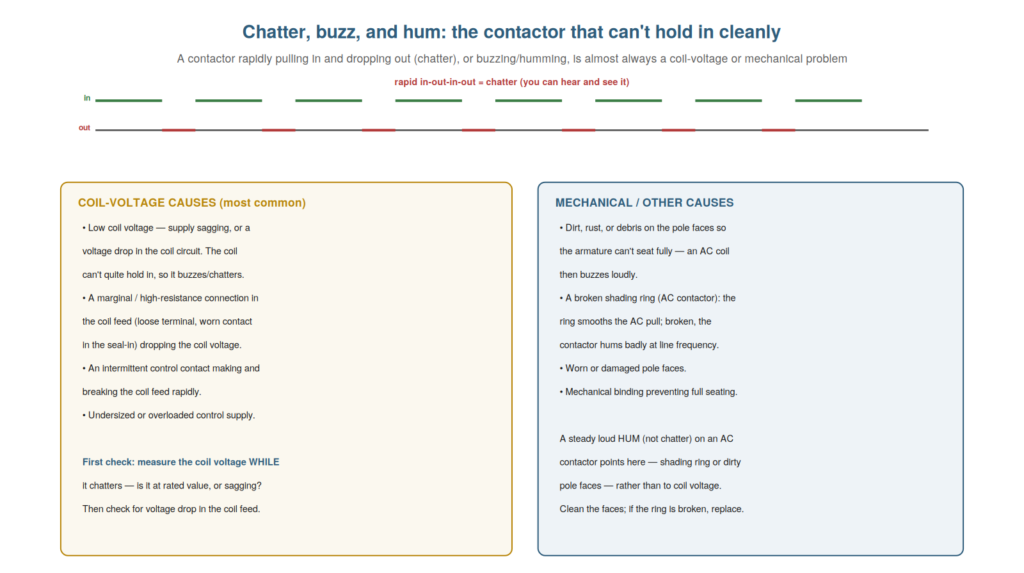
A contactor that chatters (rapidly pulls in and drops out) or buzzes and hums is a distinctive fault, and understanding its causes — almost always coil voltage or a mechanical seating problem — lets you diagnose it, because the sound points to the cause. Chatter usually means the coil cannot quite hold in; a loud hum on an AC contactor often means it cannot seat cleanly. Understanding the difference and the causes directs your diagnosis. This chapter covers chatter, buzz, and hum.
Chatter: the coil can’t hold in
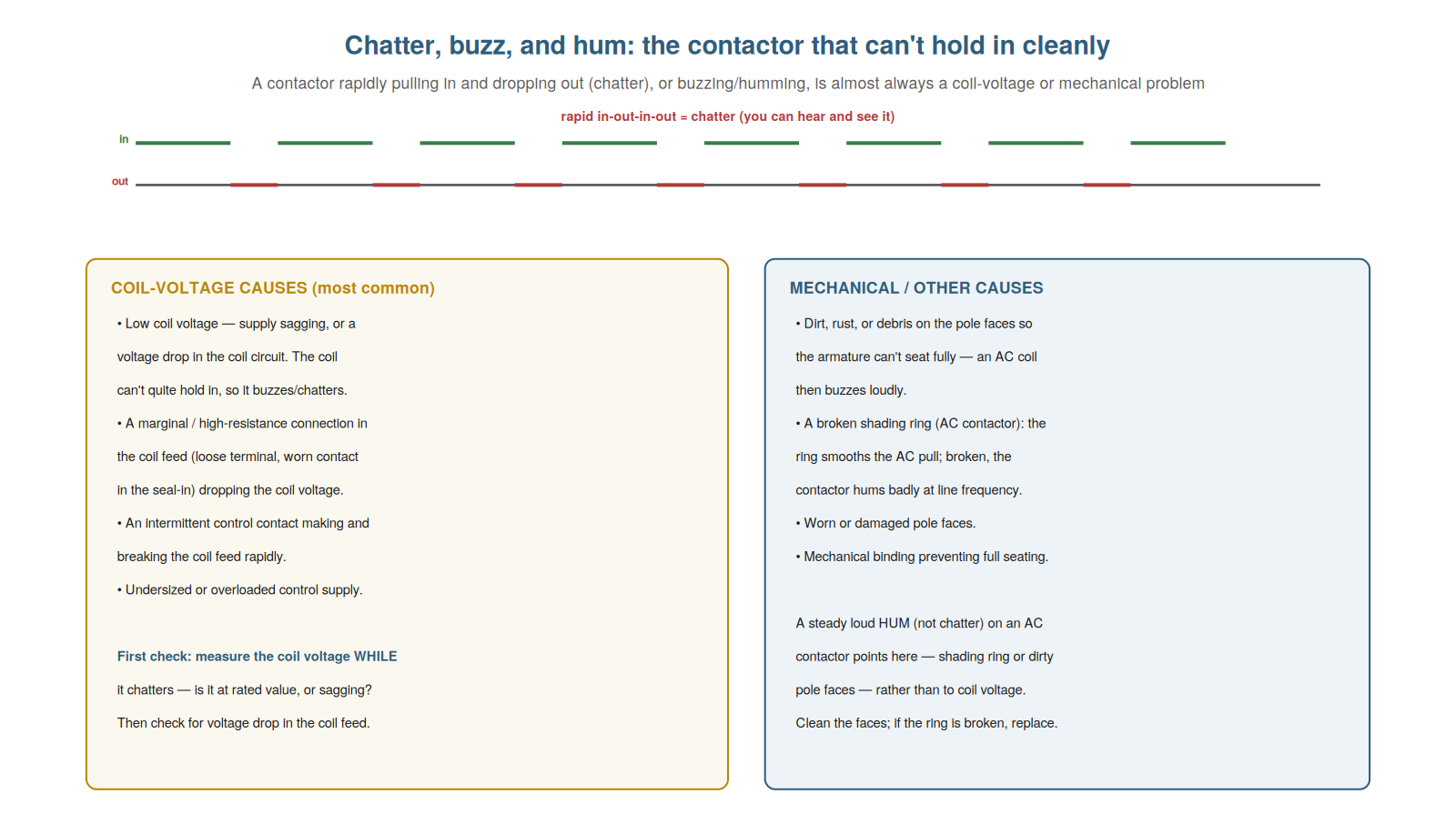
Understanding chatter as a coil-voltage problem — the coil unable to hold in — directs you to the most common cause. Chatter is the rapid pulling-in and dropping-out of the contactor, which you can see and hear as a buzzing, clattering operation. It happens when the coil voltage is marginal — not quite enough to hold the armature firmly in: the coil pulls in, but the voltage is too low to hold it, so it starts to drop out, but then pulls in again, rapidly cycling. The usual causes are low coil voltage (a sagging supply), or a voltage drop in the coil feed (a loose terminal, a worn seal-in contact, a high-resistance connection) reducing the voltage reaching the coil, or an intermittent contact rapidly making and breaking the feed. So chatter points to the coil not getting a solid, sufficient voltage. Understanding this directs the diagnosis: measure the coil voltage while it chatters — is it at rated value or sagging? — and check for a voltage drop in the coil feed. The fault is in getting solid voltage to the coil. So understanding chatter as the coil unable to hold in directs you to measure the coil voltage and check the feed. Understanding chatter as a coil-voltage problem — the coil unable to hold the armature in because the voltage is marginal, from a sagging supply, a voltage drop in the feed, or an intermittent contact — directs you to the most common cause, so that when a contactor chatters you measure the coil voltage while it chatters (is it rated or sagging?) and check for voltage drop in the coil feed (a loose terminal, worn seal-in contact, or high-resistance connection), which addresses the marginal-voltage cause behind the great majority of contactor chatter.
Hum: the AC seating problem
Understanding a loud hum on an AC contactor as a seating problem — often a broken shading ring or dirty pole faces — distinguishes it from chatter and directs a different diagnosis. An AC contactor, held in by an alternating magnetic field, uses a shading ring (a shorted turn on the pole face) to maintain the pull as the AC waveform passes through zero, preventing the armature from buzzing at line frequency. If the shading ring breaks, the pull pulsates with the AC, and the contactor hums loudly (a steady, strong hum at line frequency), unable to seat cleanly. Similarly, dirt, rust, or debris on the pole faces (the mating surfaces of the armature and core) prevents the armature from seating fully, leaving an air gap that causes a loud buzz. So a loud steady hum on an AC contactor points to a seating problem — a broken shading ring or dirty pole faces — rather than to coil voltage. Understanding this distinguishes hum from chatter: hum is a mechanical seating issue (clean the pole faces; replace if the ring is broken), while chatter is a coil-voltage issue. So understanding hum as an AC seating problem directs a mechanical diagnosis distinct from chatter’s voltage diagnosis. Understanding a loud hum on an AC contactor as a seating problem — a broken shading ring (which normally smooths the AC pull) or dirty pole faces preventing the armature from seating fully — distinguishes it from chatter and directs a different diagnosis, so that a steady loud hum points you to inspect and clean the pole faces and check the shading ring (replacing the contactor if the ring is broken) rather than to coil voltage, which correctly separates the mechanical seating cause of an AC hum from the coil-voltage cause of chatter and directs the right fix for each.
Telling them apart
Understanding how to tell chatter from hum — by the sound and by measurement — lets you direct your diagnosis to the right cause. The two sound different: chatter is a rapid, irregular clattering (the contactor actually cycling in and out), while a hum or buzz is a more steady, continuous sound (the contactor in but vibrating). And they measure differently: chatter shows up as the coil voltage being marginal or the contactor visibly cycling, so measuring the coil voltage (sagging or low) confirms it; a hum with the coil at proper voltage and the contactor staying in (just buzzing) points away from voltage and toward the mechanical seating (shading ring, pole faces). So you tell them apart by observing whether the contactor is cycling (chatter, voltage cause) or steadily buzzing while in (hum, seating cause), confirmed by measuring the coil voltage. Understanding this directs you to the right diagnosis: voltage and feed for chatter, pole faces and shading ring for hum. So understanding how to tell chatter from hum by sound and measurement directs your diagnosis to the coil-voltage or the seating cause. Understanding how to tell chatter from hum — chatter being a rapid irregular cycling (confirmed by marginal coil voltage) and hum a steady buzz with the contactor in (pointing to a mechanical seating cause with the coil at proper voltage) — lets you direct your diagnosis to the right cause, so that you distinguish the contactor cycling in and out (chatter, a coil-voltage and feed problem) from the contactor steadily buzzing while seated (hum, a shading-ring or pole-face problem) by observation and coil-voltage measurement, which sends you to the correct diagnosis for each of these related but distinct noisy-contactor faults.
Measuring coil voltage while it chatters
A key practical technique is measuring the coil voltage while the contactor is actually chattering, because the fault is dynamic and a static measurement can miss it. Chatter is a dynamic fault — the contactor rapidly cycling — and its cause (marginal or sagging coil voltage) shows up during the chattering, not necessarily at rest. So you measure the coil voltage while it chatters: connect the meter across the coil and observe the voltage as the contactor cycles. You may see the voltage sagging (too low to hold in), or dipping as the contactor tries to pull in (the inrush loading a weak supply and dropping the voltage further, causing it to drop out, then recover, then repeat). This dynamic measurement reveals the marginal-voltage cause that a static reading (with the contactor not chattering, or held in) might not show. Understanding this technique — measure during the fault — catches the dynamic cause of chatter. Using the meter’s MIN/MAX can capture the sag if it is too quick to read live. So understanding measuring coil voltage while it chatters catches the dynamic marginal-voltage cause. Understanding the technique of measuring the coil voltage while the contactor is actually chattering — observing the voltage during the dynamic fault, where it may sag or dip as the contactor cycles, rather than taking a static reading — catches the marginal-voltage cause that a static measurement can miss, so that you measure across the coil during the chattering (using MIN/MAX to capture a quick sag) to see the voltage failing to hold the contactor in, which reveals the dynamic marginal or sagging coil voltage behind chatter that a measurement taken at rest or with the contactor held in might not show.
Scenario: the chatter that was a voltage drop
A scenario shows measuring the coil voltage during chatter finding a voltage-drop cause. A contactor chattered — rapidly pulling in and dropping out with a clattering buzz. The technician, understanding chatter as a coil-voltage problem, measured the coil voltage while it chattered. He saw the voltage sagging well below rated — too low to hold the contactor in. The supply itself was fine at its source, so the drop was in the coil feed. Checking the coil circuit, he found a worn seal-in contact with high resistance, dropping much of the voltage before it reached the coil — so the coil got too little to hold in, and chattered. Replacing the worn seal-in contact restored full voltage to the coil, and the chatter stopped. Understanding chatter as a coil-voltage issue, and measuring during the fault, led him to the voltage drop in the feed. This scenario shows measuring coil voltage during chatter finding a voltage-drop cause. Understanding chatter as a coil-voltage problem led the technician to measure during the chatter and find the voltage drop. It reinforces that chatter is diagnosed by measuring the coil voltage during the fault and checking the feed for voltage drop. The scenario reinforces chatter diagnosis: understanding chatter as a marginal-voltage problem led the technician to measure the coil voltage while it chattered (sagging) and trace the drop to a worn high-resistance seal-in contact in the feed, illustrating how measuring during the dynamic fault and checking the coil feed for voltage drop finds the marginal-voltage cause of chatter.
When chatter comes from the control device
A nuance worth understanding is that chatter can originate in the control device switching the coil, not just the coil supply, because this points to a different cause. Chatter is the coil rapidly making and breaking — usually from marginal coil voltage — but it can also come from the device that switches the coil rapidly cycling its own output: a PLC output or a control relay with a marginal or oscillating signal, a failing solid-state output, or an intermittent control contact rapidly making and breaking the coil feed. In these cases, the coil voltage is being switched on and off rapidly by the upstream device, so the contactor chatters in response — the cause is the control device, not the coil supply level. Understanding this broadens the diagnosis: if the coil voltage (when present) is at rated value but is being rapidly interrupted, look upstream at what is switching the coil — is a control contact or output cycling? So understanding that chatter can come from the control device directs you upstream when the coil supply itself is not the cause. So understanding when chatter comes from the control device points the diagnosis upstream. Understanding that chatter can originate in the control device switching the coil — a PLC output, control relay, or intermittent contact rapidly interrupting the coil feed — rather than in a marginal coil supply, points the diagnosis upstream, so that when the coil voltage is at rated value but being rapidly interrupted you look at what is switching the coil (a cycling output or intermittent contact) rather than at the supply level, which broadens the chatter diagnosis beyond marginal coil voltage to include the upstream control device that may be rapidly making and breaking the coil feed.
Sound as a first diagnostic
To close, it helps to appreciate sound as a first diagnostic for these faults, because how a contactor sounds points quickly toward the cause. A contactor should pull in with a clean, single clunk and hold silently (or with a faint hum on AC). Departures from this are diagnostic: a rapid clattering is chatter (marginal coil voltage); a loud steady hum or buzz on an AC contactor is a seating problem (shading ring, pole faces); a repeated clunking in and out is chatter too. So the sound is a first diagnostic — before measuring, listening tells you the likely category (voltage chatter versus mechanical hum). Understanding this makes your ear a quick first tool: you listen, categorize, and then confirm by measurement. So appreciating sound as a first diagnostic speeds the diagnosis of noisy-contactor faults. Understanding sound as a first diagnostic for chatter, buzz, and hum — the clean single clunk of a healthy pull-in versus the clattering of chatter (marginal voltage) or the steady loud hum of an AC seating problem (shading ring, pole faces) — points quickly toward the cause, so that before measuring you listen and categorize the fault by its sound (voltage chatter versus mechanical hum) and then confirm by measurement, which makes your ear a fast first diagnostic tool for the noisy-contactor faults and speeds you toward their likely cause.