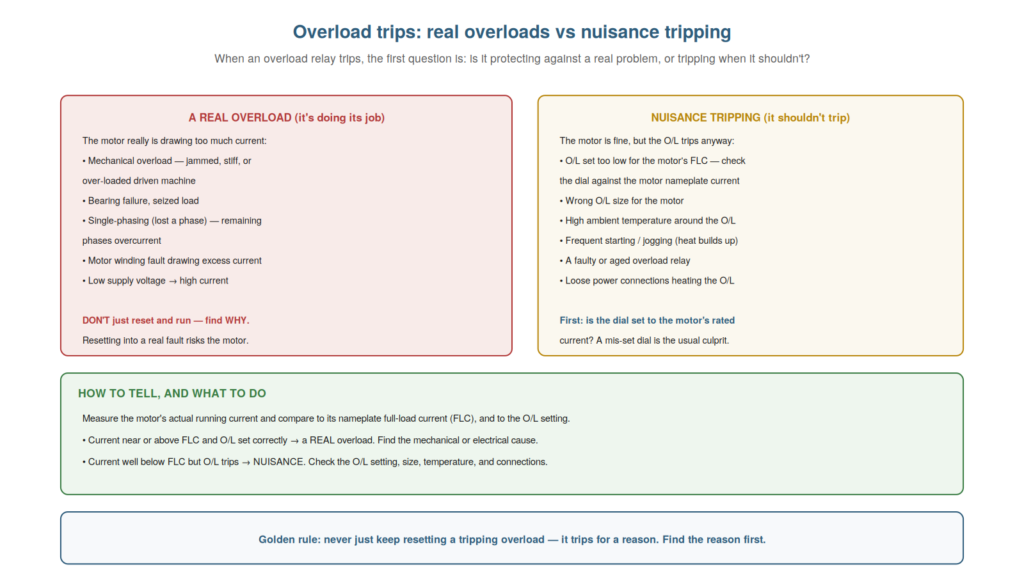
When an overload relay trips, the essential question is whether it is protecting against a real overload or tripping when it should not, and understanding how to tell these apart — and never to just keep resetting — is a key troubleshooting skill, because both are common and the responses differ. A real overload means the motor is genuinely overcurrent and you must find why; a nuisance trip means the overload is tripping wrongly and you must find why it is over-sensitive. Understanding both, and how to distinguish them, is essential. This chapter covers overload trips and nuisance tripping.
Real overload versus nuisance trip
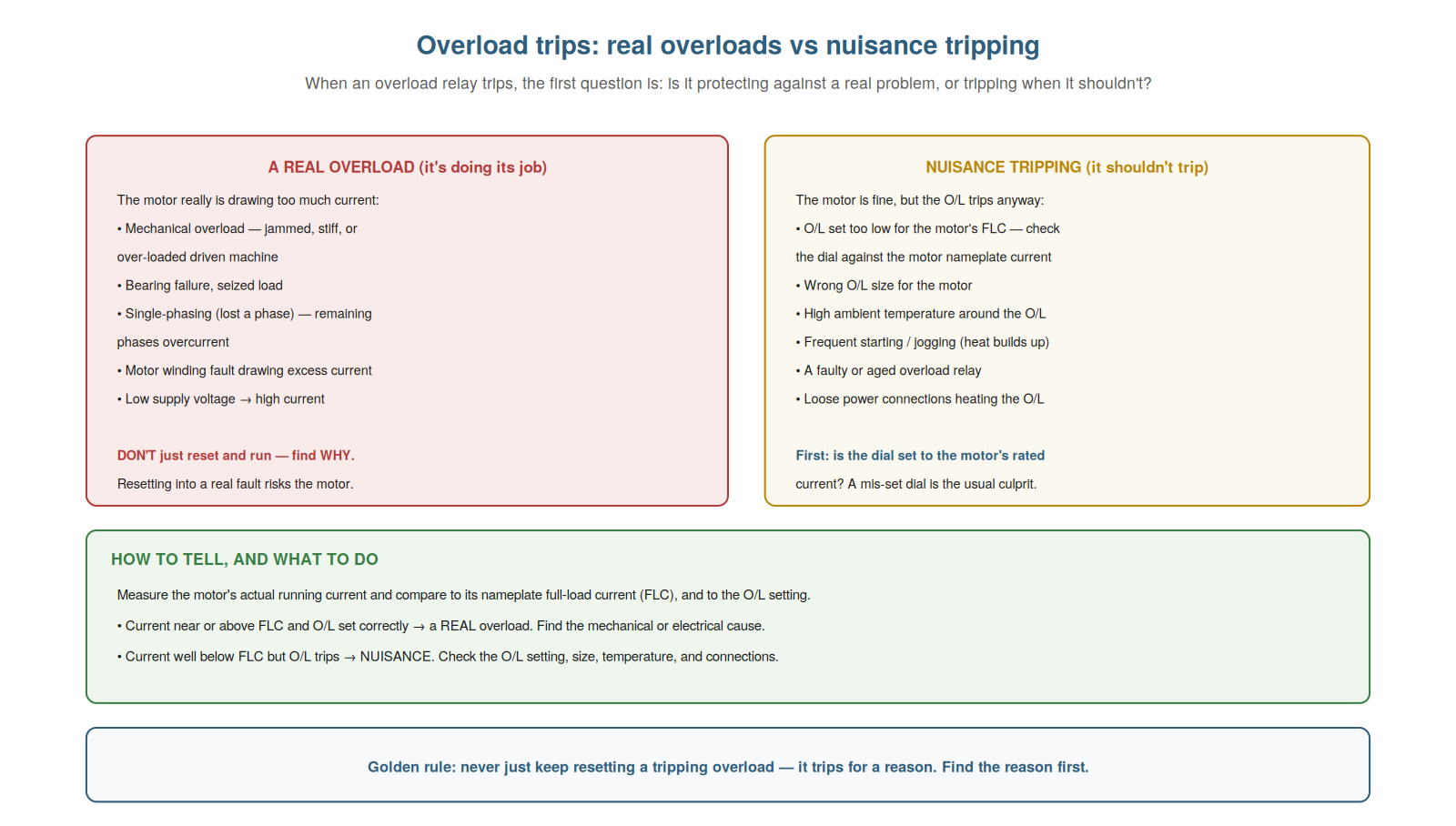
Understanding the distinction between a real overload and a nuisance trip — the motor genuinely overcurrent versus the overload tripping wrongly — is the framework for responding to any trip. A real overload means the motor really is drawing too much current for too long, so the overload correctly tripped to protect it: the causes are a mechanical overload (a jammed, stiff, or over-loaded driven machine, a bearing failure, a seized load), single-phasing (a lost phase overcurrenting the others), a motor winding fault, or low supply voltage (raising the current). A nuisance trip means the motor is fine but the overload tripped anyway, being over-sensitive: the causes are the overload set too low for the motor’s current, the wrong overload size, high ambient temperature, frequent starting or jogging building up heat, a faulty or aged overload, or loose power connections heating it. So a trip is either the overload doing its job (real overload, find the motor’s problem) or the overload tripping wrongly (nuisance, find why it is over-sensitive). Understanding this distinction frames every trip response: which kind is it? So understanding real overload versus nuisance trip frames how you respond to any overload trip. Understanding the distinction between a real overload and a nuisance trip — the motor genuinely overcurrent from a mechanical or electrical cause (the overload doing its job) versus the motor fine but the overload tripping wrongly from a mis-setting, wrong size, heat, or fault (over-sensitive) — is the framework for responding to any trip, so that you approach every overload trip by asking which kind it is, which determines whether you look for the motor’s overload cause or for why the overload is tripping when it should not, the essential framework for correctly handling the common event of an overload trip.
Measuring to tell them apart
The way to distinguish a real overload from a nuisance trip is by measuring the motor’s actual current, and understanding this measurement lets you tell them apart objectively. Measure the motor’s actual running current (with a clamp meter on a motor lead) and compare it to two things: the motor’s nameplate full-load current (FLC), and the overload relay’s setting. If the actual current is near or above the FLC and the overload is set correctly, it is a real overload — the motor genuinely draws too much, and you find the mechanical or electrical cause. If the actual current is well below the FLC but the overload trips, it is a nuisance trip — the motor is fine, so the overload is over-sensitive, and you check its setting, size, temperature, and connections. So comparing the measured current to the FLC and the setting objectively distinguishes real from nuisance: high current means real, low current means nuisance. Understanding this measurement replaces guessing with evidence, directing you to the right cause. So understanding measuring to tell them apart — actual current versus FLC and setting — objectively distinguishes real overloads from nuisance trips. Understanding how to measure to tell them apart — comparing the motor’s actual running current to its nameplate full-load current and the overload’s setting, where current near or above FLC with a correct setting means a real overload and current well below FLC means a nuisance trip — lets you distinguish them objectively, so that instead of guessing you measure the actual current and read the answer (high current pointing to a real overload whose cause you find, low current pointing to a nuisance trip whose over-sensitivity you address), which turns the real-versus-nuisance question into an evidence-based diagnosis directing you to the correct cause.
Never just keep resetting
The cardinal rule with overload trips is never to just keep resetting, and understanding why makes this an important discipline. When an overload trips, the tempting response is to reset it and run again — but this is wrong and can be harmful: the overload tripped for a reason, and if that reason is a real overload, resetting into it just trips again or, worse, subjects the motor to repeated overload that damages it. Even for a nuisance trip, repeatedly resetting without finding why the overload is over-sensitive leaves the underlying issue (a mis-setting, a fault) unaddressed. So the rule is to find why it tripped before resetting: is it a real overload (find and fix the motor’s problem) or a nuisance (correct the overload’s setting or condition)? Only after understanding and addressing the cause do you reset and run. Understanding this prevents both motor damage (from resetting into a real overload) and unresolved nuisance trips (from resetting without fixing the sensitivity). So the discipline is to treat a trip as a signal to investigate, not merely a reset to perform. So understanding never to just keep resetting — that a trip signals a cause to find — is an important discipline preventing damage and unresolved faults. Understanding never to just keep resetting an overload trip — that the overload tripped for a reason, so resetting into a real overload damages the motor and resetting a nuisance trip without addressing its cause leaves the issue unresolved — is an important discipline, so that you treat every trip as a signal to investigate (finding whether it is a real overload to fix or a nuisance to correct) before resetting, which prevents the motor damage of repeatedly resetting into a genuine overload and the unresolved recurrence of resetting a nuisance trip without fixing its cause, making ‘find why before you reset’ the cardinal rule of overload troubleshooting.
Single-phasing: a common real overload
A specific and important real-overload cause worth understanding is single-phasing, because it is a common and damaging fault that trips overloads. Single-phasing occurs when one of the three phases feeding a three-phase motor is lost — a blown fuse on one phase, an open contact on one pole of the contactor, a broken connection, or a supply phase failure. The motor tries to keep running on the remaining two phases, but to produce the same power it draws much higher current on those phases — a serious overcurrent that overheats the windings. The overload relay senses this excess current and trips, protecting the motor. So single-phasing causes a real overload (excess current on the remaining phases) and is a common reason an overload trips. Understanding it directs a specific check: when an overload trips, check whether all three phases are present and balanced at the motor — a lost phase (from a fuse, a contactor pole not making, or a connection) is single-phasing. This is a real overload to fix (restore the phase), not a nuisance trip. So understanding single-phasing as a common real overload directs a specific phase check. Understanding single-phasing as a common real overload — the loss of one of three phases (a blown fuse, an open contactor pole, a broken connection, or supply failure) causing the motor to draw damaging excess current on the remaining phases — directs a specific check, so that when an overload trips you check whether all three phases are present and balanced at the motor, recognizing a lost phase as single-phasing (a real overload to fix by restoring the phase, not a nuisance trip), which identifies a common and damaging cause of overload trips and the specific phase-checking it calls for.
Scenario: the nuisance trip that was a mis-set dial
A scenario shows measuring the current distinguishing a nuisance trip from a real overload. A motor’s overload tripped repeatedly, and the operators assumed the motor was failing. The technician measured the motor’s actual running current with a clamp meter and compared it to the nameplate FLC and the overload setting. The current was well below the motor’s FLC — the motor was drawing normal current, not overloaded. Yet the overload tripped. So it was a nuisance trip, not a real overload. Checking the overload’s dial, he found it set well below the motor’s FLC (someone had set it wrongly), so it tripped on the motor’s normal current. He set the dial correctly to the motor’s nameplate FLC, and the nuisance tripping stopped — the motor had been fine all along. Understanding real-versus-nuisance, and measuring the current, revealed the mis-set dial behind a phantom motor problem. This scenario shows measuring current revealing a nuisance trip from a mis-set dial. Understanding to measure current against FLC led the technician to find a nuisance trip and the mis-set dial. It reinforces that measuring current below FLC identifies a nuisance trip, often a mis-set overload. The scenario reinforces overload diagnosis: understanding real-versus-nuisance led the technician to measure the current (well below FLC) and identify a nuisance trip from a dial set too low, illustrating how measuring the actual current against the FLC and setting distinguishes a nuisance trip from a real overload and reveals the mis-set dial behind a phantom motor problem, corrected by setting the dial to the nameplate current.
High ambient temperature and thermal overloads
A specific nuisance-trip cause worth understanding is high ambient temperature affecting a thermal overload, because it causes trips unrelated to the motor’s actual load. A thermal overload relay trips based on heat — the motor current heats its bimetallic elements to the trip point. But the ambient temperature around the overload adds to this heat: in a hot panel or a hot environment, the overload’s elements start warmer, so a smaller current-induced heating trips them — it trips at a lower current than it would when cool. So a thermal overload in a hot location can nuisance-trip even though the motor current is normal, because the ambient heat brings it closer to tripping. Understanding this explains nuisance trips that correlate with temperature (worse when the panel or environment is hot) and are not about the motor’s load. The remedy may be temperature compensation (some overloads have it), better panel cooling, or accounting for the ambient in the setting. So understanding high ambient temperature and thermal overloads explains temperature-related nuisance trips. Understanding high ambient temperature affecting a thermal overload — the ambient heat adding to the current-induced heating so the overload trips at a lower current when hot — explains nuisance trips unrelated to the motor’s load, so that when trips correlate with a hot panel or environment (rather than the motor’s actual current) you recognize the ambient temperature bringing the thermal overload closer to tripping, addressed by temperature compensation, panel cooling, or accounting for the ambient, which explains the temperature-related nuisance trips that a thermal overload can suffer independently of the motor’s real load.
Current measurement as the arbiter
To close, it is worth emphasizing that measuring the current is the arbiter of the real-versus-nuisance question, because it replaces argument with evidence. Whether an overload trip is a real overload or a nuisance is often debated on site — but the current measurement settles it objectively: the motor’s actual current compared to its nameplate FLC and the overload setting tells you plainly which it is (near or above FLC means real, well below means nuisance). So rather than assuming or arguing, you measure, and the measurement arbitrates. Understanding this makes the current measurement your go-to for any trip question: it is the objective evidence that directs you to the right response (find the overload cause, or correct the overload condition). So the current measurement is the arbiter, turning a debatable question into a settled one. Understanding this makes you reach for the clamp meter whenever real-versus-nuisance is in question. So understanding current measurement as the arbiter settles the real-versus-nuisance question objectively. Understanding that measuring the current is the arbiter of the real-versus-nuisance question — the motor’s actual current against its FLC and the setting plainly showing which it is — replaces argument with evidence, so that rather than assuming or debating whether a trip is real or nuisance you measure and let the measurement settle it (near or above FLC meaning real, well below meaning nuisance), which makes the current measurement your objective arbiter for any trip question and directs you to the right response with evidence rather than guesswork.