Contactors and relays are electromechanical, so many of their hardest faults are intermittent and mechanical — worn contacts making unreliably, a relay not seated, a tired spring, a sticking armature — and understanding these, and how to catch them, equips you for the faults that resist a straightforward diagnosis. Because the device is physical, its intermittents are usually physical: loose, worn, or sticking parts. Understanding the mechanical suspects and the pattern-and-provoke approach lets you crack these faults. This chapter covers intermittent and mechanical faults.
The mechanical suspects
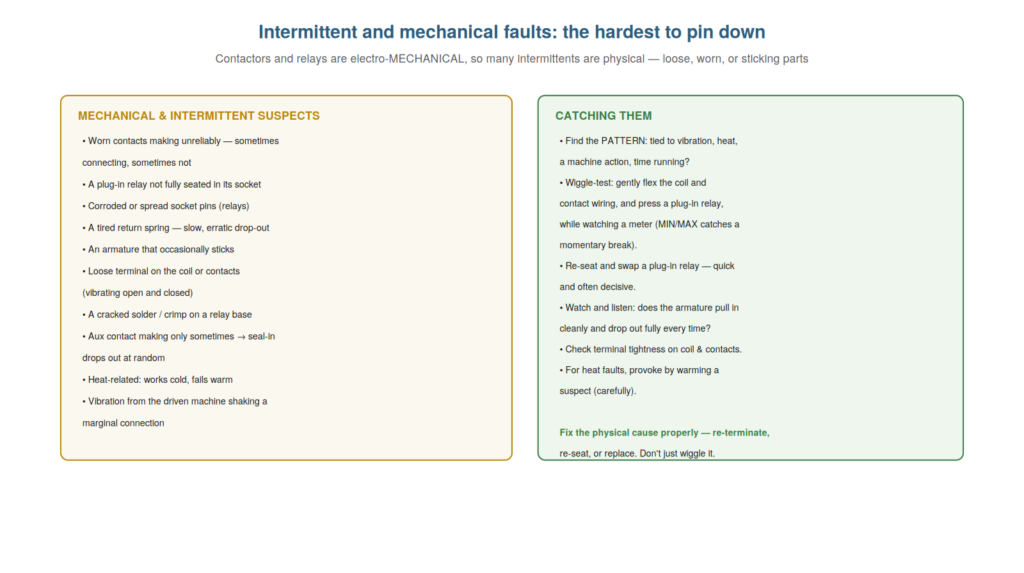
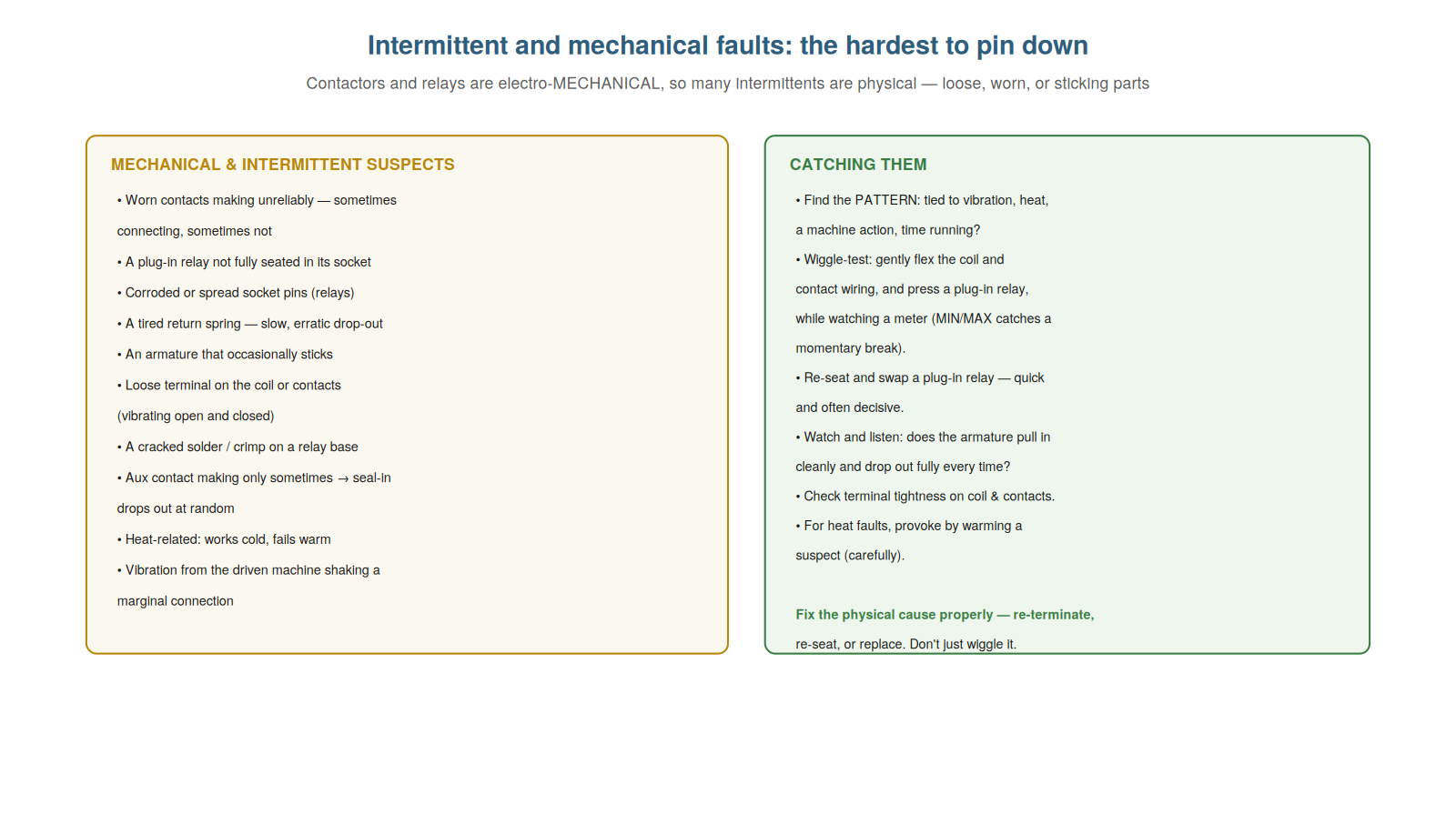
Understanding the mechanical suspects — the physical things that fail in a contactor or relay — orients you to where intermittent faults live. Because these devices are electromechanical, their intermittent faults are usually physical: worn contacts making sometimes and not others; a plug-in relay not fully seated in its socket, or corroded/spread socket pins making an unreliable connection; a tired return spring giving slow or erratic drop-out; an armature that occasionally sticks; a loose terminal on the coil or contacts vibrating open and closed; a cracked solder or crimp on a relay base; an aux contact making only sometimes (so a seal-in drops out at random); heat-related faults (working cold, failing warm); and vibration from the driven machine shaking a marginal connection. So the mechanical suspects span the contacts, the socket and pins, the spring, the armature, the terminals, and the effects of heat and vibration. Understanding these orients you to look at the physical parts and connections when a contactor or relay behaves intermittently. So understanding the mechanical suspects orients you to where intermittent contactor and relay faults live. Understanding the mechanical suspects — worn contacts, an unseated or corroded plug-in relay, a tired spring, a sticking armature, loose terminals, cracked joints, an intermittent aux contact, and heat- or vibration-related faults — orients you to where intermittent contactor and relay faults live, so that when a device behaves intermittently you look to its physical parts and connections (the contacts, socket and pins, spring, armature, terminals, and the effects of heat and vibration), which directs your search to the mechanical and connection faults that, because these devices are electromechanical, cause the great majority of their intermittent problems.
Catching them: pattern and provoke
The approach to intermittent faults is to find the pattern and provoke the fault, and understanding it lets you catch faults that are absent when you look. Since an intermittent fault comes and goes, you first find its pattern: does it correlate with vibration (the machine running), heat (after running a while), a machine action, or time? The pattern points to the cause and location. Then you provoke the fault to confirm and pinpoint it: gently wiggle the coil and contact wiring and press or re-seat a plug-in relay while watching a meter (MIN/MAX catches a momentary break); re-seat and swap a plug-in relay (quick and often decisive); watch and listen to whether the armature pulls in cleanly and drops out fully every time; check terminal tightness; and for heat faults, carefully warm a suspect to trigger it. When provoking reproduces the fault, you have caught and localized it. So the pattern points to where, and provoking confirms it. Understanding this pattern-and-provoke approach lets you catch the intermittent that a static check would miss. So understanding catching them by pattern and provoke lets you find intermittent faults that are absent when you look. Understanding how to catch intermittent faults by pattern and provoke — finding what the fault correlates with (vibration, heat, an action, time) to point to the cause, then provoking it (wiggle-testing the wiring, re-seating or swapping a plug-in relay, watching the mechanism, checking terminals, warming a heat-suspect) while watching a meter to reproduce and pinpoint it — lets you catch faults that are absent when you look, so that you use the fault’s own pattern to locate it and physical provocation to confirm it, which is the effective approach to the intermittent contactor and relay faults that defeat a static measurement by using their coming-and-going and physical nature against them.
Fixing the physical cause properly
Once an intermittent mechanical fault is found, understanding the importance of fixing the physical cause properly — not just temporarily — ensures the fault does not return. The temptation, having found a marginal physical fault, is a quick fix: wiggling a connection back to life, re-seating a relay, nudging a sticking armature. But these are temporary — the marginal condition remains and the fault will return. Fixing properly means addressing the physical cause: re-terminate a loose connection (don’t just retighten a stripped terminal), replace worn contacts or a tired spring, replace a relay with corroded pins or clean and secure the socket, replace a device with a sticking mechanism. The principle is to make the repair last by fixing the physical cause, not just restoring operation momentarily. Understanding this ensures your fix holds: an intermittent fault fixed properly stays fixed, while one merely disturbed back to life returns, often at the worst time. So understanding fixing the physical cause properly ensures the intermittent fault is resolved, not just temporarily cleared. So understanding to fix the physical cause properly — not just wiggle it back to life — ensures the intermittent fault stays fixed. Understanding the importance of fixing the physical cause properly — re-terminating rather than just retightening, replacing worn contacts, tired springs, corroded relays, or sticking devices rather than temporarily disturbing them back to life — ensures an intermittent mechanical fault does not return, so that having found the marginal physical cause you make a proper, lasting repair rather than a temporary fix, which resolves the fault for good instead of leaving the marginal condition to cause the intermittent to return, often at the worst possible time, the essential final step in troubleshooting these physical, come-and-go faults.
The plug-in relay: re-seat and swap first
A practical shortcut worth understanding for intermittent relay faults is to re-seat and swap the plug-in relay early, because it is quick and addresses the most common relay fault points at once. A plug-in relay’s most common fault points are its socket connection (poor seating, corroded or spread pins) and the relay itself (worn contacts, a tired coil). Re-seating the relay (unplugging and firmly re-inserting it) addresses a poor-seating or lightly-corroded-pin fault in seconds. Swapping in a known-good identical relay addresses a faulty relay (worn contacts, coil) equally quickly, and — if it fixes the fault — confirms the relay was the problem. Because both actions are fast and address the common relay fault points, doing them early is efficient: for an intermittent or suspected relay fault, re-seat and swap before investing in detailed measurement. Understanding this shortcut saves time on the common relay faults. If re-seating or swapping fixes it, you have found the fault quickly; if not, you have quickly ruled out the relay and socket. So understanding to re-seat and swap the plug-in relay first efficiently addresses the common relay fault points. Understanding the shortcut of re-seating and swapping a plug-in relay early — re-seating to address poor seating or corroded pins in seconds, and swapping in a known-good relay to address a faulty relay and confirm the diagnosis — efficiently addresses the most common relay fault points at once, so that for an intermittent or suspected relay fault you re-seat and swap before detailed measurement, which quickly fixes or rules out the socket-and-relay faults that cause most plug-in relay problems and saves the time of a detailed diagnosis when a fast re-seat or swap resolves or eliminates the common causes.
Scenario: the random drop-out
A scenario shows the pattern-and-provoke approach catching an intermittent seal-in fault. A machine occasionally dropped out at random — the contactor releasing for no apparent reason, then restarting fine — defeating a straightforward diagnosis since nothing was wrong when checked. The technician looked for the pattern: the drop-outs seemed to coincide with the machine vibrating during a certain operation. That pointed to a physical, vibration-related fault in the coil circuit. Suspecting the seal-in aux contact or a loose connection, he wiggle-tested the coil circuit wiring and gently disturbed the seal-in contact while watching a meter in MIN/MAX — and provoked a momentary break at a loose terminal on the seal-in contact. Vibration was intermittently opening that loose terminal, dropping the coil out. He re-terminated it properly, and the random drop-outs stopped. Understanding to find the pattern and provoke the fault caught an intermittent that static checks missed. This scenario shows pattern-and-provoke catching an intermittent seal-in drop-out. Understanding to find the pattern (vibration) and provoke the fault led the technician to the loose terminal. It reinforces that intermittents are caught by finding the pattern and provoking the fault, then fixing the physical cause. The scenario reinforces the intermittent approach: understanding to find the pattern (vibration) and provoke the fault (wiggle-testing while watching MIN/MAX) led the technician to a loose seal-in terminal opening under vibration, illustrating how the pattern-and-provoke method catches an intermittent drop-out that static checks miss, and a proper re-termination — not a temporary wiggle — resolves it.
Vibration from the driven machine
A specific intermittent cause worth understanding is vibration from the driven machine, because it loosens connections and causes intermittents that correlate with machine operation. A running machine vibrates, and that vibration is transmitted to the control panel and its devices. Over time, vibration works connections loose (terminal screws backing off, wires fatiguing) and can shake a marginal connection open momentarily. This causes intermittent faults that correlate with the machine running or with particular operations that vibrate more: a contactor that drops out or a signal that glitches when the machine vibrates, but is fine when still. Understanding this directs the diagnosis: an intermittent that appears with machine vibration points to a vibration-loosened connection, found by checking terminal tightness and wiggle-testing while the vibration (or a simulation of it) is present. It also suggests prevention: proper termination, locking terminals, and periodic tightness checks resist vibration. So understanding vibration from the driven machine explains vibration-correlated intermittents and directs you to loosened connections. So understanding vibration from the driven machine explains a common intermittent cause. Understanding vibration from the driven machine — the running machine’s vibration transmitted to the panel, working connections loose and shaking marginal ones open — explains intermittents that correlate with machine operation, so that an intermittent appearing with vibration points you to a vibration-loosened connection (found by checking tightness and wiggle-testing) and suggests prevention through proper termination and periodic checks, which explains and directs the diagnosis of the vibration-related intermittent faults common in machinery and their loosened-connection cause.
Patience, pattern, and a proper fix
To close, it helps to recognize that intermittent contactor and relay faults reward patience, pattern-finding, and a proper fix above all, because embracing this carries you through the hardest of these faults. Intermittents are frustrating precisely because they resist the quick look — not there when you check — and the temptation is to give up, guess, or bodge a temporary fix. But they yield to patience (accepting they take time), pattern-finding (correlating the fault with vibration, heat, or operation to locate it), and a proper physical fix (re-terminating, re-seating, or replacing, not just disturbing it back to life). The technician who brings these cracks intermittents that defeat the impatient. So patience, pattern, and a proper fix are the attitude and approach for these hardest faults. Understanding this equips you for the intermittent and mechanical faults that most test a troubleshooter. So recognizing that intermittents reward patience, pattern, and a proper fix carries you through the hardest faults. Understanding that intermittent contactor and relay faults reward patience, pattern-finding, and a proper fix above all — the disciplined acceptance that they take time, the correlation of the fault with vibration, heat, or operation to locate it, and the proper physical repair rather than a temporary bodge — carries you through the hardest of these faults, so that instead of giving up or bodging when a fault is absent as you check, you bring patience, find the pattern, and make a lasting fix, which distinguishes the technician who resolves intermittents from the one they defeat and is the right approach to the electromechanical intermittents that most test a troubleshooter.