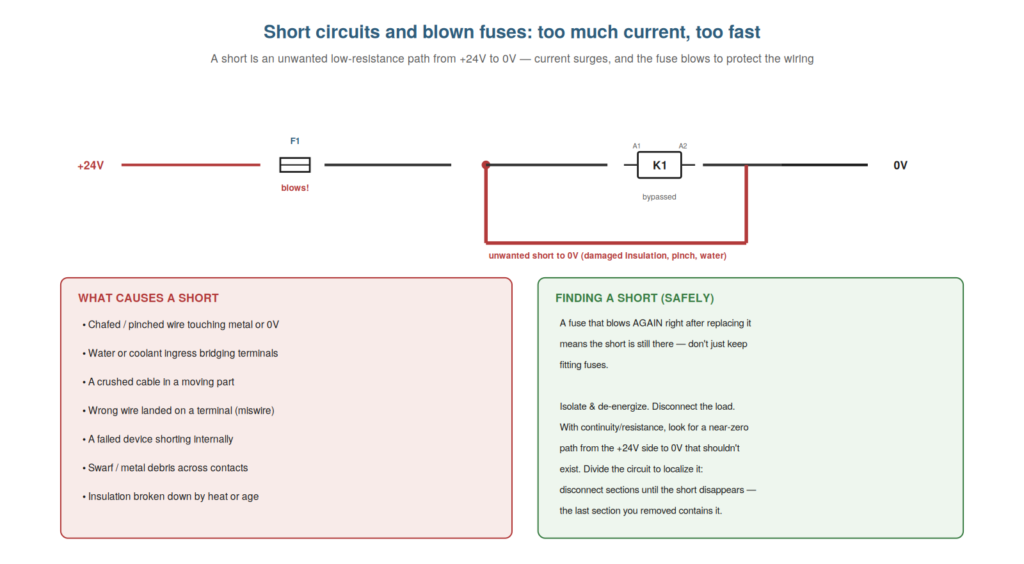
The short circuit — an unwanted low-resistance path from +24V to 0V — is the fault behind most blown fuses, and understanding it, along with how to find it safely, addresses a fault that can be both puzzling and, if mishandled, damaging. A short causes excess current that blows the protective fuse, and simply replacing the fuse without finding the short just blows it again. This chapter covers short circuits and blown fuses and the safe, systematic way to find them.
What a short is
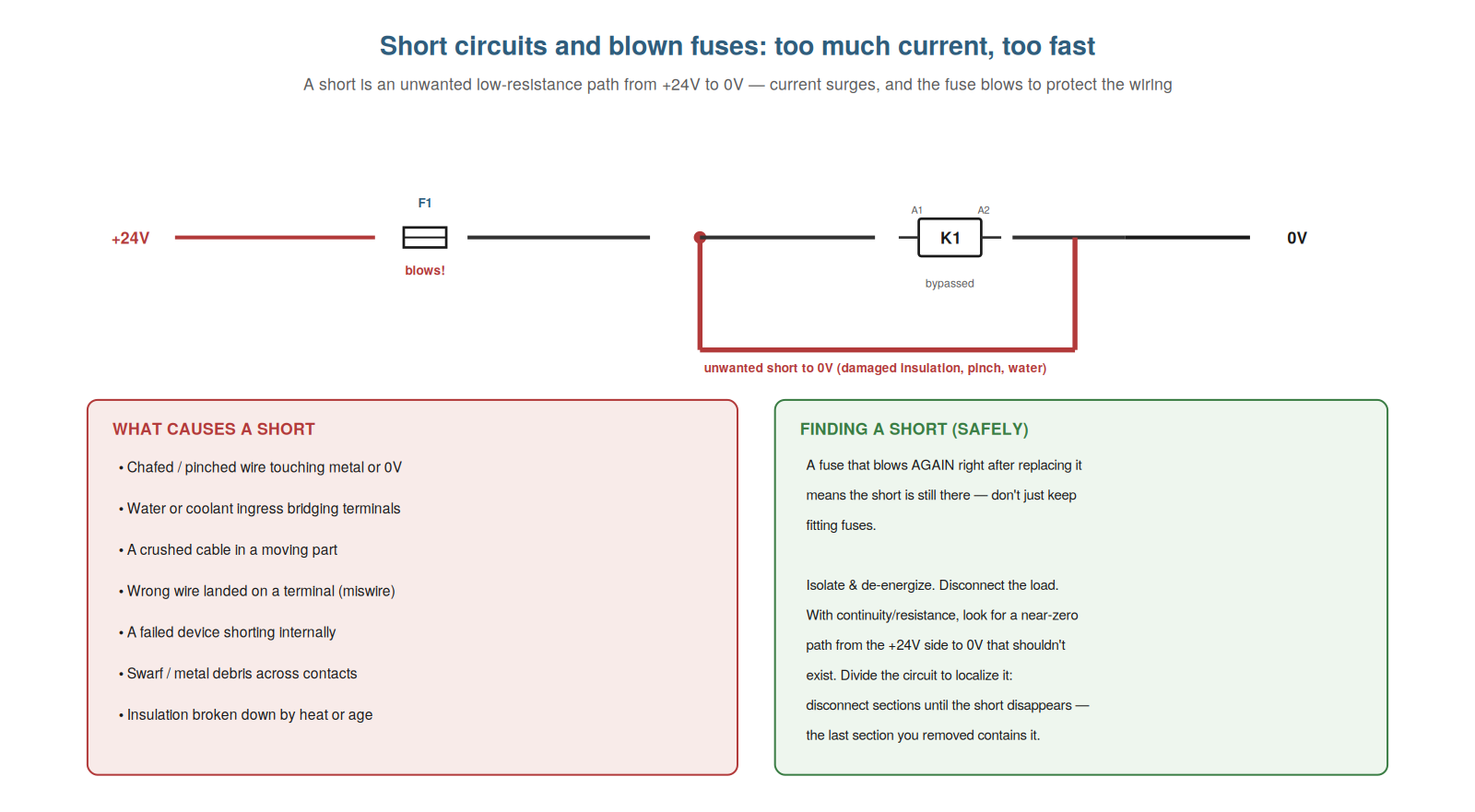
Understanding what a short circuit is — and why it blows fuses — clarifies the fault behind most blown fuses. A short circuit is an unwanted low-resistance path from the +24V side to the 0V side, bypassing the intended load. Because the path has very low resistance, a large current flows (far more than the normal load current), and this excess current is what the fuse is there to catch: the fuse blows, opening the circuit to protect the wiring and devices from the damaging current. So a short causes excess current, and the fuse blows in response. This is why a short is behind most blown fuses: the fuse did its job in response to the short’s excess current. Understanding this — a short as an unwanted low-resistance path causing excess current that blows the fuse — clarifies the relationship between the short and the blown fuse, and makes clear that the blown fuse is a symptom of the short, not the fault itself. So the fault to find is the short (the unwanted path), with the blown fuse as its sign. Understanding what a short is — an unwanted low-resistance path from +24V to 0V that causes excess current, blowing the fuse — clarifies the fault behind most blown fuses, so that you understand the short as the actual fault (the unwanted path bypassing the load) and the blown fuse as its symptom (the protection responding to the excess current), which makes clear that finding and fixing the short, not merely replacing the fuse, is what resolves the fault, and sets up the safe, systematic approach to locating the unwanted path that the short represents.
Don’t just keep fitting fuses
A critical rule with blown fuses is not to just keep fitting new ones, and understanding why makes this an important discipline. When a fuse blows, the temptation is simply to replace it — but if a short caused it, the new fuse will blow too, as soon as the circuit is energized, because the short is still there. Repeatedly fitting fuses without finding the short wastes fuses, achieves nothing, and can be dangerous (each attempt sends damaging current through the short, potentially worsening the fault or causing overheating). The key sign is a fuse that blows again immediately upon replacement or re-energizing: this means the short is still present and must be found. So the rule is: a fuse that blows again means find the short — do not just keep fitting fuses. Understanding this — that repeated fitting without finding the cause is futile and risky — makes finding the short, not replacing the fuse, the proper response. So the discipline is to treat a re-blowing fuse as a clear signal to locate the short. Understanding not to just keep fitting fuses — that a fuse blowing again immediately means the short is still there, so repeated replacement is futile and risky — makes finding the short the proper discipline, so that when a fuse blows again upon replacement or re-energizing, you recognize this as the clear sign that the underlying short remains and must be located, rather than wastefully and dangerously fitting fuse after fuse, which is an important discipline because it directs you to fix the actual fault (the short) instead of repeatedly sacrificing fuses to a fault that is still present and potentially worsening with each attempt.
Finding a short safely
Finding a short must be done safely and systematically, and understanding the approach lets you locate the unwanted path without hazard. The safe approach: first, isolate and de-energize the circuit — you do not hunt a short by repeatedly energizing it. Then, with the circuit dead, disconnect the load (so you are looking for the unwanted path, not the normal load path) and use continuity or resistance to look for a near-zero-resistance path from the +24V side to 0V that should not exist — the short. To localize it, divide the circuit: disconnect sections progressively, checking after each whether the short is still present; when disconnecting a section makes the short disappear, the short is in that section. This divide-and-conquer on a dead circuit narrows the short to a location. So finding a short safely means isolating, then systematically searching (with continuity, dividing the circuit) for the unwanted low-resistance path. Understanding this approach — isolate, then search and divide for the near-zero path — lets you find a short without the hazard of repeatedly energizing it. It reinforces that shorts are found safely on a dead, isolated circuit by looking for the unwanted low-resistance path and dividing to localize it. Understanding how to find a short safely — isolating and de-energizing, disconnecting the load, and using continuity to search for the near-zero path from +24V to 0V that should not exist, dividing the circuit progressively to localize it — lets you locate the short without the hazard of repeatedly energizing the fault, so that you hunt the unwanted path systematically on a dead, isolated circuit, narrowing it down by dividing until you find the section containing the short, which is both the safe and the effective way to resolve the short behind a blown fuse, addressing the actual fault rather than its symptom.
Partial shorts and overloads
A subtler variant worth understanding is the partial short or overload — not a dead short but excess current — because it causes different symptoms than an outright short. A dead short (near-zero resistance from +24V to 0V) draws huge current and blows the fuse instantly. A partial short or overload is less severe: a connection that is not a full short but leaks current (partial insulation breakdown, moisture, a partly-failed device), or simply too much load, drawing more current than normal but not enough to blow the fuse instantly. This causes different symptoms: the fuse may blow after a delay or only under certain conditions, the supply may be pushed toward overload (dropping or cycling), or components may run warm from the excess current. So a partial short or overload is a milder excess-current fault with more subtle, conditional symptoms than a dead short. Understanding it explains faults where current is excessive but not catastrophic — a slowly-blowing fuse, an overloaded supply, warm components. So understanding partial shorts and overloads — excess current short of a dead short — explains these subtler excess-current symptoms. Understanding partial shorts and overloads — the leaking connection or excess load that draws more current than normal but not enough to blow the fuse instantly — explains faults with subtler, more conditional symptoms than a dead short, so that when a fuse blows after a delay or only sometimes, or the supply is pushed toward overload, or components run warm, you recognize a partial short or overload drawing excess current rather than a dead short, which directs you to look for the leaking path or excess load behind these milder but real excess-current faults that do not announce themselves with the instant fuse-blow of a full short.
Scenario: the fuse that kept blowing
A scenario shows the discipline of finding the short rather than refitting fuses. A fuse kept blowing, and the first instinct on site had been to keep replacing it — each new fuse blew immediately. The technician stopped this: understanding that a fuse blowing again means the short is still there, he set about finding the short instead of sacrificing more fuses. He isolated and de-energized the circuit, disconnected the load, and used resistance to look for the unwanted near-zero path from +24V to 0V. To localize it, he disconnected sections progressively, checking after each whether the short remained; when he disconnected one section, the short disappeared — it was in that section. Inspecting it, he found a wire chafed against the metal frame, shorting +24V to ground. He repaired the wire, and the fuse held. Finding the short, not refitting fuses, had resolved it. This scenario shows finding the short rather than repeatedly refitting fuses. Understanding that a re-blowing fuse means the short persists led the technician to isolate and find the chafed wire. It reinforces that a fuse that keeps blowing calls for finding the short, not fitting more fuses. The scenario reinforces the discipline with blown fuses: the technician resolved a repeatedly-blowing fuse by recognizing the short was still present and systematically finding it — isolating, disconnecting the load, and dividing to localize the chafed wire — rather than wastefully refitting fuses, illustrating how the rule ‘a fuse that blows again means find the short’ directs you to the actual fault instead of sacrificing fuse after fuse to a short that remains.
Isolating to localize the short
A key technique worth understanding in more depth is progressive isolation to localize a short, because it is the systematic way to narrow a short to its location. Once you know a short exists (a fuse blowing, or a near-zero resistance from +24V to 0V measured with the circuit isolated and load disconnected), you localize it by progressively disconnecting sections of the circuit and re-checking: disconnect a branch or section, and check whether the short is still present. If the short remains, it is not in the disconnected section; if the short disappears, it is in the section you just disconnected. By dividing the circuit this way — disconnecting sections and observing when the short goes away — you narrow the short to a specific section, then within it to the fault. This is divide-and-conquer applied to a short: each disconnection tests whether the short is in that part. So understanding progressive isolation gives you the systematic method to localize a short. It turns ‘there is a short somewhere’ into a located fault by methodically disconnecting and re-checking. Understanding how to isolate progressively to localize a short — disconnecting sections of the circuit one at a time and re-checking whether the short remains, so that the section whose disconnection removes the short contains it — gives you the systematic method to narrow a short to its location, so that instead of vaguely knowing a short exists, you methodically divide the circuit by disconnecting sections and observing when the short disappears, narrowing it to a specific section and then the fault, which is divide-and-conquer applied to shorts and the reliable way to localize the unwanted low-resistance path behind a blown fuse.
The fuse as a clue, not just a part
To close, it is worth crystallizing the mindset this chapter builds: treating a blown fuse as a clue, not just a part to replace, because this mindset prevents the commonest short-circuit mistake. A blown fuse is telling you something — that excess current flowed, usually from a short — so it is a clue to a fault, not merely a consumable to swap. The mindset of asking ‘why did this blow?’ before refitting turns a blown fuse from a nuisance into the start of a diagnosis, and prevents the futile, dangerous cycle of refitting fuses into a persisting short. So treating the fuse as a clue is the mindset that leads to fixing the cause. Understanding the fuse as a clue, not just a part — asking why it blew before refitting — prevents the commonest short-circuit mistake. Understanding the fuse as a clue, not just a part to replace — recognizing that a blown fuse is telling you excess current flowed, usually from a short, and asking why before refitting — prevents the commonest and most dangerous short-circuit mistake, so that you treat a blown fuse as the start of a diagnosis rather than a mere consumable to swap, which leads you to find and fix the short behind it rather than futilely and dangerously refitting fuses into a persisting fault, the mindset that flows from understanding shorts and blown fuses.