Pneumatic actuators are very common in industrial automation.
They are used when a machine needs simple, fast, straight-line movement. For example, pushing a product, clamping a part, opening a flap, moving a small component, or feeding material into position.
In simple words:
A pneumatic actuator uses compressed air to create mechanical movement.
How a Pneumatic Actuator Works
A pneumatic actuator gets its energy from compressed air.
Usually, the compressed air comes from a central air system in the factory. This air is sent through tubes to the actuator.
The most common pneumatic actuator is a pneumatic cylinder.
A pneumatic cylinder normally has:
A cylinder body
A piston inside the cylinder
A piston rod
Air ports
Seals
Compressed air supply tubes
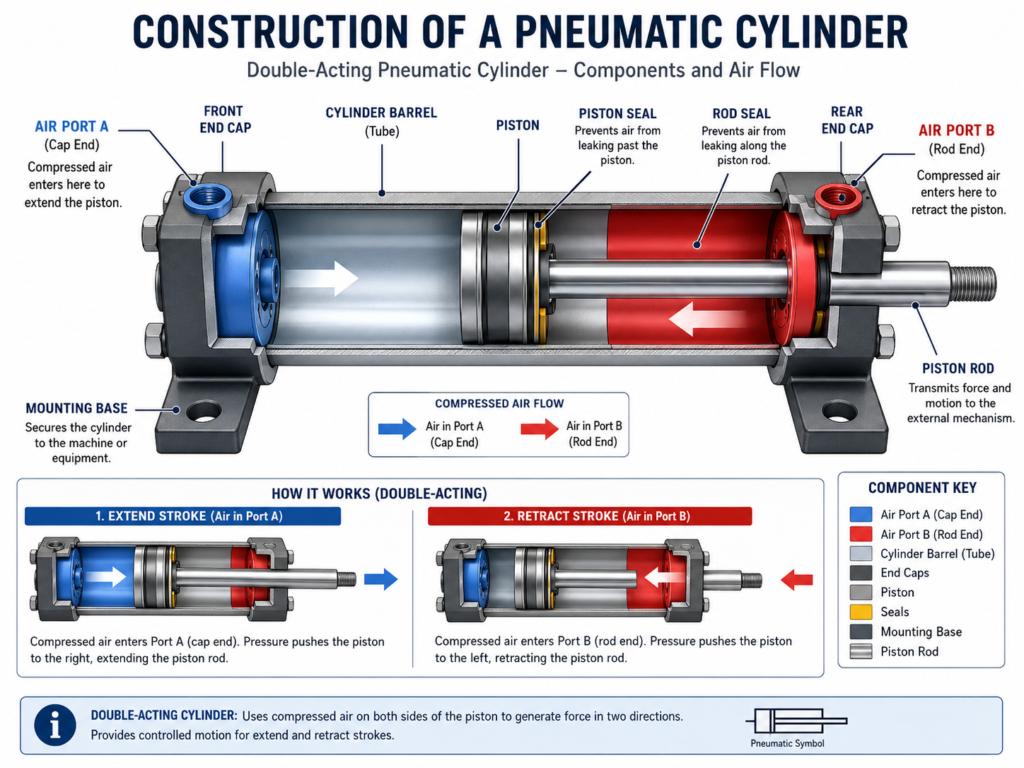
When compressed air enters one side of the cylinder, it pushes against the piston. This force moves the piston and the piston rod.
The movement is usually linear, meaning it moves in a straight line.
For example:
The rod extends.
Then the rod retracts.
That simple movement can be used to push, pull, lift, clamp, stop, or position something in a machine.
Where Pneumatic Actuators Are Used
Pneumatic actuators are used in many automated production lines.
Common examples include:
Pushing products on a conveyor
Clamping parts during assembly
Moving small machine components
Opening and closing gates
Feeding parts into a machine
Pressing labels or stamps
Moving simple pick-and-place mechanisms
Applying adhesive in a straight path
Sorting products
Stopping products on a conveyor
They are popular because they are simple, fast, and relatively easy to control.
Why Pneumatic Actuators Are Popular
Pneumatic actuators are widely used because they are practical.
They are usually:
Simple to install
Fast in operation
Reliable for repetitive movement
Good for on/off control
Easy to control with valves
Suitable for many factory environments
Often cheaper than more complex motion systems
For many automation tasks, you do not need very precise position control. You only need the actuator to move from one end position to another.
For example:
Extend the cylinder.
Retract the cylinder.
That is why pneumatic actuators are a good solution for many simple machine movements.
Pneumatic Actuators and Control Logic
Pneumatic actuators are often controlled with simple discrete logic.
A PLC can control a solenoid valve.
The solenoid valve controls the air flow.
The air flow moves the pneumatic cylinder.
For example, a PLC output turns on a solenoid valve. The valve sends compressed air to the cylinder. The cylinder extends and pushes a product into position.
A sensor can then confirm that the cylinder reached the end position.
The PLC can use this signal before moving to the next step in the machine sequence.
This makes pneumatic actuators very useful in PLC-controlled systems.
Limitation: Air Is Compressible
One important thing to understand is that air is compressible.
This means air can be squeezed and compressed under pressure.
Because of this, pneumatic actuators are not usually the best choice for very accurate position control.
They are good for simple movements, but not ideal when you need very precise speed, force, or position control.
For example, if you need exact positioning, a servo motor, stepper motor, or hydraulic system may be better depending on the application.
Pneumatics are best for simple movements like:
Fully extended
Fully retracted
Open
Closed
Push
Clamp
Release
Pneumatic vs Hydraulic Actuators
Pneumatic and hydraulic actuators work in a similar basic way.
Both use pressure to create movement.
The difference is the medium they use.
Pneumatic actuators use compressed air.
Hydraulic actuators use pressurized liquid, usually oil.
Hydraulic fluid is almost non-compressible, so hydraulic systems can produce much higher force and better control than pneumatic systems.
Because of that, hydraulic actuators are often used when high force is needed.
Examples include:
Press machines
Heavy lifting systems
Construction equipment
Large clamps
Metal forming machines
Heavy industrial machinery
Pneumatic actuators are usually better for lighter, faster, simpler automation tasks.
Hydraulic actuators are better for heavy force and more demanding applications.
Pneumatic Actuator Example
Imagine a conveyor line where products move one by one.
A sensor detects that a product is in position.
The PLC receives the sensor signal.
The PLC turns on a solenoid valve.
Compressed air flows into the pneumatic cylinder.
The cylinder extends and pushes the product into another lane.
Then the PLC turns off the valve or activates the return valve.
The cylinder retracts.
The machine is ready for the next product.
This is a very common type of pneumatic automation task.
Simple, fast, and effective.
Final Thoughts
Pneumatic actuators are important components in industrial automation.
They convert compressed air energy into mechanical movement and are commonly used for simple linear actions like pushing, pulling, clamping, lifting, sorting, and stopping parts.
They are easy to control, reliable, and useful for many production line tasks.
Their main limitation is that air is compressible, so they are not the best choice for very accurate position control or very high-force applications.
For simple and fast movements, pneumatics are often a great solution.
In short:
Pneumatic actuators are simple, practical, and very useful for automated machines.