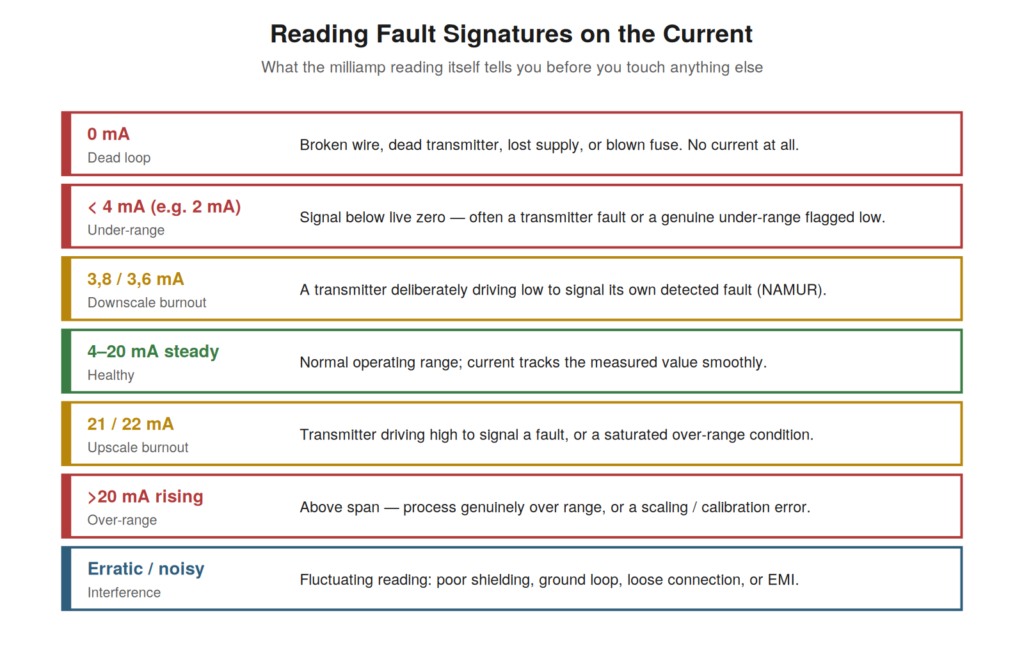
One of the most powerful aspects of the 4–20 mA loop is that the current value itself often tells you what kind of fault you have, before any further investigation. Because a healthy loop lives between 4 and 20 mA, currents outside or at the edges of this range, and erratic currents, each point to characteristic faults. Reading these fault signatures directly from the milliamp value is a fast and informative first diagnostic step.

The dead loop and under-range
A reading of 0 mA is the signature of a dead loop — no current flowing at all — which means a complete break somewhere: a broken wire, a dead transmitter, a lost power supply, or a blown fuse. Thanks to live zero, this is unambiguous, because a working loop never reads 0 mA, so 0 mA always means a fault of complete interruption. A reading below 4 mA but not zero — say 2 or 3 mA — indicates an under-range condition: the signal is below the live-zero minimum, which can mean a transmitter fault, a genuine under-range of the process being flagged low, or certain wiring problems. Both of these low-current signatures point to a specific class of problem — complete interruption for 0 mA, and below-range operation for currents under 4 mA — that directs the subsequent investigation. Reading the low current and recognizing which signature it is (dead versus under-range) is the first step toward the fault.
The healthy range and the burnout edges
A steady reading between 4 and 20 mA is the signature of a healthy loop, the current tracking the measured value normally — though a steady healthy current does not rule out a scaling fault in how that current is interpreted. Readings just below 4 mA (like 3,8 or 3,6 mA) or just above 20 mA (like 21 or 22 mA) are the signatures of deliberate burnout signaling: a transmitter driving the current slightly outside the normal range to indicate a fault it has detected in itself, driving downscale (low) or upscale (high) by convention. Recognizing these burnout signatures is important, because they mean the transmitter is reporting its own fault, not that the process is at an extreme — the current just outside the normal range is a fault flag, not a measurement. Reading these edge currents and recognizing them as burnout signaling directs you to the transmitter’s own diagnostics rather than to a process or wiring investigation, which is a different and more targeted response.
Over-range and erratic signatures
A reading above 20 mA that is not a burnout flag — a genuinely elevated current — signals an over-range condition: the process is above the top of the range, or there is a scaling or calibration error driving the current high. An erratic, fluctuating reading is the signature of noise or an intermittent problem: interference from poor shielding or a ground loop, a loose connection introducing intermittent resistance, or electromagnetic interference. Each of these signatures points to its class of fault — over-range to a process or calibration issue, erratic to noise or intermittent connections. Reading the current’s behavior, not just its value — is it steady or fluctuating, within range or outside it — classifies the fault before any further work. This is the great diagnostic value of the fault signatures: the current itself, read for its value and behavior, tells you the class of fault and directs your investigation, turning the first measurement into a strong clue about what is wrong.
The signature narrows the search instantly
The great value of reading the fault signature is that it narrows the search instantly, before any labor. Each signature points to a specific, limited set of causes: 0 mA to a complete break (wire, transmitter, power, fuse); erratic to noise or intermittent connections; correct-low-fails-high to the voltage budget; steady-but-wrong-value to scaling; edge currents to transmitter burnout. So the very first measurement — reading the current and classifying its signature — converts a vague complaint (‘the reading is wrong’) into a focused investigation of a particular fault class. This is enormously efficient compared to checking possibilities at random, because the signature has already eliminated most of them. A technician who reads the signature first goes directly to the likely causes for that signature, while one who ignores it may check unrelated things. The signature is the loop telling you what kind of fault it has, and reading it first is the fastest possible start to a diagnosis, focusing all subsequent effort on the right class of problem from the very beginning.
Scenario: the signature that redirected the search
A scenario shows a fault signature redirecting a search that was heading the wrong way. A loop was reading wrong, and a technician began suspecting the transmitter, preparing to replace it. Before doing so, reading the loop current revealed a steady, healthy value in the normal range — the current was fine. This signature redirected the search entirely: a healthy current meant the transmitter was probably producing the right signal, so the fault was more likely in the scaling than in the transmitter. Checking the scaling configuration revealed the error — a wrong range — and correcting it fixed the reading, with the transmitter never needing replacement. Had the technician not read the signature and simply replaced the transmitter, the new transmitter would have read equally wrong, because the fault was in the scaling, not the device. The scenario shows how reading the signature first prevents wasted effort: the healthy-current signature said ‘the current is fine, look at the interpretation,’ redirecting the search from the transmitter to the scaling and saving an unnecessary replacement. Reading the signature before acting is what steered the diagnosis to the real fault.
Combining signature with context
The fault signature is powerful, but it is even more so combined with context — what you know about the loop, the process, and recent events. A 0 mA signature says ‘complete break,’ but context narrows it further: if the loop was just worked on, suspect the recent wiring; if a fuse is shared with other things that also failed, suspect the supply. An erratic signature says ‘noise,’ but context sharpens it: if a nearby drive was recently installed, suspect its interference. A high-current failure says ‘voltage budget,’ but context confirms it: if a device was recently added to the loop, that is likely the cause. Combining the signature (what class of fault) with context (what changed, what else is affected, what the history is) often points directly to the specific cause, faster than the signature alone. So while reading the signature is the essential first step, enriching it with context — recent work, related failures, known history — accelerates the diagnosis by turning the fault class into a specific likely cause. The signature classifies; the context localizes; and together they often identify the fault quickly, which is why a good troubleshooter reads both the current and the situation.
The signature as the loop speaking
There is a nice way to think about fault signatures: the loop, through its current, is telling you what is wrong, and reading the signature is listening to it. Thanks to live zero and the diagnostic conventions, the current is not just a measurement but a communication about the loop’s health: 0 mA says ‘I am broken,’ erratic says ‘I am being interfered with,’ a burnout current says ‘my transmitter has failed,’ a healthy current says ‘I am fine — look elsewhere.’ Reading the signature is receiving this communication, letting the loop tell you its condition before you investigate. This framing captures why reading the signature first is so valuable: the loop is offering diagnostic information in its very current, and reading it is the fastest way to learn what is wrong, straight from the loop itself. A technician who reads the signature listens to what the loop is saying; one who ignores it investigates blindly what the loop would have told them. The current loop, by design, communicates its health through its current, and reading the fault signatures is understanding that communication — a conversation with the loop that begins every good diagnosis, in which the loop’s first words tell you where to look.
A quick mental signature table
It is worth holding a quick mental table of the fault signatures, so that reading a current immediately suggests its meaning. Zero milliamps: dead loop, a complete break — wire, transmitter, power, or fuse. Below four: under-range or fault. Just below four (like 3,6): downscale burnout, transmitter self-reporting a fault. A steady four to twenty: healthy — but if the value is wrong, suspect scaling. Just above twenty (like 21): upscale burnout, transmitter fault. Above twenty and rising: over-range, process high or scaling error. Erratic: noise or intermittent connection. Correct at low, failing at high: voltage-budget problem. Holding this table in mind means that whenever you read a loop current, its meaning comes immediately — the current value maps to a fault class without deliberation. This instant recognition is what makes reading the signature the fast first step it should be: the current is read, and its signature and likely causes come to mind at once, directing the diagnosis immediately. Committing this mental table to memory — the currents and what each signifies — makes fault-signature reading automatic, so that the first measurement instantly classifies the fault and points to its causes, which is exactly the quick, informative start to a diagnosis that the fault signatures are meant to provide.
The signature as the diagnosis’s opening move
Reading the fault signature is the opening move of a loop diagnosis, and making it a consistent first step sets up everything that follows well. Just as a good chess player has a sound opening, a good loop diagnosis opens with reading the current and its signature, which classifies the fault and orients the whole subsequent diagnosis. This opening move is quick, informative, and directive: one measurement, interpreted through the signatures, tells you the fault class and points to the likely causes and the appropriate approach. Making it your consistent first step — always reading the current signature before deeper investigation — ensures every diagnosis starts from the loop’s own diagnostic information, oriented correctly from the outset. A diagnosis that opens with the signature proceeds efficiently, guided by what the loop revealed; one that skips it may wander before finding direction. So establishing the habit of always opening with the signature — read the current, classify the fault, then proceed — gives every loop diagnosis a strong, informed start. The signature is the opening move because it is quick and highly informative, extracting the loop’s own diagnostic information first to guide all that follows, and making it a consistent habit ensures your loop diagnoses always begin from the best available information, oriented correctly toward the fault from the very first measurement.