When people think about actuators, they usually imagine motors, pneumatic cylinders, hydraulic cylinders, or solenoids.
But actuators can also be extremely small.
This is where MEMS come in.
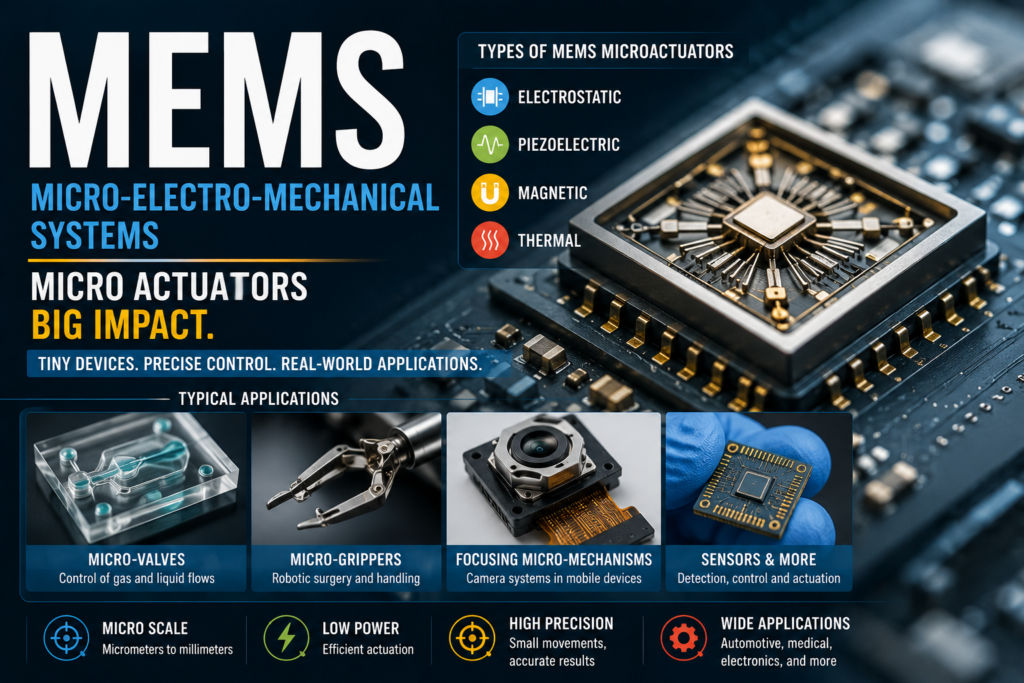
MEMS stands for Micro-Electro-Mechanical Systems. These are tiny devices made using microfabrication techniques. In simple words, MEMS are very small mechanical and electrical systems built on a micro scale.
Even though they are tiny, they can still sense, control, or create movement.
What Are MEMS?
A Micro-Electro-Mechanical System is a small device that combines mechanical parts and electrical components.
MEMS devices can be as small as a few micrometers and can also be a few millimeters in size.
To understand the size, a micrometer is much smaller than a millimeter. So these devices are not like normal factory actuators that you can easily see moving. They work on a very small scale.
But their effect can still be important in real products and industrial applications.
MEMS can be used to:
Sense movement
Control signals
Create small mechanical movement
Open or close tiny valves
Adjust optical systems
Move small tools
Control tiny amounts of gas or liquid
What Are Microactuators?
A microactuator is a tiny actuator.
Just like a normal actuator creates movement or force, a microactuator also creates movement, but on a much smaller scale.
The movement may be very small, and the force may also be very small, but it can still be useful.
For example, a microactuator can move a tiny camera lens, open a small valve, or control a miniature tool in a medical device.
So the basic idea is the same:
An actuator creates movement.
A microactuator creates very small movement.
Types of MEMS Microactuators
MEMS microactuators can work in different ways depending on the type of energy or physical principle used.
The main types include:
Electrostatic microactuators
Piezoelectric microactuators
Magnetic microactuators
Thermal microactuators
Each type has its own advantages and is used for different applications.
Electrostatic Microactuators
Electrostatic microactuators use electric charge to create movement.
When voltage is applied, attraction forces are created between small structures. These forces can move tiny mechanical parts.
Electrostatic actuation is common in MEMS because it works well at very small sizes and does not always require much current.
These actuators are often used in tiny switches, mirrors, sensors, and micro-positioning systems.
Piezoelectric Microactuators
Piezoelectric microactuators use special materials that change shape when voltage is applied.
This shape change is very small, but it is fast and precise.
Piezoelectric microactuators are useful when accurate small movement is needed.
They can be found in applications such as:
Precision positioning
Medical devices
Inkjet printing
Micro pumps
Optical systems
The movement is small, but the control can be very accurate.
Magnetic Microactuators
Magnetic microactuators use magnetic fields to create movement.
They work with the same basic idea as many larger electric motors and solenoids, but on a much smaller scale.
These actuators may use tiny coils, magnets, or magnetic materials to produce force.
Magnetic microactuators can be useful when a stronger movement is needed compared with some other MEMS actuator types.
Thermal Microactuators
Thermal microactuators use heat to create movement.
When a material is heated, it expands. This expansion can be used to move a tiny mechanical structure.
The movement is usually small, but it can be useful in MEMS devices.
Thermal microactuators are simple in principle, but they may use more energy and can be slower compared with some other microactuator types.
Where MEMS Microactuators Are Used
MEMS microactuators are used in many industries.
Common industries include:
Automotive
Electronics
Medical devices
Communications
Consumer devices
Industrial measurement systems
Even though these devices are small, they are already used in many products around us.
Examples of MEMS Microactuators
Here are some simple examples.
Micro-Valves
Micro-valves are tiny valves used to control small amounts of gas or liquid.
They can be used in medical equipment, lab devices, gas analysis systems, and miniature fluid control systems.
Micro-Grippers
Micro-grippers are tiny gripping devices.
They can be used in robotic surgery, medical tools, and micro-assembly systems where very small objects must be handled carefully.
Camera Focusing Mechanisms
Many mobile devices use tiny focusing mechanisms to move camera lenses.
This allows the camera to focus automatically, even though the movement inside the camera module is very small.
Micro Pumps
Micro pumps can move tiny amounts of fluid.
They are useful in medical dosing systems, lab-on-chip devices, and miniature chemical analysis systems.
Why MEMS Are Important
MEMS are important because they make it possible to build very small systems that can still perform useful mechanical and electrical functions.
They allow products to become:
Smaller
Smarter
More precise
More efficient
More integrated
In automation and modern technology, this is very valuable.
A normal pneumatic cylinder may move a product on a conveyor. A MEMS microactuator may control a tiny valve in a medical device. Both are actuators, but they work at completely different sizes.
MEMS Compared with Normal Industrial Actuators
Traditional actuators are used to move larger machine parts.
For example:
Motors rotate shafts
Pneumatic cylinders push parts
Hydraulic cylinders lift heavy loads
Solenoids move small mechanical parts
MEMS microactuators do similar jobs, but on a much smaller scale.
They are not used to move heavy factory loads. Instead, they are used when tiny, precise movement is needed.
So, MEMS are not a replacement for industrial motors or cylinders. They are used in different applications where size and precision are more important than large force.
Final Thoughts
MEMS, or Micro-Electro-Mechanical Systems, are tiny devices that combine electrical and mechanical functions.
They can sense, control, and create movement on a micro scale.
MEMS microactuators are used in many industries, including automotive, electronics, medical, and communication systems.
The main types of MEMS microactuators include electrostatic, piezoelectric, magnetic, and thermal actuators.
For beginners learning automation, the most important thing to remember is this:
A normal actuator creates movement in a machine. A MEMS microactuator creates very small movement inside tiny devices.
Even though MEMS are small, their impact can be big.