Beginner question: What can I safely prove before buying any part?
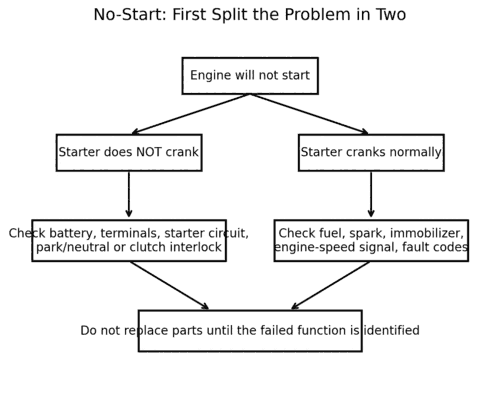
This is one of the most confusing faults for beginners. The radio, hazard lights, and interior lights may work normally, yet turning the key or pressing the start button produces no cranking. The presence of low-current accessories does not prove the starting circuit is healthy.
First listen and observe. Is there one heavy click, repeated fast clicking, a relay click from the fuse box, or complete silence? Do the dashboard lights dim sharply? Does the start request appear to be recognized? Does moving the selector from Park to Neutral change anything? Each observation narrows the problem.
What to Look For
Work from the symptom outward. Note what still works, what fails at the same time, and whether the fault changes with heat, vibration, rain, or electrical load. These observations often tell you where to measure first.
Possible causes include a weak battery, poor battery cable connection, failed starter motor or solenoid, faulty starter relay, ignition switch or start-button issue, clutch or park/neutral interlock problem, immobilizer authorization problem, wiring fault, or control-module issue.
The correct path is to prove whether the starter has adequate power and ground and whether the solenoid is receiving a start command. Avoid replacing the starter only because it did not turn. A perfect starter cannot operate if the control circuit never tells it to.
Beginner Diagnostic Checklist
- Verify the exact symptom before touching anything.
- Check battery condition and obvious power/ground connections when relevant.
- Check the correct fuse and connector condition.
Stop and get help if: airbag, high-voltage, or safety-critical circuitry is involved.