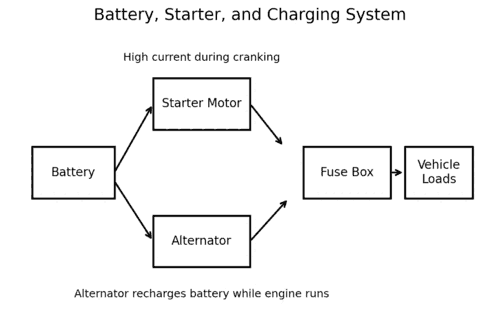
The starter circuit usually has a high-current path and a control path. The high-current side connects the battery to the starter motor through heavy cables and the starter solenoid. The control side tells the solenoid when cranking is allowed.
On older vehicles, the ignition switch may more directly control a starter relay. On newer vehicles, the start request can travel through several modules and conditions before the starter is energized. The car may need to see the correct key, brake or clutch input, gear-selector position, engine status, and other conditions.
What to Look For
Do not confuse a reading with a conclusion. A meter showing 12 volts proves voltage is present at that moment; it does not automatically prove the circuit can deliver enough current under load.
This is why wiring diagrams and scan data become increasingly important on modern vehicles. A no-crank fault may not be a simple broken wire. The control module may be intentionally refusing to crank because one required input is missing.
For a beginner, the key diagnostic question remains simple: is the starter receiving both its heavy battery supply and the correct command when a start is requested? If yes and it does not operate, the starter or its ground path becomes more suspect. If no command exists, trace the control side instead.
Beginner Diagnostic Checklist
- Verify the exact symptom before touching anything.
- Check battery condition and obvious power/ground connections when relevant.
- Check the correct fuse and connector condition.
Stop and get help if: you cannot identify a safe test point or the vehicle may move unexpectedly.