Beginner question: What can I safely prove before buying any part?
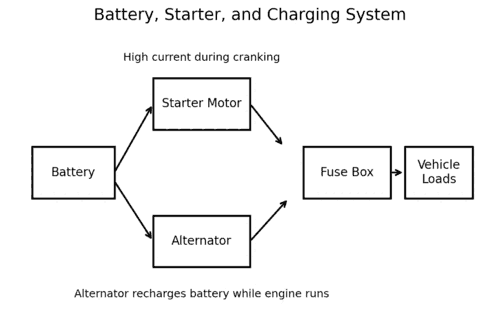
Once the engine is running, the alternator supplies most of the vehicle’s electrical power and replenishes energy removed from the battery during starting. Charging systems are more sophisticated than they once were. Many modern cars vary charging voltage intentionally based on battery state, temperature, electrical load, fuel economy strategy, and control-module commands.
Common charging complaints include a battery warning lamp, repeated dead batteries, dimming lights, electrical systems shutting down, unusual alternator noise, or a battery that tests good but does not remain charged.
What to Look For
Work from the symptom outward. Note what still works, what fails at the same time, and whether the fault changes with heat, vibration, rain, or electrical load. These observations often tell you where to measure first.
A single voltage reading can be useful but is not always enough to judge a smart charging system. The diagnostic process should consider battery health, belt drive, alternator output, wiring voltage drop, battery monitoring sensors, fault codes, and commanded charging behavior where scan data is available.
If charging voltage is abnormal, do not immediately replace the alternator. A poor alternator cable, bad ground, blown high-current fuse, damaged belt, weak battery, or control issue can create similar symptoms.
Beginner Diagnostic Checklist
- Verify the exact symptom before touching anything.
- Check battery condition and obvious power/ground connections when relevant.
- Check the correct fuse and connector condition.
Stop and get help if: airbag, high-voltage, or safety-critical circuitry is involved.