Parasitic drain is current that continues to flow after the vehicle should be asleep. Some current is normal because security, memory, keyless entry, and communication modules need standby power. The problem is excessive current or a module that never goes to sleep.
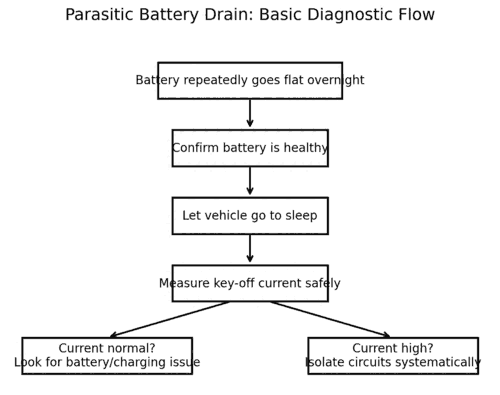
A safe parasitic-draw test requires understanding the meter’s current limits and the vehicle’s sleep behavior. On some vehicles, connecting a meter incorrectly can wake modules or interrupt power in a way that resets the fault. A clamp meter capable of measuring low DC current can be useful because it avoids opening the circuit.
What to Look For
Do not confuse a reading with a conclusion. A meter showing 12 volts proves voltage is present at that moment; it does not automatically prove the circuit can deliver enough current under load.
Once excessive draw is confirmed, isolate it methodically. Pulling fuses one at a time can help, but modern fuse panels may contain circuits that wake the network when disturbed. Scan-tool sleep-status information, fuse voltage-drop methods, or current-clamp testing may be better on complex cars.
Common causes include glove-box or trunk lights staying on, infotainment modules, door modules, aftermarket devices, stuck relays, alternator diode faults, and control modules that remain awake because of network activity.
Beginner Diagnostic Checklist
- Verify the exact symptom before touching anything.
- Check battery condition and obvious power/ground connections when relevant.
- Check the correct fuse and connector condition.
Stop and get help if: you cannot identify a safe test point or the vehicle may move unexpectedly.