Beginner question: What can I safely prove before buying any part?
A fuse is a deliberate weak link. It is designed to open when current becomes excessive, protecting the wiring from overheating. Replacing a blown fuse with a higher rating defeats that protection and can turn a small electrical fault into damaged wiring or a fire risk.
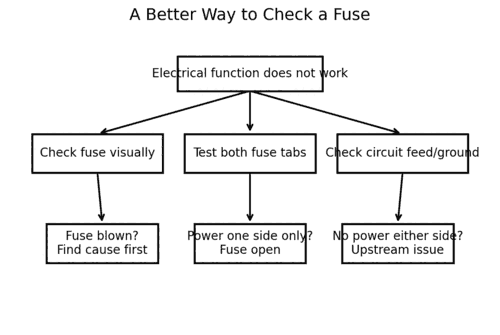
A blown fuse usually means either the load drew too much current or the power wire shorted to ground. If a replacement fuse blows immediately, stop replacing fuses and find the cause. A repeatedly blowing fuse is evidence, not an inconvenience to bypass.
What to Look For
Work from the symptom outward. Note what still works, what fails at the same time, and whether the fault changes with heat, vibration, rain, or electrical load. These observations often tell you where to measure first.
Many blade fuses have small exposed test points on top. With the circuit powered as required, a meter or suitable test light can check for power on both sides. Power on one side but not the other indicates an open fuse. No power on either side can mean the fuse is fine but its feed is missing.
Always use the correct fuse type and rating. Some vehicles use cartridge fuses, fusible links, high-current strip fuses, or electronic power distribution rather than only conventional blade fuses.
Beginner Diagnostic Checklist
- Verify the exact symptom before touching anything.
- Check battery condition and obvious power/ground connections when relevant.
- Check the correct fuse and connector condition.
Stop and get help if: airbag, high-voltage, or safety-critical circuitry is involved.