A MOSFET is controlled mainly by gate-to-source voltage, but real designs must also account for gate charge, resistance, transient voltage, and heat. N-channel devices usually offer lower resistance for similar cost and size.
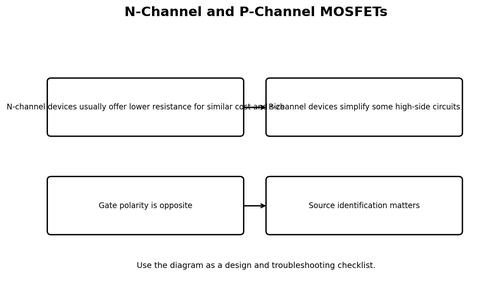
The main ideas are: N-channel devices usually offer lower resistance for similar cost and size. P-channel devices simplify some high-side circuits. Gate polarity is opposite. Source identification matters.
Do not ask only whether the gate voltage exceeds threshold. Ask what RDS(on) is specified at the actual VGS you will provide, how much current flows, what transient voltage exists, how quickly the gate is charged, and whether the thermal path can remove the resulting heat.
A useful troubleshooting habit is to divide the circuit into control, switch, and load. Prove each block separately before blaming the component in the middle.
Worked thinking: An N-channel device is commonly used low-side while a P-channel device can switch the positive rail in a simple 12 V circuit. The example is meant to demonstrate the method, not to replace the ratings and test conditions of the actual part you use.
Design view – N-channel devices usually offer lower resistance for similar cost and size. Ask which component or connection establishes this behavior and which rating could be exceeded if the load changes. This turns a descriptive fact into a selection rule.
Troubleshooting view – P-channel devices simplify some high-side circuits. Imagine the reading if this condition were missing, too weak, too high, reversed, or intermittent. A useful test is one that separates those possibilities instead of merely producing another number.
Design view – gate polarity is opposite. Ask which component or connection establishes this behavior and which rating could be exceeded if the load changes. This turns a descriptive fact into a selection rule.
Troubleshooting view – source identification matters. Imagine the reading if this condition were missing, too weak, too high, reversed, or intermittent. A useful test is one that separates those possibilities instead of merely producing another number.
A switch should be evaluated in both steady state and transition state. ON-state voltage drop creates heat, OFF-state voltage stress can damage the device, and the brief transition between states can be the most stressful period during fast or repetitive switching.
Finish by verifying the real load. A driver that works with an LED may still fail with a relay, motor, solenoid, heater, or long cable because startup current, inductance, wiring resistance, and electrical noise change the conditions dramatically.
Worked Example
An N-channel device is commonly used low-side while a P-channel device can switch the positive rail in a simple 12 V circuit.
Hands-On Mini-Lab
- Identify gate drain and source from the datasheet.
- Verify the gate has a pull resistor that defines OFF.
- Measure VGS rather than gate-to-ground voltage alone.
- Measure load current and voltage drop across the MOSFET.
- Estimate conduction loss and observe temperature after several minutes.
Common Beginner Mistakes
- Using VGS(th) as the fully-on voltage.
- Leaving the gate floating.
- Choosing only by headline drain-current rating.
- Ignoring switching loss during PWM.
Fault-Finding Lens
- Verify the actual supply voltage at the load and switching device while the load is commanded ON.
- Measure the control quantity at the device itself: base current for a BJT, VGS for a MOSFET, or coil voltage for a relay.
- Check the load independently when possible so a failed load is not mistaken for a failed driver.
- Inspect protection parts, grounds, connectors, and wiring for open circuits, shorts, reversed polarity, or excessive voltage drop.
- After the repair, repeat the original operating condition and verify current, voltage drop, temperature, and turn-off behavior.
Check Your Understanding
- Explain n-channel and p-channel mosfets in your own words.
- Which voltage or current would you measure first to verify this stage?
- What is one failure mode that could make the switch run hot?
- What protection component or design margin is most relevant here?
- How would the circuit behave during controller startup or reset?
Key Points
- N-channel devices usually offer lower resistance for similar cost and size.
- P-channel devices simplify some high-side circuits.
- Gate polarity is opposite.
- Source identification matters.