
By Dovydas Kersys · Chapter 1 of 58 in Machine Commissioning.
Before you begin: Follow the machine documentation, risk assessment, site procedures and lockout/tagout requirements. Commissioning can expose personnel to electrical energy, stored pressure and unexpected motion. Never defeat a safety function merely to make a test easier. Examples and diagrams are generic and must be checked against the actual machine.
Commissioning is the controlled process of proving that a machine has been installed correctly, can be energized safely, responds to commands as designed, protects people as intended, and produces the required result repeatedly. It connects design intent to the physical machine.
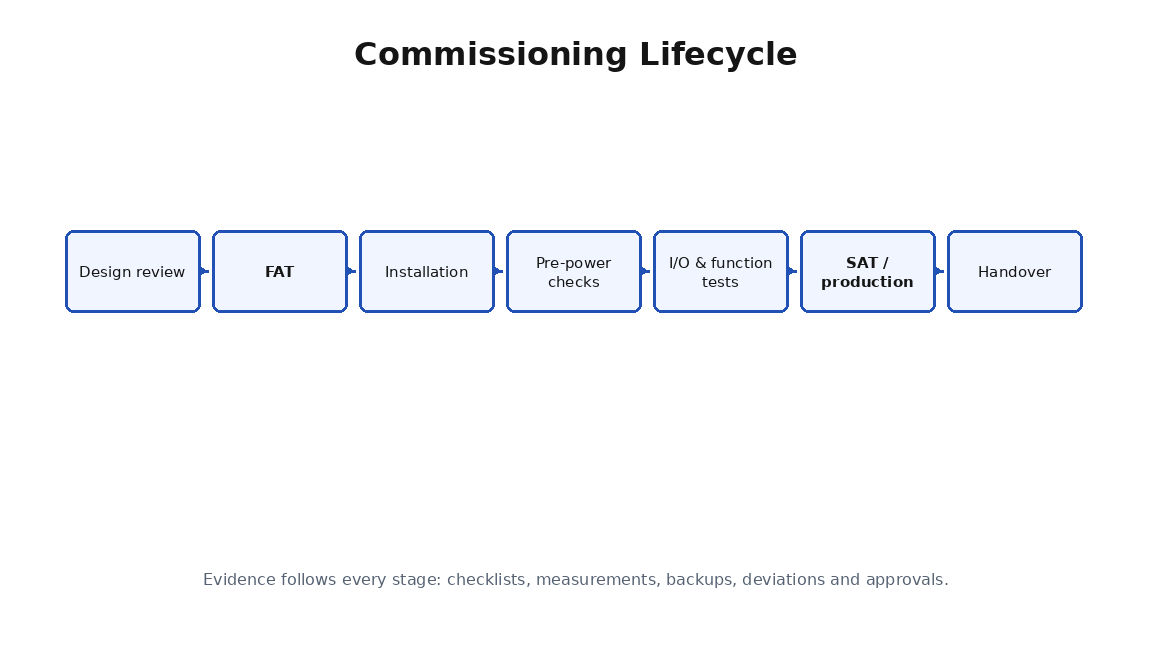
A disciplined commissioning lifecycle reduces rework and creates traceable evidence.
Why this matters during commissioning
A machine can be mechanically complete and still be nowhere near production-ready. Commissioning exposes incorrect wiring, reversed devices, missing software conditions, poor parameter choices, documentation errors, and interactions that could not be seen on a drawing.
Commissioning procedure
- Define the intended operating modes and acceptance criteria before testing.
- Confirm the machine has reached the required mechanical and electrical completion level.
- Divide the work into layers: utilities, power, I/O, functions, safety, sequences, process, performance.
- Prove each layer and record evidence before moving to the next.
- Close deviations with a retest instead of relying on verbal confirmation.
Common failure patterns
- Testing several unproven layers at once, making root cause hard to isolate.
- Calling a machine commissioned because it runs once in manual mode.
- Treating undocumented parameter or code changes as temporary when they become permanent.
- Leaving handover documentation until the end and forgetting the final settings.
Evidence to record
- Measured value and test point
- Expected value / expected state
- Observed value / observed state
- Pass/fail result and any deviation
- Name/date or responsible person where required
Field example
A conveyor line may jog correctly with maintenance controls yet fail automatic production because photoeyes are misnamed, a downstream-ready permissive is inverted, and the alarm text points to the wrong zone. Commissioning must prove the whole behavior, not only motion.
FIELD RULE: Commissioning should reduce uncertainty step by step. If a later test fails, you should know which earlier layers have already been proven.
Continue the series
- Next chapter: Roles, Boundaries and Communication: Commissioning Guide
- Browse all Machine Commissioning chapters
Adapted from Machine Commissioning for Maintenance and Automation Technicians, by Dovydas Kersys. © 2026 Dovydas Kersys. Featured cover image is an AI-generated editorial illustration.