
By Dovydas Kersys · Chapter 3 of 58 in Machine Commissioning.
Before you begin: Follow the machine documentation, risk assessment, site procedures and lockout/tagout requirements. Commissioning can expose personnel to electrical energy, stored pressure and unexpected motion. Never defeat a safety function merely to make a test easier. Examples and diagrams are generic and must be checked against the actual machine.
Factory Acceptance Testing and Site Acceptance Testing serve different purposes. FAT proves as much of the design as practical before shipment; SAT proves that the installed machine works in its real environment with real utilities, interfaces, products and operators.
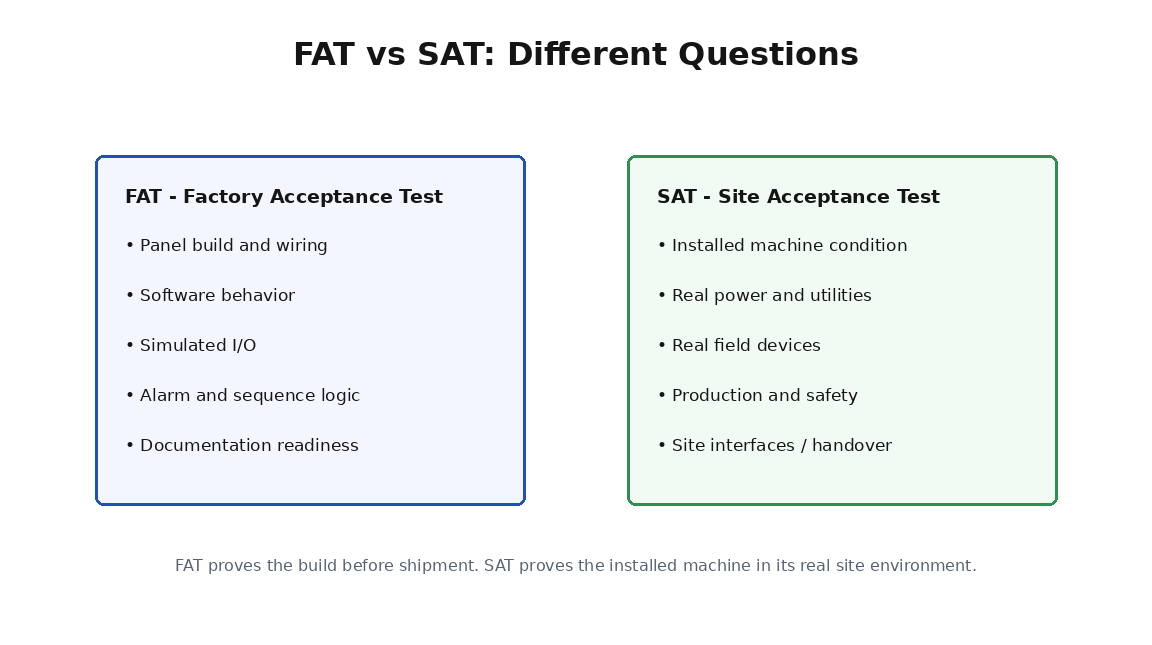
FAT and SAT answer different questions and should complement one another.
Why this matters during commissioning
Without predefined acceptance criteria, testing becomes subjective. A machine can “work” while still missing cycle-time, safety, quality, recovery, alarm or documentation requirements.
Commissioning procedure
- Review the written FAT/SAT scope and identify what is simulated versus real.
- Convert requirements into observable tests with expected results.
- Record deviations and classify whether they block shipment, startup, production, or final acceptance.
- Repeat affected tests after changes.
- Link final acceptance to closed evidence rather than memory.
Common failure patterns
- Using a FAT pass to assume site wiring and utilities are correct.
- Changing requirements during SAT without documenting the change.
- Testing only normal operation and ignoring fault/recovery cases.
- Signing acceptance with open critical punch items.
Evidence to record
- Test ID and requirement
- Initial condition
- Test action
- Expected result
- Observed result
- Deviation reference and retest result
FIELD RULE: A strong acceptance test includes abnormal conditions: sensor missing, guard opened, drive faulted, network lost, pressure low, and power interrupted.
Continue the series
- Previous chapter: Roles, Boundaries and Communication: Commissioning Guide
- Next chapter: Documentation and Drawing Control: Commissioning Guide
- Browse all Machine Commissioning chapters
Adapted from Machine Commissioning for Maintenance and Automation Technicians, by Dovydas Kersys. © 2026 Dovydas Kersys. Featured cover image is an AI-generated editorial illustration.