By Dovydas Kersys · Chapter 15 of 58 in Machine Commissioning.
Before you begin: Follow the machine documentation, risk assessment, site procedures and lockout/tagout requirements. Commissioning can expose personnel to electrical energy, stored pressure and unexpected motion. Never defeat a safety function merely to make a test easier. Examples and diagrams are generic and must be checked against the actual machine.
A digital output loop check proves command, PLC logic, physical output, interposing device and final actuator. Output tests require more caution because they can create motion or energize hazardous equipment.
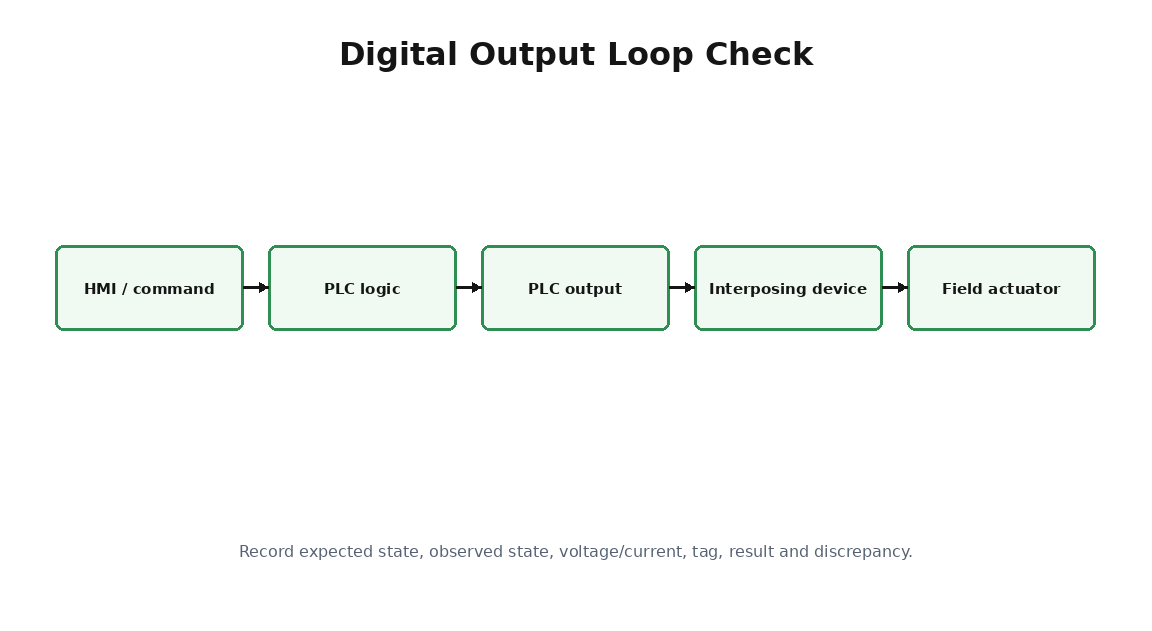
Output commissioning must prove both electrical actuation and the physical result.
Why this matters during commissioning
An output LED is only one link in the chain. A lit PLC output can still be followed by a blown fuse, failed relay, wrong coil voltage or jammed actuator.
Commissioning procedure
- Make the area safe and define exactly what may move.
- Issue the command through the normal interface or a controlled test function.
- Verify the intended PLC output changes.
- Measure voltage/current at the output and at the field device if needed.
- Observe the final actuator response and associated feedback input.
- Remove test forces or temporary bypasses immediately after the check.
Common failure patterns
- Wrong output mapped to the command.
- Output module common missing.
- Interposing relay contacts wired to wrong terminal.
- Solenoid energizes but valve spool or cylinder does not move.
Evidence to record
- Command source
- Output tag/address
- Electrical measurement
- Actuator response
- Feedback response
- Pass/fail
FIELD RULE: Never assume a PLC output force is harmless. Treat it like a direct command to the field device.
Continue the series
- Previous chapter: Digital Input Loop Checks: Commissioning Guide
- Next chapter: Analog Input Commissioning
- Browse all Machine Commissioning chapters
Adapted from Machine Commissioning for Maintenance and Automation Technicians, by Dovydas Kersys. © 2026 Dovydas Kersys. Featured cover image is an AI-generated editorial illustration.